First lady sparks blue calico craze
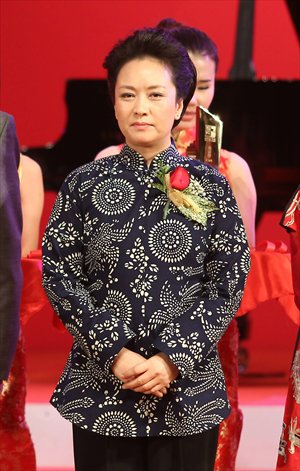
By sporting heritage clothing, Peng Liyuan boosts hopes for Chinese fashion
As Chinese first lady Peng Liyuan made her stunning debut in recent official visits abroad, the focus is often on her style of dress, especially in social media such as Sina Weibo.
Recently a Weibo user named "Xue Xi Yuan Di" posted a photo of Peng Liyuan wearing a shirt made of blue calico, which again drew the public's attention toward first lady's style.
It was verified that the photo was taken at the 2011 ceremony for the China Arts Award.
Wu Yuanxin, curator of Nantong Blue Calico Museum, confirmed that the pattern of the blue calico Peng wore was called Fenghuang Tuanhua (phoenix and flower) and the template of the pattern was collected and duplicated by him.
Wu told the Global Times, "the blue calico Peng wore was printed in a typical traditional pattern. The pattern symbolizes good luck and reunion."
The pattern Fenghuang Tuanhua was recorded in Wu's book, Zhongguo Lanyinhuabu Wenyang Daquan (encyclopedia of Chinese blue calico patterns), published in 2005.
Blue calico is a kind of traditional printed and dyed handicraft indigenous to the south area of the Yangtze River with a long history that can be traced back to Qin (221-206BC) and Han (206BC-220AD) dynasties.
But according to Wu, "The traditional folk craft is endangered because few young people are willing to [be inheritors]." As one of the few practitioners left from his generation, Wu has had to break with tradition and persuade his daughter to learn the craft.
Blue calico is dyed using blue-grass, a natural plant dyestuff. It features a blue background with white flowers or white background with blue flowers. Making blue calico requires a series of complicated processes that include selecting the cotton cloth, drawing designs, dyeing, and sunning.
The patterns on the cloth originate from animals, plants and fairytales, and they express wishes of good fortune in the future.
Nantong blue calico of Jiangsu Province was included in the first batch of national intangible cultural heritage in 2006. Wu is the representative inheritor of Nantong blue calico.
According to Wu, besides Peng Liyuan, there have been many Chinese leaders and celebrities who favored Nantong blue calico.
Another inheritor of blue calico is Wu Ying, who is the General Manager of Hangzhou Wuyuerenjia Craft Garments Company in Zhejiang Province.
"Blue calico is a living intangible cultural heritage," said Wu Ying. "We are extending the design of traditional blue calico these years, applying them onto T-shirts, handbags and household items. More and more young people like things made of blue calico and are beginning to recognize the value of this traditional handicraft."
However, blue calico was regarded as old-fashioned by young people in the 1950s and 1960s, according to Wu Yuanxin. Back then, almost all of Nantong blue calico was exported abroad.
With the increase of Chinese labor costs resulting in less demand abroad, and support from the government for items of intangible cultural heritage, blue calico is making a comeback. Nowadays, 90 percent of blue calico produced in Nantong is sold in the domestic market.
In terms of the popularity of Peng's photo wearing blue calico in Weibo, Wu Ying can't help to expressing her joy: "It's definitely a good thing for blue calico."
Peng's patronage of domestic clothing brands and traditional Chinese clothes has caused others to once more favor Chinese traditional culture.
Coincidently, a gift to Russian President Vladimir Putin during President Xi Jinping's recent visit was an embroidered portrait of Putin also from Nantong, Jiangsu Province. The portrait was made by Shen Shou Art Gallery using the technique of Shen embroidery, which is another example of a Chinese intangible cultural heritage.
With the trend led by China's first lady, Chinese intangible cultural heritages are becoming tangible on the national and international stage.