Gilded ambition
By Wei Xi Source:Global Times Published: 2013-4-15 19:08:01
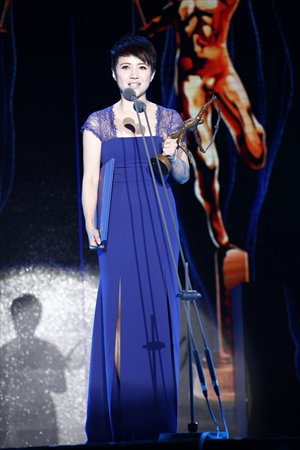
Yan Bingyan takes the actress of the year.
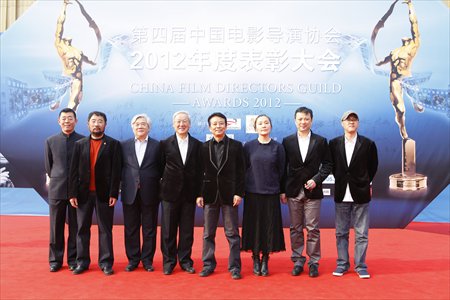
The 4th China Film Directors Guild Award ceremony was held last Friday afternoon in Beijing, as an annual occasion to reward the previous year's best movies, as well as directors and actors who made outstanding achievements.Final judge members of this year's China Film Directors' Guild Award. From left, Gu Changwei, Mi Jiashan, Yu Benzheng, Xie Fei, Huang Jianxin, Ma Liwen, Fang Gangliang and Zhang Meng Photos: Courtesy of China Film Directors Guild Award
Back to 1942, a historical feature about a deadly famine that took place in central China's Henan Province during the War of Resistance against Japanese Aggression (1937-45), took the movie of the year award, while its director Feng Xiaogang was rewarded as the director of the year.
In Feng's acceptance speech, he did not miss the opportunity to criticize China's current film examination system, a topic he speaks of frequently.
The actor of the year award was given to Huang Bo, who starred in a number of movies during last year, including Lost in Thailand and Design of Death. And Yan Bingyan won actress of the year for her performance in Feng Shui.
Box-office champion Lost in Thailand, which had five nominations, received a special jury award for its director, leading actor and producer Xu Zheng .
Xie Fei, the 70-year-old veteran director and professor of Beijing Film Academy, was given an award for "outstanding contribution" for his long career in the industry.
To be the 'Oscar' of China
Though only in its 4th year and not very well known to the outside, the China Film Directors Guild Award has a big ambition - to be the "Oscar" of China.
According to Huang Jianxin, former chairman of China Film Directors Guild, these annual awards are selected in a way similar to that of the Oscars: that is, all the awards are selected by a large number of professionals. A group of seven directors, led by Golden Lion recipient Jia Zhangke, first selected 24 movies of different types from the hundreds of works of the past year. Nearly all of the 300-plus members of the guild watched all 24 of this year's selections before choosing five nominees for each category. Finally, a group of nine judges including veteran directors like Xie Fei and Gu Changwei determined the winners.
Huang prefers to call it "a professional award" and believes it will not be interfered with by any outside factors.
"It has many rules within the Guild. For example, though [we] may have sponsors, there is no title given for any sponsorship," Huang told the Global Times in a face-to-face interview after Friday's ceremony.
He added that all the voting results are certified by world leading tax consultants KPMG, in a similar fashion to the way PricewaterhouseCoopers has certified results for the Academy Awards for over 70 years.
"This practice has wide recognition within the industry, and therefore the directors say it is an award worthy of trust," Huang said.
As the chairman of the final judging panel, Huang explained that box-office numbers have little impact in the initial selection of 24 films. That's why some of the big awards were given to movies and actors with little name recognition among the public, such as Song Fang and his work Memories Look At Me.
Informal gathering
This event doesn't require formal dress to walk the red carpet, and according to Huang, that this is just how they want it.
"As a guild, there should be a main objective, [the responsibility to] protect the rights of directors, [an occasion] to reward the achievements of a year, and [the duty to] sum up the existing problems," Huang explained.
He added that because it is an award of the directors' guild, the top award is the director of the year, rather than a movie work as in many other domestic and foreign awards.
Along with the rising number of domestically made movies and box-office earnings, more and more movie awards have been set up in the past few years. Besides the decades-long Golden Rooster and Hundred Flowers Awards, there are the Golden Goblet Awards of the Shanghai International Film Festival and the coming Beijing International Film Festival will hand out its Tiantan Award.
Long road ahead
While all of them want to be the most influential film award of the Chinese mainland, comparable to Hong Kong Film Awards in Hong Kong and Golden Horse Awards in Taiwan, or even catch world attention like Cannes or Oscars, they share very limited influence now.
Shi Chuan, deputy director of the Shanghai Film Association, believes that it is because the awards in the mainland have "too much interference from the government."
"There are too many things behind a movie, making the selecting of awards impure," he said. "The only solution is to withdraw government organizations [from the process] and give the awards back to the people, to professional or audience organizations."
Though Shi thinks it is necessary to have awards like the China Film Directors Guild Award, which functions as a "mechanism for professional encouragement," and "to resist the pure market-oriented situation," he is conservative about how it can keep an independent status.
"The ceremony of last year was too luxurious, causing doubts about its objectivity," Shi commented. "Whether it can become an authority with its own brand is yet to be seen."
As a mainland screenwriter, Zhao Junjun believes in the professionalism of the award, yet he points out that professionalism and influence are two different things, especially among the common public.
"Seeing from this year's situation, the directors' guild wanted to spread this award [to the public], but it obviously has a long way to go," Zhao said. "How the professional opinions from the guild can guide the common audience, rather than being led, is a matter of concern."
As for Huang, he thinks the influence of their awards on a world stage is closely linked with the overall development of Chinese culture. "When China becomes the number one movie producing nation and with the most influential movie works, the world attention will be caught," he said.
Posted in: Film