Translated into cash
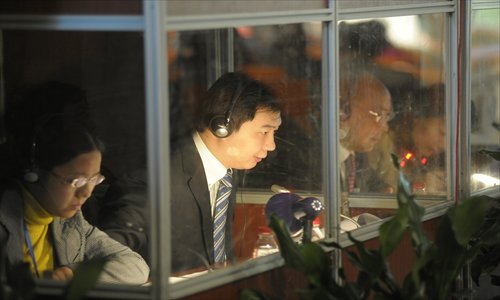
The profession of simultaneous interpreting has been appearing in several surveys and online polls recently where public opinion has been placing it among the highest-paid professions in China.
Mission possible
Money matters
When a simultaneous interpreter from Shanghai appeared on a popular television matchmaking show last month, he added to this belief by saying that an interpreter like him could earn in a day what an average city worker would earn in a month.
While there is some debate over exactly how much an interpreter can earn, public opinion is fairly unanimous that whatever they earn they deserve it given the efforts and talent involved in their work. Most of the time simultaneous interpreters work inside a booth in a corner of a conference hall. Unlike the consecutive interpreters, who are seen at press conferences for example and deliver their translations when the speaker pauses, simultaneous interpreters speak to their recipients while the speech continues.
They are not in the limelight but they have hugely stressful jobs - they have to listen, understand fully then translate into another language while the speech continues.
An important role
In Shanghai international conferences have become commonplace and the role of simultaneous interpreters is well recognized. But being a leader in this field is not an easy task - most of the city's top interpreters have to choose between being freelancers or working full time for a job in another field and interpreting in their spare time.
The challenge for simultaneous interpreters is being able to translate fluently while someone else is speaking in another language. This becomes even harder when the speakers are speaking quickly and using advanced technical language or jargon.
Most of Shanghai's simultaneous interpreters have graduated from foreign language schools or majored in interpretation. The Graduate Institute of Interpretation and Translation at Shanghai International Studies University was established 10 years ago and has trained a number of the interpreters who have gone on to work in international conferences, or for government and international organizations like the United Nations.
Chai Mingjiong is the dean of the institute, and outlined the basic qualities needed for a prospective interpreter: fluency and accuracy in a foreign language and Putonghua, clear pronunciation, the ability to express oneself clearly, a sound general knowledge and being able to learn and master things quickly.
Interpreters also should have a stable personality and good reflexes - if they make a mistake, they must be able to continue their translations confidently without missing a beat. And they have to be in good physical condition as well - the work can be physically demanding.
The number of students accepted for study at the institute reveals how elite this group is. Of the 600 or so applications received in recent years only 10 have been enrolled in the conference interpreting course.
Wang Minjie, the executive vice secretary-general of the Shanghai Association of Interpreters (the first of its kind in the country), also helps train interpreters. Every Sunday afternoon, Wang holds a workshop to coach interpreters or prospective interpreters. With 15 years' experience, he has his own ideas about what makes a good interpreter and for him a priority is a love and passion for the work.
"It's a job that requires a vast amount of hard training. Many are drawn to the profession because of its prestige and pay. But when they discover how hard it is in reality many give up. From what I have seen I think about half of the people who wanted to join the profession didn't continue when they discovered the real situation."
Wang is in a minority among interpreters - he did not graduate from a foreign language school or majored in English. The 39-year-old studied medical equipment marketing at college and later obtained a second degree in computer information management. Within a year of his graduation in 1997, he had tried seven jobs as he looked for his real career.
He eventually settled down as a simultaneous interpreter because of his personal interest and passion for English. His own experience, he believes, is the proof that passion for a subject can turn a mission impossible into a mission possible.
"I was very poor at English at the beginning. I didn't do well in English in gaokao (college entrance examinations). I took the written test three times and the oral test four times to eventually obtain a Shanghai Advanced Level English-Chinese Interpretation Accreditation Certificate. It's the love for the profession and the relentless efforts I've made that have made me who I am today."
Wang enjoys his work even when he faces seemingly impossible challenges but this is now not just because he enjoys the use of language - he believes his work pushes him constantly to learn more about different subjects and fields.
Wang said many wrongly think that simultaneous interpreters have wonderful memories or, at least, amazing short-term memories. "To be honest, I don't think I'm good at memorizing things. Knowledge, insight, logic, good judgment and proper understanding of the speaker's intention are more important."
According to Wang, the growing conferencing market in Shanghai has seen an increase of simultaneous interpreters. But in busy seasons, there is still a lack of talent. "During the 2010 World Expo in Shanghai, some consecutive interpreters were given jobs as simultaneous interpreters."
In the spotlight
Every year in March at the conclusion of the annual meetings of the country's policymakers and advisors in Beijing, the premier's press conference draws a big national audience. Nowadays the way the interpreters handle the press conferences is also the subject of fierce debate.
Netizens post online the premier's original words in Chinese and how the interpreter translated them in English and then discuss whether this was a good interpretation and whether it could have been improved. This new public attention is a source of pressure for the interpreters, according to Zhang Jianmin, a senior interpreter with the Ministry of Foreign Affairs.
"People are now paying more attention to politics. There are more press conferences being broadcast and the interpreters' performances are being watched and analyzed. It's pressure but it also helps drive us to improve our work," Zhang said. The 43-year-old has worked as an interpreter for several Chinese leaders, including former premiers Zhu Rongji and Wen Jiabao and former presidents Jiang Zemin and Hu Jintao.
Interpreters for international conferences face slightly different problems. Wang Minjie said that since the beginning of the new century, more international conferences have been held in Shanghai and the subjects have become more detailed and specific.
"For the IT industry alone, conferences can focus on cloud computing, storage technologies, green data centers and so on. Many speakers are discussing frontier technologies or the latest trends, which even insiders sometimes don't have a clear understanding of. We have to be able to learn quickly and maintain our passion and enthusiasm."
Wang said very few of the conference interpreters in the city were specialists although if an interpreter had been a doctor or medical school graduate, he or she would have an advantage and connections in that field. But most interpreters needed to be able to handle a wide range of topics over a broad range of conferences. Experience is very important for an interpreter.
"In 1998 I prepared for two weeks before I went to be interviewed for an interpreter's job at a conference. Nowadays, it takes me just one day or half a day to prepare for a two-day conference," Wang said. "Many industry topics are connected. For instance, building-integrated photovoltaics (BIPV) involve not just solar energy but also construction. In the past decade, the market in China has trained a group of outstanding interpreters who are proficient in many industries. Most of this sort of knowledge cannot be learned at school."
Alongside the growth of conferences, Wang said tougher requirements had been imposed on interpreters, who were now expected to use standard terms for particular industries.
"Sometimes during a conference someone will pass us a note, reminding us how to express a particular term or offer advice. I welcome these tips because they help me avoid making mistakes."
A 2011 Xinhua news report naming simultaneous interpreting as the country's best-paid profession said that the lack of talent in the field had meant the job demanded top pay rates. The report quoted netizens saying that good and reputable simultaneous interpreters can earn up to 8,000 yuan ($1,302) for an hour's work. Some even said that the pay was calculated for every minute an interpreter worked.
Wang Minjie said he had no idea how these rumors developed but interpreters were normally paid by the day instead of hour or minute.
"Interpreters will cost around 5,000 yuan to 8,000 yuan for a day. But that is what agencies charge. Individuals can get from 3,500 yuan to 6,000 yuan for a day from the agencies. For half a day's work, the pay is 60 percent of the daily rate. Of course there are a few people with good connections who can get work directly from conference organizers without an agency. They will probably earn more."
But Wang said the pay for interpreters had remained almost unchanged for the past 10 years. "Certainly it doesn't look as good as it was in the past." Still there are occasional windfalls. Interpreting a 10-minute press conference at an auto show may fetch 5,000 yuan. Rates are not precisely fixed, Wang said.
The way simultaneous interpreters work might be linked to with people's misunderstanding that the job is paid by the minute. At conferences interpreters usually work in pairs, taking 15 to 20 minute stints at a time.
Regardless of whether an interpreter is paid by the day, hour or minute, a consultant with a city public relations company that regularly needs to work with interpreters for company events, said it's quite a lucrative profession.
"We pay between 5,000 and 7,000 yuan for interpreters for a half-day event. Usually they only need to work for around two hours and for most of the time, they do consecutive interpreting," she said. "But these are really good interpreters. We don't work with an interpreter a second time if he or she fails us on the first occasion."
The consultant said her company didn't use translation agencies but worked directly with reputable interpreters who were employed full time by government departments.
According to the US Bureau of Labor Statistics, the average annual salary for simultaneous interpreters in that country in 2010 was $49,790, but interpreters involved in scientific and technical consulting could earn an annual average $99,650.
Misunderstandings
But even in this glamorous and lucrative world, there can be misunderstandings. Last year some interpreters claimed that an agency had not paid them for months. The agency, Yuanpei Translation, had promoted itself as being a provider of translation and interpreting services for the 2008 Beijing Olympic Games and sponsor of the translation and interpretation program for the 2010 World Expo in Shanghai.
"By February 2013, the company owed me more than 50,000 yuan," a freelancer interpreter complained in an online forum. Another interpreter in the similar situation told the Global Times that the job looked much better in the media than it actually was.
The man, who insisted on anonymity, said, "I don't want to really upset the company because I might never get paid then. And it might affect my work with other agencies."
This is a risk that freelancer interpreters face. Insiders say that some 60 percent of the city's simultaneous interpreters are freelancers and most of the rest are employed full time but not with agencies.
An interpreter surnamed Chen with eight years' experience told the Global Times that no agency would spend 200,000 to 300,000 yuan a year to employ a full-time interpreter. "They would find clients first, get their money and then look for the interpreters to do the job. For them this business model is guaranteed and risk free."
On the other hand, leading interpreters will expect to be earning more than 300,000 yuan a year, she added.
Most agencies and interpreters work with each other on a trust basis. There are few signed contracts in this work and most of the jobs are handed out by phone calls or e-mails.
Legal experts say that the relationship between a translation agency and an individual interpreter would be defined as a service relationship, which is not protected by China's Labor Contract Law.
"Legally, a translation company and an individual interpreter are equal parties. For the foreseeable future, the country will not interfere in the economic relationship between equal parties. But in reality, interpreters are disadvantaged. It is a problem," said Yin Weiyao, a lawyer with the Shanghai Brilliance Law Firm.
Yin suggested that to protect themselves, interpreters should ask for contracts. "They could be important evidence if there's a conflict."