Seeking stardom – once again

Last Sunday saw Shanghai Dragon TV airing the first episode of Chinese Idol, the country's latest reality singing contest. It's another talent show for viewers to absorb and discuss along with a plethora of experts, fans and critics over the following weeks - wasn't the new girl great and weren't the judges cruel? Nowadays there's another question: haven't we seen these contestants before?
Reality television talent contestants stepped into the spotlight in 2005 as the second season of Hunan Satellite TV's Super Girl, China's first reality talent contest proved a national hit with the final show attracting 400 million viewers.
The finalists, teenage or 20-something girls, (more than 120,000 hopefuls had auditioned for the show), became household names overnight. Within months, the winner Li Yuchun had become an A-list showbiz icon with a huge fan base - Time magazine's Asia edition called her "one of the most popular figures in China."
Just as the phenomenal Super Girl spurred television stations all over the country to come up with a range of reality talent shows, Li Yuchun and other finalists gave hope to other young talented performers that they too could become real stars.
They tried their luck in Happy Girl (Hunan Satellite TV), Happy Boy (Hunan Satellite TV), My Show (Shanghai Dragon TV), and Blossoming Flowers (Qinghai Satellite TV), among many others. Many of the contestants signed contracts with music companies, released albums and were kept busy with live performances.
More recently domestic television companies have been purchasing overseas reality show formats that have proven internationally popular. Last year's The Voice of China (Zhejiang Satellite TV), which followed The Voice franchise playbook from the Netherlands, has been the most talked about talent show since Super Girl. Its finalists, from underground singers to amateur enthusiasts, have enjoyed some fame. But none of them have flourished to become stars like Li Yuchun.
Springboard for fame
Now there is Chinese Idol, one of the many adaptations of The Idols reality television franchise - the most famous, American Idol, is now running for its 12th year and has proven a springboard vaulting obscure performers to the top of the charts.
Wang Leiqing is the director in chief for Chinese Idol. "China has not witnessed the emergence of any iconic figure since Li Yuchun," Wang told a press conference. "Years have passed and it's time to look for a new one."
But the public might already have seen "new." On a recent May afternoon, the Global Times went backstage at Chinese Idol and met the contestants, the idols-to-be. For most of them, a talent show is not a new experience.
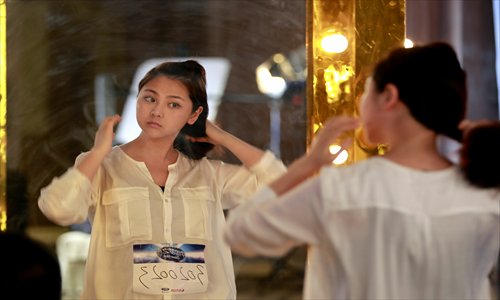
Chongqing native Cai Yingxuan coolly checked herself in her dressing room mirror. When she was asked her age, the doll-like singer immediately replied "17" - then smiled and added "10 years ago."
Contestants for this show have to be aged between 18 and 28 so Cai is one of the oldest contestants taking part. Singing in front of cameras, audiences and judges is not new for her. When she was 20 Cai entered Super Girl Season 3 and appeared in the Chengdu preliminary selection final.
She was immediately popular, and many predicted she would represent Chengdu in the national finale. But her popularity also spurred rumors that she had been unfairly selected to endorse a dairy product which sponsored the show there.
Although Cai did not make it to the national final, ending up in eighth place in the Chengdu final was enough get her a contract with Tianyu, a media company managed by Hunan Satellite TV.
At first her contract life was agreeable. She was making good money - "I was paid 10,000 yuan ($1,630) for a performance and I usually got five or six gigs a month. Making money was pretty easy."
But as the Super Girl aura dimmed and the three singles she released between 2006 and 2010 made little impression, Cai had to change her career path. She joined an all-girl group Up Girls and moved to Beijing.
Depressed and down
But being one of the six girls in the group did not improve her life or career greatly. There were few engagements and Cai spent most of her time being depressed. In 2011 Cai started to feel constantly thirsty and found she was putting on weight unexpectedly. Within a couple of months, she went from weighing 45 kilograms to 65 kilograms. She had diabetes.
This meant medical care and treatment and the end of her contract with the girl group. She moved back home to Chongqing and although her diabetes was soon under control with regular insulin injections, it took her longer to shake off her depression.
One morning in March this year she woke up and decided to change her life around again. "I didn't want my parents to see me at a loss. I had to pull myself together. I chose singing as a career and it is still my real interest, so I shall stick with it no matter how and do as much as I can."
Taking part in Chinese Idol was Cai's first step in her comeback. She saw the show being promoted on the Internet, signed up, and weeks later got through the initial auditions in Shenzhen.
For her first round song, Cai chose "Beautiful Bimbo," a 1990s funky hit by one of the judges Coco Lee. It was the number she sang on her Super Girl debut seven years ago.
"Because this is my first step in getting back into show business, I have not set any goals for myself. I regard everything I have done so far as a breakthrough. I believe I have a brilliant future in store," she said.
Back from the mountains
Yu Mengfei stood out from the other female contestants - not for being tall, fair-skinned and confident, but because she was not wearing any makeup. Six years ago Yu was quite well-known in Shanghai as a contestant on My Show. Then known by her own name Yu Hongting, she made it to the national final and with her polished voice and skillful performances was named "the most popular contestant" and "best live performer."
But unlike her fellow finalists, Yu did not score a contract. At the end of My Show, with all the publicity and polls in her favor, an entertainment company that had managed her in 2005 appeared and claimed she was still under contract to the company. Until the dispute was settled in 2008, Yu was prohibited from performing or signing contracts with any other companies.
After the problem was sorted out, she did not rush to sign a contract with a new company but began performing in bars in Beijing and spending her days studying music and singing.
Yu read and reread books on vocal techniques, learned to play keyboards, took up songwriting and immersed herself in the sometimes difficult and edgy worlds of jazz, neo soul and gospel. "My aim is just to be a good singer. As I think there is still so much for me to learn, I prefer to focus on that."
She showed up on Chinese Idol because the program's producers, who had worked with her and knew her from My Show, contacted her personally and persuaded her to participate.
"I haven't been in the public eye for a long time, so I agreed to have a go and see how things turn out. I think taking part in the show can be another type of music education for me. Watching the performances and listening to the judges can help my own music evolution."
In the studio, she looks cool, calm, and collected. She describes her retreat from public life as being like "practicing kung fu deep in the mountains" and she thinks that now is a good time to head back to the spotlight. "Every now and then, you need to walk out of the mountains to see how other people are doing in the world, and then know where you really are."
A studied career
While most contestants chatted or daydreamed as they waited, Shu Yi sat by himself in a corner reading a novel. He assumed he would finish the book before it was his turn to perform.
The 25-year-old good-looking Hebei native has been taking part in reality television talent shows for nine years. "I have appeared in more than 10, big and small, at national and provincial levels." Unlike many of his fellow contestants he sees singing just as a hobby and has continued his education in the meantime. Following a bachelor's degree in economics, he is now studying for a master's degree in logic and intends to pursue a PhD.
"Taking part in these shows has never been in conflict with my academic work. I believe art is a good inspiration for any discipline and it makes my mind more agile. My supervisor is very supportive as well."
Over the years, he has traveled to Beijing, Guangzhou, Wuhan, Changsha, and Xi'an for contests but he doesn't think this has been expensive. "There are just the travel expenses. But I get the experience of seeing many different parts of the country.
"I am here partly because my teachers, classmates and friends have big hopes for me and always encourage me whenever there is a chance," Shu said. "Personally, losing never affects me. I just want to see myself making progress."
Shu taught himself to be a songwriter. He has to date recorded eight original songs of his own. On Chinese Idol, he performed his first song which he had written when he was 18. "It's called 'Memory' and reflects on a very innocent and pure relationship."