Hong Kong drifters
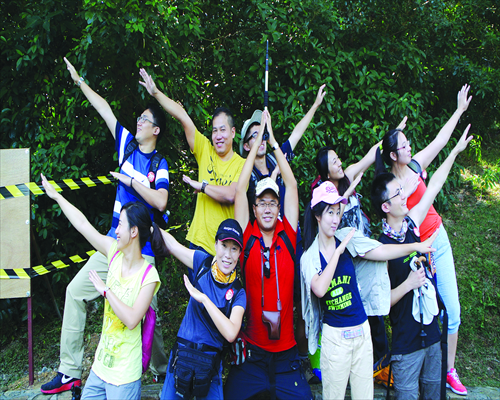

For a city of immigrants like Hong Kong, the integration of newcomers is nothing new, but still from time to time the topic makes headlines as it relates to social conflicts caused by the collision of different cultures.
At issue right now is a Hong Kong government policy in effect since 2001 that allows mainland students to stay and work in the SAR after graduation. After more than a decade, the mounting number of this group has drawn some unwanted attention and given rise to a new word, gang piao, or "Hong Kong drifters."
From a bystander's perspective, the process of each generation's blending into local society is an uneasy mixture of sorrow and tears. However, when you approach the individuals and learn more about their feelings, you find a different story.
Young newcomers "Before filming we thought that people of this group must be experiencing some tough times as they are 'drifting' in Hong Kong, but it turns out that they are not only enjoying what the place has to offer, but also are very energetic and full of aspirations," said Jason Lo, one of the two directors of the documentary Incomplete Recordings of Hong Kong Drifters' Life, which is a five-episode serial that began showing online in early May. Fortunate generation For most of these young people, after four years of study in Hong Kong universities (or one year for a master degree), they gradually adapt and overcome language difficulties and cultural barriers. After graduation, most of them say the No.1 reason to stay is the highly-efficient, transparent and fair working environment. Some friction normal
According to references from the book New Immigrants to Hong Kong by Lüqiu Luwei, a female journalist from Phoenix TV, this newest generation can be summarized as the fourth generation of mainland immigrants to Hong Kong. It is composed primarily of mainland students who study in Hong Kong and then work there after graduation. The previous waves of immigrants can be traced back to years 1980, 1949 and the War of Resistance against Japanese Aggression (1937-45).
In 2001, the Hong Kong government first allowed mainland students who studied in the region to continue to work there after graduation. In 2003, China's Ministry of Education first gave permits to Hong Kong universities to independently enroll students from the mainland. And in 2008, the Hong Kong government further loosened its requirements for non-local students to work there, allowing them to unconditionally stay for up to 12 months after graduation.
The series of measures greatly boosted the flow of mainland students studying and working in Hong Kong. According to the statistics of the Immigration Department of Hong Kong SAR, the total number of mainland students to study and work there after graduation now has surpassed 50,000.
And unlike early generations of immigrants who may have come with the whole family with no thought of returning to their hometown again, the current new generation take Hong Kong more like an active option - a favorable environment in which they can live and work, not just for the permanent identity card.
"My first year here was the worst. I felt isolated in such an unfamiliar environment," said Liu Ke from Jiangsu Province, who came to study in Hong Kong Baptist University in 2008 for four years and then stayed to work in the region. "But now I feel like Hong Kong is my home. I love its fair and uncorrupted environment, which promises success for anyone who makes an effort," Liu said in the documentary.
While already gaining a competitive edge due to their academic achievements in the mainland, most of these young people enjoy the pleasure of success that comes with the fast-paced working style in Hong Kong. Meanwhile, mainly coming from those relatively wealthy families in the mainland, this class of immigrant does not have the additional pressure to support a family back home.
"We are indeed lucky compared to those local Hong Kong young people, without so much pressure from the family," said Cheng Wenwen, who came from Beijing eight years ago and is now employed in the advertising industry. "Some of those young people are still dependent on their parents even if they already have a job," she said.
Short of a life of bitterness and hardship that earlier generations of immigrants had to endure, current immigrants in Hong Kong are actually in many ways no different from their peers in the mainland who leave hometowns to struggle in big cities like Beijing and Shanghai.
Even the problems they face are similar, like where to find their "Mr or Mrs Right." "People say that the proportion of Hong Kong's female to male population is 10 to 1," said Cheng, "It seems that girls are always waiting for their Mr Right to appear, but where is he after all?"
In fact since 2012, the issues and conflicts between mainland and Hong Kong people that have made the most headlines are things like the restrictions on pregnant mainland women who want to give birth in Hong Kong, or limits on the amount of milk powder one can carry back to the mainland.
"What most Hong Kong people have seen (emphasized) is the negative side of some mainland people's behavior like spitting or jaywalking," said Cheng Fang, who came to Hong Kong from Xinjiang Uyghur Autonomous Region, "We are stuck somewhere in between."
"What most Hong Kong people know about the mainland is still very limited," said Hu Yuguang, who was from Guangzhou and has stayed in Hong Kong for five years. "They (seem to focus more on) negative news like poisonous food or melamine milk powder."
While local people's negative impression about mainlanders is increasingly intensified by those sensational local news stories, the backlash has now begun to spread to those gang piao who study and work there.
Recently some local students have launched a campaign on facebook against Hong Kong universities enrolling too many students from the mainland, implying that some of those students are not actually coming to study as much as they are using college as a way to disguise their real intention, which is to stay in the region after graduation.
"The integration of these newcomers from the mainland into Hong Kong is an inevitable process since they have determined to settle down here since the first day they came," said Lo, "Hong Kong is originally a city of immigrants. One generation after another has promoted the development of local culture and the economy. And as for the conflicts, they are just part of the process."