One story, two versions
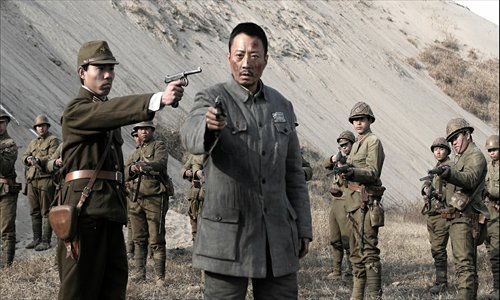
A scene from Troubled Times Three Brothers Photo: IC
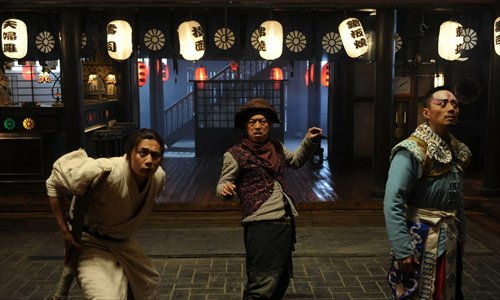
A scene from The Chef, The Actor, The Scoundrel Photo: CFP
While the Chinese authorities have issued 22 new rules to regulate TV dramas based on the War of Resistance against Japanese Aggression (1937-45), a number of which were criticized for having over exaggerated performances, one is still raising audiences' attention in a good way: Troubled Time Three Brothers.
Currently airing on provincial TV stations like Heilongjiang TV, Hubei TV and Shandong TV, as well as a few video websites, the TV drama, together with its movie version The Chef, The Actor, The Scoundrel, have instigated new discussions on the taopai mode of production - that is for a production company to create a movie and a TV series on the same theme.
Using the same team
Though the TV drama and the movie are distinct versions of the same story, the same team has produced both, with Guan Hu as director and Huang Bo, Zhang Hanyu and Liu Ye as the three leading actors.
Naturally, the two stories share many similarities from characters and background settings to certain plots. For instance, both happen during the anti-Japanese aggression period in the early 1940s, and the three actors play a marksman, a chef and a ruffian who are essentially nobodies but use their own wits to fight the invasion. Also, Japan's tactic of using biological warfare is included as a plot element in both.
After a few episodes on TV, audiences who had seen The Chef, The Actor, The Scoundrel were asking the same question: Is the TV drama simply a longer version of the movie?
As Ying Luojia, producer of Troubled Times Three Brothers told Media & Entertainment Industry Reporter, they were originally gathered for the TV drama. But some insiders suggested that with three Golden Horse best actors (Huang Bo, Zhang Hanyu, and Liu Ye) and a Golden Horse best director (Guan Hu) gathered for one project, it was a pity that it was not for a movie. The idea motivated director Guan Hu.
Mixed reviews
After premiering on the Chinese mainland in late March, The Chef, The Actor, The Scoundrel made 200 million yuan ($32.38 million) at the box office - a fair achievement but not enough to compete with movies of the period like Finding Mr Right and So Young, which grossed two and three times as much.
Yet, the film caused extremely different feedback among both professionals and common audience members.
Xu Zheng, director of Lost In Thailand, which set the box-office record for domestic movies with 1.3 billion yuan, posted on his Sina Weibo on April 4 that he thinks The Chef, The Actor, The Scoundrel is extremely cool, as it has "strong style, unique ideas and intensified temperament."
However, two days later, playwright Ning Caishen commented also on Sina Weibo that The Chef, The Actor, The Scoundrel was "the worst domestic movie since the beginning of this year." Movie critic and web editor Zhang Yi gave it only three points out of 10, saying that it was chaotic and appeared to have been done in a rush. It seemed to him that "the movie was shot before there was a complete script."
Along with the diverse opinions about the movie, the TV drama also has a love-it-or-hate-it relationship with its audience. Some think it's a good example of an anti-Japanese drama, while others find loop holes in the plot, thinking it is not carefully made.
As common audiences are discussing the content and plot, industry insiders care more about whether the taopai mode of production is beneficial.
Looking for synergy
Producing a TV drama after a hit movie has proven successful among audiences. The opposite way is also not a new phenomenon in the industry, especially in the US.
One typical example is marvel's movie The Avengers (2012), which is to generate a TV series S.H.I.E.I.D. under the same director Joss Whedon.
In fact, as early as the 1960s, according to Shanghai-based Wenhui Daily newspaper, a deal was reached between the movie and TV industries in the US, which allowed movie producers to buy a good theme from TV producers at a very low price. And taopai, therefore, became a common practice.
As many insiders agree, taopai is able to reduce costs and boost each other's marketing. That's the main reason the mode is widely applied.
As a previous report from Beijing Business Today analyzed, outside of production costs, the most expensive links in the movie and TV industrial chain are marketing and distribution.
"Statistics show that in the [accounting ledger] of a Hollywood blockbuster, the costs for promotion can be as high as 30 to 40 percent. This share is also rising with domestic works. In a domestic movie with an investment of over 100 million yuan, the cost for promotion and distribution may reach as high as dozens of millions of yuan," the report wrote.
But when the same work is produced in two forms, the two can help offset each other.
Before the TV drama version of The Message, a 2009 movie work directed by Gao Qunshu and staring Zhou Xun, Zhang Hanyu and Li Bingbing, Huayi Brothers Media's president Wang Zhonglei told the media that he thought the success of the movie version could help to produce the TV drama or even serve as a free publicity.
Wang further explained that following up with a TV drama can help a director fully express the original ideas, which may be constrained in a movie. Conversely, a movie following a TV series can benefit from its popularity and therefore ensure more benefits for the investors.
While these ideas seem correct theoretically, they do not always work out.
As reporters from Nanjing Daily wrote, some insiders also pointed out when making a taopai, it is very important to understand the age group of the target audience. For example, some TV dramas face a middle-aged audience, and therefore are not suitable for cinema, as the majority of the audiences going to cinemas are in their 20s and 30s.
Even so, not all taopai achieve success. When the TV drama Struggle was aired in 2007, it not only received a warm welcome among audiences but also turned its ensemble of leading actors into stars. But when the movie version, titled Stand By Me, screened four years later in 2011, few people even heard of it.
And with the TV version of Love Is Not Blind, though at first it followed the success of the movie, after the initial wave of promotion ended, it was given little notice.
In movie critic Cui Ting's opinion, taopai is nothing but a marketing method. The success of the former is able to help the latter in promotion, but whether the latter can achieve success, depends on itself.
"But because TV dramas do not need a high investment and always have a fixed audience, there are few examples of failure," Cui noted.