China’s animated struggle with cartoons
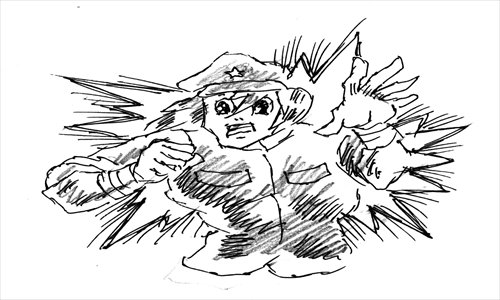
Illustration: Peter C. Espina/GT
Japanese animation master Hayao Miyazaki's new film The Wind Rises will be released this month. Many Chinese anime fans celebrated this announcement, although for me it was bittersweet because it reminded me of the embarrassing state of homegrown animation.
I have been addicted to anime and manga since I was a boy. For two decades, I have closely followed its developments, including computer graphics replacing hand-drawn animation, celebrities voicing characters and the genre's evolution in the blockbuster age.
But more importantly, anime and manga have pushed their boundaries by tackling a wide variety of themes.
Both worlds explore every frontier you can imagine. Time travel fantasies come to life with robotic cat Doraemon, girls who dream of magic, beauty and justice aspire to be like heroines in Sailor Moon, while sci-fi fans can indulge in the mecha anime wonderland of Gundam.
But other series tackle deeper issues. Neon Genesis Evangelion questions the meaning of life and purpose of humanity, while sci-fi series Legend of the Galactic Heroes explores democracy and war.
By comparison, tune into any Chinese cartoon and you're likely to see animals living harmoniously together, students learning the error of their mischievous ways or cartoon series inspired by Ming Dynasty (1368-1644) literary classic Journey to the West.
Characters in Chinese cartoons often have manga-esque faces, while some creatures look like rejected Pokémon species. Furthermore, many plots are suspiciously familiar to manga fans.
The "Chinese anime" wave took off in 2006, when the State Administration of Radio, Film and Television banned prime time broadcasting of foreign cartoons in a bid to "spur the domestic cartoon industry."
Hindering the development of Chinese animation is the perception of it as a kids-only genre, hence the exclusive depiction of content suitable for children. The country's flagship animated series, Pleasant Goat and Big Bad Wolf, is a classic example.
When you compare the state of animation in China to Japan's edgy series, it's easy to dismiss our works as child's play.
Overuse of hackneyed expressions has also limited the growth of Chinese animation, long regarded as a medium to foster children's morality. Watching Chinese cartoons can be a cringe-worthy experience, with clichés extolled by teachers and parents constantly trotted out by characters.
China's "cartoon protectionism" is also fueling the demise of its animation industry. No matter how bad domestic productions are, children will still watch them because they have no alternative.
A side effect of this is that many creative independent animators are forced to give up their dreams and follow the boring yet profitable status quo.
So, what is the solution? Firstly, China's media watchdog should be aware that people of all ages enjoy animation. Some content should therefore cater to mature audiences.
Secondly, one of the main motives for enjoying animation is the escape it offers from the real world. People want to relax and let their imagination run wild, which can't happen if clichés and slogans from the real world constantly bombard them.
Finally, foreign competition should be encouraged instead of locked out. After all, the tallest trees grow in the wild and not in sterile greenhouses with glass ceilings.
This article was published on the Global Times Metropolitan section Two Cents page, a space for reader submissions, including opinion, humor and satire. The ideas expressed are those of the author alone, and do not represent the position of the Global Times.