Standing on the corner
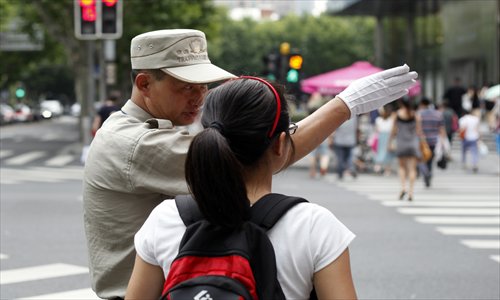
Traffic assistant Jin Mingbao gives directions to a passer-by. Photo: Cai Xianmin/GT
Traffic assistants first appeared in the city in 2003 and today they can be found on most major intersections, wearing their tan uniforms and caps, blowing their whistles and keeping pedestrians and cyclists in order as they wait for traffic lights to change.
Often regarded as one of the most thankless jobs of any in the city, traffic assistants came into existence for two reasons: there were concerns about road safety as the number of cars in Shanghai soared; and at that time several State-owned companies and factories had closed down and many workers were unemployed. To solve both these problems, the city government proposed turning the unemployed into traffic assistants.
The strategy was adopted in cities all over the country. According to the China Police Daily, there were about 227,000 traffic assistants nationwide in 2012. In Shanghai, there were around 8,000 traffic assistants by May 2006. Exact figures of the number of assistants now working in Shanghai are not available but some experts suggest there could be about 10,000 on the city streets.
Jin Mingbao is one of the thousands of traffic assistants in Shanghai. The 51-year-old man now works at the intersection of Huaihai Road Middle and Huangpi Road South. Lean and friendly, he has been on duty at that corner for six years ever since he lost his job as a hairdresser at a State-owned hair salon.
Across the road in her uniform and cap is Jin's wife, 46-year-old, pony-tailed Zhang Heping. After her former employer, a stationery factory, closed down five years ago, she also became a traffic assistant.
They are on the morning shift from 7 am to 1 pm alongside four other assistants. The six of them take turns, working for an hour, then taking a 30-minute break in a small lounge in the basement of the nearby Hong Kong Plaza shopping mall before heading back to the intersection.
Their 22-year-old son, who trained as a cook at a technical school, became a traffic assistant last year after he could not find a cooking job. He takes over the corner from 1 pm to 7 pm with five others. Both shifts involve rush hours and Zhang said the peak times for this intersection were between 7:30 am and 9:30 am and 4:30 pm and 6:30 pm.
Police training
All of these traffic assistants were recommended to the Shanghai Traffic Police Corps by their neighborhood committees in Huangpu district. Once accepted, the trainee traffic assistants undergo a three-day course at police academies, where they study traffic laws, learn the correct hand gestures and most importantly, the phrases they use when addressing pedestrians and cyclists.
The set phrases have been designed to reduce the prospect of conflict. Seven-year traffic assistant veteran Wang Wei, who used to make tea caddies, said strong language was never allowed. When someone starts crossing the street against the red light, assistants have to say: "It is not okay to cross the street when the red light is on." People who stand on the road while waiting for the lights to change are told: "Sorry, please step back onto the pavement."
At the end of the course, they sit a written test and those who pass go on to work for a three-month trial period on city intersections. Throughout this time, traffic police and team leaders check on them and assess their performance.
The assistants who are accepted are then invited to sign work contracts with the district branches of the Shanghai Traffic Police Corps. According to the Jiefang Daily, only one in 10 applicants is signed up. "They are all one-year contracts," Jin told the Global Times. "Renewals are based on how well we have been doing our jobs."
Traffic police and the team leaders check on the assistants as they work. A traffic policeman surnamed Liu standing at an intersection in Xuhui district explained that they would keep an eye on assistants who were not paying attention to the traffic and those who waved their arms around unnecessarily - behavior like this would go into their reports.
Friendly persuasion
One of the key duties of the traffic assistants is to enforce the traffic laws but they can only do this by persuasion - an almost impossible task perhaps in a city where jaywalking and running red lights is considered normal behavior. They cannot impose fines or arrest anyone who ignores them.
If there is a serious offence, traffic assistants can turn to the traffic police (there is usually one officer on duty at each intersection in rush hours). Over the years, the police and the assistants have come to work together as a team.
Peng Lihong is a youthful 48-year-old traffic assistant who blows her whistle when she encounters a serious problem with someone ignoring her or behaving dangerously. "The police hear this and come to the rescue right away. Sometimes they have their backs to me but they get to the problem quickly. Once the traffic police step in, the lawbreakers behave themselves."
Traffic assistants also check on cars parked illegally. They cannot issue fines as such but they can attach a warning to cars parked in the wrong places. If they are around a serious traffic accident, they help at the scene.
But the one significant role traffic assistants play these days is as living maps and advice centers. Constantly they are asked by passers-by for directions to a street, a tourist venue or a building. Most answer these questions quickly and cheerfully. They have either done their homework beforehand or have grown familiar with the district where they are working.
"I can understand those who ask even if they have strong accents from different areas, or with foreign accents," smiled Zhang. "I try my best to make myself clear to them as well."
Slapped and abused
At times traffic assistants have to deal with aggressive pedestrians and cyclists. According to a Shanghai Evening Post report in July 2007, after a traffic assistant asked a man to stop jaywalking, he was abused and then the offender had his 20-year-old son beat the assistant up. Other assistants have been slapped and verbally abused.
The assistants told the Global Times that the worst offenders were middle-aged Shanghainese. Peng said she and her colleagues often felt hopeless when they had to deal with Shanghainese aged over 40. "They are a lot more aggressive than the rest. Many of them just don't listen and argue that there is nothing wrong with jaywalking when there are no vehicles approaching. Those who do step back to the pavement and wait will stand there and abuse us."
In contrast are the young people who, according to Peng, "rarely violate traffic laws these days" and non-locals who "usually obey once they are reminded." When Zhang caught two teenagers riding bicycles on a sidewalk, they groaned "bad luck" to each other but got off and walked away quietly.
There are also difficulties with their relationship with traffic police at times. The China Police Daily reported in May that some traffic police felt superior to traffic assistants and failed to treat them as equals at work. This, the newspaper pointed out, hurt and disturbed traffic assistants and partly accounted for their low morale.
Things could be improving. During a shift change, the Global Times spotted traffic police and traffic assistants exchanging smiles and friendly conversations. Wang, among many others, feels the traffic police are more pleasant now. "In the early years around 2005, the traffic police never got along with us. But nowadays we are like brothers. The traffic police have come to understand that even though they are the major cog in the machine and we are the minor one, we have our uses."
Traffic policeman Liu echoed this point. He admitted that when traffic assistants were first added to his team in 2003, he did not see the point. "We hadn't had traffic assistants before and I didn't care about them. Over time I started to appreciate them - it is challenging for me to have to watch over four corners at once and they really make things easier."
Not a fortune
Working in this stressful environment, constantly exposed to traffic and weather, does not result in a fortune. Traffic assistants in Shanghai are paid 1,740 yuan ($283.81) a month for working six days a week. The salary does not increase for the length of service. Before 2008, Jin said, assistants were only paid 1,000 yuan a month. However, the current deal is only slightly above the city's minimum wage of 1,620 yuan.
There is an annual award for the "Best Traffic Assistant of the Year," which is presented by the Shanghai Traffic Police Corps with a 300-yuan cash prize. Jin won the honor in 2008 and Zhang in 2012.
During Shanghai's hot, humid summer, traffic assistants are paid a heat allowance of 200 yuan a month - but most report suffering after working long hours in the direct heat. Wang suffered a heat stroke once and was taken to hospital. "With a certificate from the hospital, I was entitled to sick leave. I was encouraged not to return to work until I was completely recovered."
Most assistants return to work as soon as possible if they have been ill. On sick leave they lose 13.30 yuan a day. Assistants on personal leave have 70 yuan deducted each day.
While they do receive welfare benefits and insurance, they are not entitled to the citywide housing contribution fund. They have no paid holidays even though most Chinese workers enjoy a five-day paid holiday after working for one year.
Wang said he had been told that the assistants would be upgraded to a police officer level this year which would entitle them to paid holidays and the housing contribution fund. The Shanghai Traffic Police Corps did not respond to requests from the Global Times for comment or information.
Some traffic assistants have young children to support and struggle to pay their bills but say they have no options for other work. But most declare themselves content with their work. Jin and Zhang find "time passes quickly" when they direct traffic. Peng is positive about the work as well.
"Some might look down on us, but I personally don't experience any bad feelings. Actually I find it fun."
Male traffic assistants retire at 60 and women at 50. This means quite a number of the current traffic assistants are due to retire soon - Peng and Zhang, for example, will leave within the next four years. A new breed of younger traffic assistants will take their place. Anyone who has been unemployed for three years after graduation is entitled to apply to become an assistant.
While veterans Jin and Zhang look forward to working at the intersection until they step down, the young newcomers tend to see the job as a temporary position.
"I am taking advantage of the relatively short working hours to make time for extra studies," one 25-year-old female traffic assistant surnamed Yao in Hongkou district said. "I want to sit recruitment exams."