Top Marks
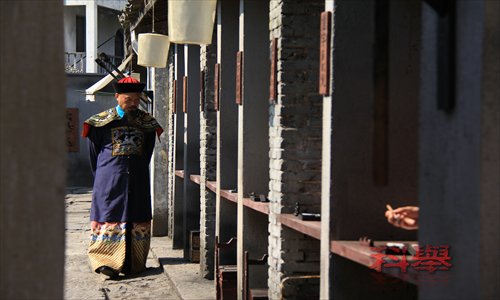
A scene from the documentary Keju Photo: Courtesy of Han Jing
In today's examinations, including the gaokao (college entrance exams), the three highest-scoring candidates are still called "zhuangyuan," "bangyan" and "tanhua" - terms used to denote the first, second, third place in the keju, the civil service exams of Imperial China.
Though the 1,300-year-old exam system was abolished after 1905, it continues to influence Chinese people even today, along with China's neighbors. Established in 607 during the Sui Dynasty (581-618), the keju was considered the most effective way for emperors to select talented bureaucrats from the public. Previous dynasties had used less meritocratic means of hiring administrators, with officials simply inheriting or being recommended to government posts.
A documentary on the ancient exam system recently aired on the CCTV-9 channel. After debuting last month, Keju will get repeat broadcasts on the same channel.
The Global Times talked to Han Jing, the director of the documentary. Based in Shanghai, Han is the senior editor at Shanghai Film Group, and as an experienced producer and director, she has made a number of historical documentaries. Keju was a co-production between CCTV Documentary Channel and Han's film studio.
Historical perspective
The documentary chronologically traces the evolution of the keju over five episodes and also addresses interesting topics such as cheating.
"This is the first time for a documentary to approach the topic of the keju system from a macro historic perspective, closely connecting it with the continuity and downfall of various dynasties. It doesn't just review the exam system, it puts it in the context of China's social, political, cultural and economic development," Han said.
A history buff, Han got the idea to make this documentary five years ago. Supported by CCTV-9, the director started the project two years ago, spending a whole year writing a 50,000-word script based on primary sources and research from historians.
"While researching, I found out a lot of exciting things. For example, I discovered that the keju system played an important role in maintaining a dynasty's long, stable reign and even in maintaining the dynastic system itself," Han said. "What's more, the advantage of the keju lies in the relatively fair, just and open mechanism in selecting talents, which enabled many ordinary people get the chance to climb into the upper class."
Dramatic reconstruction
Another highlight of the documentary is the way it was shot. According to Han, due to the lack of visual materials and relics (especially before the Song Dynasty, 960-1279), the producers relied on dramatic reconstructions - producing roughly 80 drama scenes using more than 1,500 actors.
Although this approach has provoked criticism for not being purely factual, Han considers it a necessary and reasonable compromise. "The final effect is to give the audience a vivid impression of what was happening in vital historic stories related to the keju." In her camera lens, the faces of the characters are not in focus and most of the dramatic scenes feature blurred backgrounds, which Han says is a balanced way to recreate past events.
According to CCTV-9, the documentary Keju is currently being translated into English.