‘Museum slave’ ’til the grave
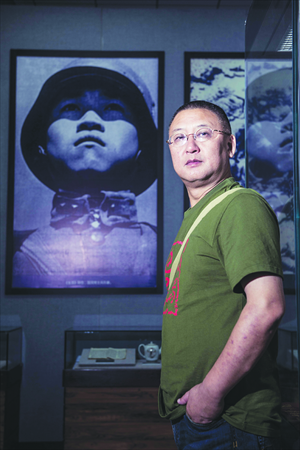
Millionaire Fan Jianchuan uses his riches to build museums in China and hopes that they will remain behind even long after he is gone. Photo: Li Hao/GT
Fifty-six-year-old millionaire Fan Jianchuan, who enlightens more than 1 million annual visitors at his museum complex in Anren, a small township about an hour's drive southwest of Chengdu, says that creating the unique 100,000-square-meter Jianchuan Museum Cluster that showcases some 8 million relics - 95 percent of which he personally acquired - is simply not enough for him.
Considered one of the most famous private curators in the country, Fan is working to build another 70 museums with the goal of bringing the total number of museums owned to 100 one day.
Adding to his current cluster of around 30 museums in Anren - focused on the War of Resistance against Japanese Aggression (1937-45), the Cultural Revolution (1966-76) and the 8.0-magnitude Wenchuan earthquake in 2008 - he is currently planning to construct another cluster of 20 museums in Ya'an, Sichuan, to preserve the local Chinese-style architecture of the area. He is considering to build another 30 museums in a major city, such as Beijing or Shanghai, to educate the public on China's reforms and opening-up since 1978.
And after these projects are complete, Fan will have just one dream left to realize before his time is up.
"I'll happily die after building a 60-floor museum tower to story the astonishing history of the People's Republic of China, with every floor featuring a different year," he told the Global Times, his eyes glowing with excitement.
All in
From a poor family in Yibin, Sichuan Province, Fan, who was sent to the countryside as an educated youth during the Cultural Revolution, led a life of varied professions - as soldier, college economics instructor and even deputy mayor of his hometown - before becoming a property developer in 1994, opening Jianchuan Group.
The success of his private real estate company has over the years provided Fan with millions of yuan to support his collector's habit, or perhaps obsession, with money supporting his projects even coming at the expense of selling off business properties, he said.
But by the mid-1990s, Fan began running out of space to store his treasures. He decided in 1999 that it was time to design a special place for their keeping, one that would also allow the valuables to be appreciated by others.
Six years later, Jianchuan Museum Cluster became a reality in 2005. Moved by the 1980s film The Bloody Battle of Taierzhuang, which tales the fight put up by the Kuomintang army, including soldiers from Sichuan - among them his father and his father-in-law - Fan dedicated seven museums in the cluster to the war and says more are on the way.
"The museums exist to have the country remember the lessons we learned," he said.
The very best of the museums include a picture frame made from the wreckage of a Japanese plane that was shot down in 1944 by Robert Gruber, a former US pilot who came to China to help in the war, and a boiler plate from the battleship USS Missouri where Japan formally signed the Instruments of Surrender in 1945, which was given to Fan by a retired US navy colonel.
Other crowd favorites at Jianchuan Museum Cluster feature a collection of diaries and letters from Japanese soldiers, denunciation posters from the Cultural Revolution, and a bloody wedding gown dug out from beneath the debris, which calls on reflection for the lives lost to the Wenchuan earthquake.
Fan said that the idea of showing the pieces is to let them tell their own stories.
"What we took away from the war has had a great influence on our country's development, but also reminds us that we need to think about why we were invaded in the first place," said Fan. "With the Cultural Revolution, we need to remember our shame and fault, and the reasons behind our experience with such national insanity for a decade.
"But let peace and confidence grow from these dark times, never hatred," he added.
'I'm a slave'
Content with being a "slave to his museums," Fan has worked tirelessly over the years to build up a national network for the scouting and purchasing of interesting relics.
In fact, unlike no where else in the country, he has built special museums within the cluster to showcase specific moments in history, including the sacrifice and contributions of the Kuomintang army - a project that required approval from 22 goverenment departments as the then ruling nationalist party was only recently given the credit. The other museums also detail the life of war prisoners, traitors, and the US "Flying Tigers,"a volunteer air force group that was sent to help China during World War II.
Some pieces shown in the museums were donated from war veterans and decorated military officers, albeit after a lot of chasing and months of persuasion, he admits.
Charging visitors only nominal entry fees between 20 yuan ($3) and 100 yuan for three-day passes, Fan only started to turn a profit to keep his museums afloat in 2010, after adding hotels and tea shops to the cluster.
Museum visitor Huang Hongwei described his tour as surprisingly life-changing.
"My son kept asking me if these objects were real. I was also shocked to see the collections from the Cultural Revolution; it reminded me of the times I had forgotten, or forced myself to forget," he said.
It is providing this kind of meaningful visitor-experience that Fan finds "so personally rewarding."
And in an age where private museums in China are struggling with land appropriation, funding as well as relic management and legislation issues, Fan ultimately hopes to provide people with a lasting memory of the past.
In 2007, he declared in his will that he is leaving his museums behind for the country, gifting them after death to ensure that "they last for 1,000 years."