Succulents Sweep Shanghai
Succulent plants are so named because they store water in their thick and fleshy leaves, stems or roots. They are said to be perfect for people who do not have green thumbs as they are generally very tolerant of changing temperatures and only require occasional watering.
Outdoors, some species thrive in ground cover plantings and pots. Indoors, they are a nice living alternative to cut flowers. They typically grow in small clusters which do not take up too much room, making them ideal for city dwellers.
Being a versatile group of plants, there is a booming interest in growing succulents among Shanghai's amateur gardeners.
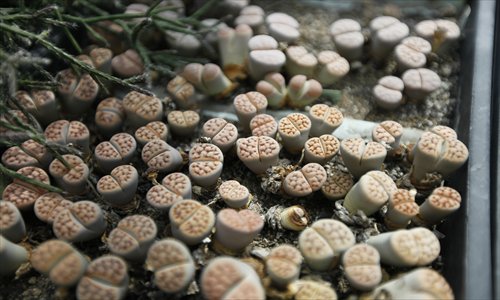
There is a booming interest in growing succulents among Shanghai's amateur gardeners. Photo: Cai Xianmin/GT
Succulent aficionados
Growing succulent plants is a major hobby for Wang Xiaojin, who began to grow them about two years ago. "I chose several pots of cacti and Haworthia cooperi at a local flower market. These little things looked rare and unusual, especially the Haworthia cooperi. It has a translucent tip on each of its leaves, which makes it resemble jewels," Wang told the Global Times.
The seller told her that they were not hard to take care of as the plants are not picky about soil or temperature. However, Wang later discovered that her new Haworthia cooperi were not as easy to keep alive as the seller claimed.
Like many succulent novices, she overtended to her plants and watered them more often than they needed. Wang learnt from her mistakes that too much love is as likely to kill succulents as total neglect.
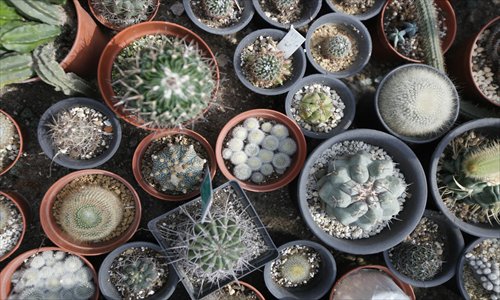
There is a booming interest in growing succulents among Shanghai's amateur gardeners. Photo: Cai Xianmin/GT
She invested in a new batch of plants and gradually got the gist of how to care for them. Her collection now includes nearly 60 pots of around 100 different species.
Always on the look out for new species, Wang now travels to plant nurseries in the suburbs, such as Jiading district and Pudong New Area. The sheer number of succulent plant varieties makes them highly collectable items.
"As I've become more and more interested in these plants, I've met a lot of friends who share the same interest. One problem is that when I see a new plant that I don't have, I can't help thinking about getting one for myself," Wang admitted.
So far, she has spent almost 10,000 yuan ($1,630) buying succulents. Some rare species are particularly expensive. "When you see them, you just can't resist them," Wang said.
In Wang's opinion, succulent plants are perfect for busy office workers. "One of the attractions of having these succulents is that they are one of the toughest and most resilient plants on Earth. They've adapted to cold, drought and terrible conditions. This means I can leave them alone and let them grow all by themselves," Wang said.
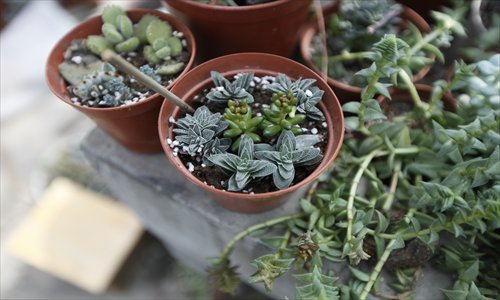
There is a booming interest in growing succulents among Shanghai's amateur gardeners. Photo: Cai Xianmin/GT
Caring for succulents
After picking up a succulent plant, one should first of all know what species it is. "Plants are like people, they have their own habits and preferences. Only after you know it well can you make it grow well," Xie Weisun, a succulent specialist from the Shanghai Botanical Garden, told the Global Times.
Xie has over 30 years of experience in keeping succulents. In the 400-square-meter nursery where he works, there are over 2,000 different species. Each one of them is a treasure in his eyes.
Most succulents, like cacti, originate from deserts where they flourish in a dry, hot climate. The plants also feel comfortable with sandy, well-drained soil to prevent root rot.
When they are moved to nurseries and homes in the city, they should be placed in brightly lit areas with lots of sunlight. The temperature should be controlled between 32 C in summer and 10 C in winter.
"When it comes to watering, the key is to know when your plant enters into its dormant period, as normally succulents go into a dormant phase either in winter or in summer," Xie explained.
Excessive water can kill succulents when they are in a dormant period, but during the warmer months of the year, they need more water as they enter into the growing and flowering phase.
"This is the point you can show your love for the plants, and you can water them more often and use fertilizer, so that the plant will reward you by producing delicate and beautiful flowers," Xie said.
Instead of pouring water directly over the pot, it is suggested that one should soak the pot in water and let the dry soil absorb water from the bottom, thus pots with a drainage hole are preferred.
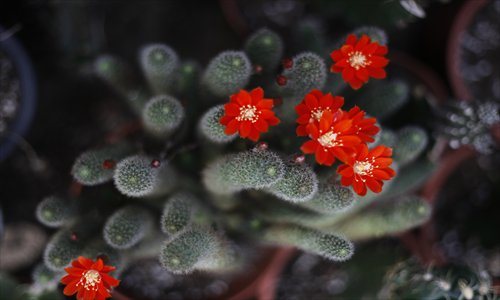
There is a booming interest in growing succulents among Shanghai's amateur gardeners. Photo: Cai Xianmin/GT
When the succulent plant outgrows or looks uncomfortable in the pot, the plants should be repotted.
"Small pots should be changed once every year and new soil with nutrients should be added into the new pots. Meanwhile, old roots should be cut off. One tip is after you cut off the old roots, put the plant in the sunshine upside down for a few days. When it is put in new soil again, the new roots will grow faster," Xie added.
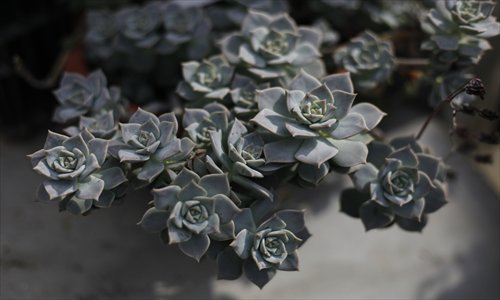
There is a booming interest in growing succulents among Shanghai's amateur gardeners. Photo: Cai Xianmin/GT
Succulent workshops
Tucked away in the garden of an old building on Yanqing Road, Doroq Garden regularly holds succulent growing workshops. They offer a place for succulent fans to share ideas about succulent gardens and exchange notes.
Some succulents, such as sempervivums and echeverias, have natural rosette shapes with colorful leaves at their most brilliant in the cooler months. The workshops teach beginners how to place succulents together to create an eye-catching array of plants and add color to a winter garden without much maintenance.