Silk purses and sows' ears
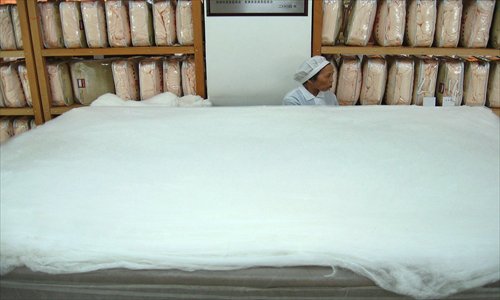
A textile worker sits behind a silk quilt spread out so shoppers can examine it closely. Photo: CFP
Silk is one of China's treasures - it has been part of its history for more than 5,500 years. The cultivation of the silk worm, at first to make clothes only an empress could wear, led to the existence of the legendary Silk Road along which the rare thread was transported to Central Asia, Africa and Europe. Silk became a glamorous and exotic symbol of China.
Today it is still exotic and on the top of the souvenir shopping lists for tourists from all round the world. Near tourist haunts in Shanghai, silk shops abound.
But a recent study in Beijing sounded alarm bells about the authenticity of some silk products sold in China. The Beijing News reported that a study by the Beijing Consumer Association in May showed that 19 out of 40 silk quilts bought from local retailers, department stores and online stores (including Wal-Mart, Sogo and online commerce site yihaodian.com) did not meet national safety and quality standards. Eight were incorrectly labeled.
None at all
A silk quilt manufactured by Shanghai's Baolai Home Textile, which claimed to be made of 100 percent silk, for example, actually contained no silk at all, while another product contained much less silk than its label claimed. A 3-kilogram silk quilt sold by another Shanghai brand, Homes Textile, was found to weigh only 1.91 kilograms.
All textile products need to pass quality inspections before they can be sold in the market. However, these inspections are usually undertaken by the manufacturers.
The Shanghai Municipal Bureau of Quality and Technical Supervision carries out random inspections on textile products and can fine companies that sell sub-quality products. In late 2012, silk quilts made by Homes Textile, for example, were found to contain less silk filling than labeled and the company was fined 90,000 yuan ($14,680) by the bureau and 36 of the quilts were confiscated.
Qiu Huimin, a quality control engineer at the Shanghai Institute of Fibre Inspection, said that silk quilts were especially prone to being underweight. "Raw silk is expensive, so manufacturers tend to cut their costs by giving short weights. And as people cannot directly see what's inside a silk quilt, it's quite difficult to be caught."
A woman who works at a silk factory told the Global Times, "A ton of raw silk costs between 350,000 yuan to 400,000 yuan, which means each kilogram is worth 350 to 400 yuan. That doesn't include the costs of processing, transportation, advertising and selling. The price of a light summer silk quilt that weighs half a kilogram shouldn't cost less than 250 yuan."
Quality control engineer Qiu said there were several ways people could check to see if the material was made of 100 percent silk. In the past people would feel the material to see if it felt smooth, soft and rich. But Qiu said that thanks to modern technology, many man-made fibers now felt exactly the same as silk and it was almost impossible to distinguish natural silk from artificial ones by feeling it.
Burning ambitions
Experts suggest that a better way to check if the silk is real is to burn it. If the thread is real silk, it will ball up and turn to ash immediately. There should be no visible flame. The burnt thread should smell like burnt hair, not the plastic smell of artificial fibers or the charred smell of burnt paper - silk and hair contain similar proteins. The ash should be black and brittle. If you burn an artificial thread it should not leave any ash, just a lump of black molten fiber.
But Qiu warned that this test can only be used on products that claimed to have 100 percent silk. It doesn't work if the silk is blended with other fabrics.
Many of the shops in town are aware of the test. At one silk shop near Yuyuan Garden, a shop assistant readily brought out a lighter to prove that her silk was genuine. She turned a silk nightgown inside out and pulled a loose thread from it and burned it. She then did the same with a thread from a synthetic silk scarf to illustrate the difference.
But not every shop does this. At other silk shops also near Yuyuan Garden, shop assistants when asked shrugged and said they didn't have lighters or claimed their silk was too valuable to risk setting fire to a thread. "Silk" scarves here can be bought for between 50 and 600 yuan or more.
Far away from lighters in shops, Qiu's laboratory technicians use three or four steps to analyze fibers, immersing them in alkaline solutions, and looking at them through microscopes to examine their formation and shape. Real silk melts in alkaline solutions, and real silk has an irregular shape when viewed through a microscope, Qiu said.
The city's major department stores require suppliers to provide quality inspection reports issued by third-party quality assessors though these are not legally compulsory. At the shops near Yuyuan Garden, which are mostly run by individuals, no one could show a certificate of authenticity for their products.
The Shanghai Institute of Fibre Inspection provides government-recognized fiber identification services for the public. Customers who have bought doubtful silk products can get a free initial assessment of dubious materials before deciding to go further and asking the institute carry out an official detailed analysis.
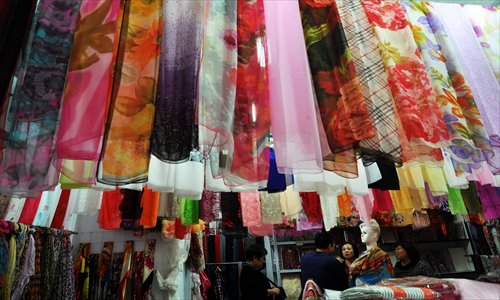
Colorful silk scarves on display in a shop. Silk products are always a popular souvenir choice for tourists in China. Photo: CFP
Seek an agreement
Qiu said it was better if consumers could come to an agreement with the seller or manufacturer of the product before going for inspection. "We've seen cases when the customer ordered a test and the manufacturer then refused to admit that it was their product that was tested. And customers and manufacturers should agree on who should pay for the tests."
China's silk industry is an export-oriented market. But silk exports dropped 9.44 percent in the first seven months of 2012. According t0 Bao Mingxin, a professor at Donghua University's Fashion and Art Design Institute, the global trend towards man-made and synthetic textiles has now reached the high-end market.
"The past decade has seen huge improvements in technology and synthetic and artificial textiles can be even more comfortable and permeable than natural products. Some are even better for color, patterns, anti-wrinkle and fade-proof properties. This is a change from years past when Chinese people regarded pure cotton and silk as the best fabrics.
"Because silk clothes take a long time to manufacture and place heavy demands on manufacturers, silk is now almost only used in high-end brands and products," he said.
According to the European Man-Made Fibres Association, man-made fibers like viscose and modal now account for 66 percent of all fibers used worldwide.
Changing tastes
In the domestic market, silk companies are trying their best to cater to the tastes of the younger generation, who do not normally buy silk. Sun, a 25-year-old office worker, said, "I rarely think of buying silk products because I think silk clothes are usually old-fashioned. But I would certainly consider silk if the design was good and it was reasonably priced."
Her view was echoed by 24-year-old Xiao Fei. "I don't have any silk in my wardrobe. Silk clothes make you look mature and formal and most of the brands I buy don't have any silk products."
Shanghai Silk Group, one of the largest silk companies in the city, has launched new ranges to cater to the younger generation but older people still feel the allure of the fabric. A 52-year-old tourist surnamed Wang from Northeast China who was buying silk in a shop on Nanjing Road East, said, "Silk is definitely better than other material in summer. The smooth texture and glossy surface always looks flattering."
In the West, some animal protection activists have argued that insects are sentient and refuse to wear silk products - after silkworms have secreted enough silk to form cocoons, the cocoons are placed in boiling water and the silkworms are killed.
People for the Ethical Treatment of Animals, a global charity dedicated to establishing and protecting the rights of all animals, has also launched campaigns against silk and encouraged people to use "humane" alternatives to silk, such as nylon and polyester. According to its website, about 3,000 silkworms die to make 390 grams of silk.