Sage wisdom
By Hu Bei Source:Global Times Published: 2013-8-6 18:58:01
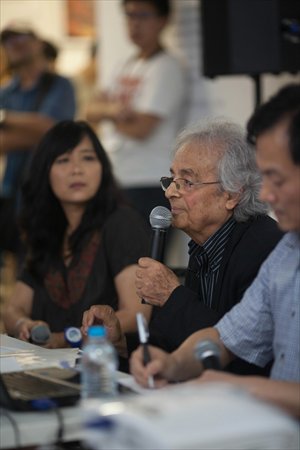
Adonis (center) attends a poetry event about himself at Minsheng Art Museum in Shanghai on August 4. Photo: Courtesy of Minsheng Art Museum
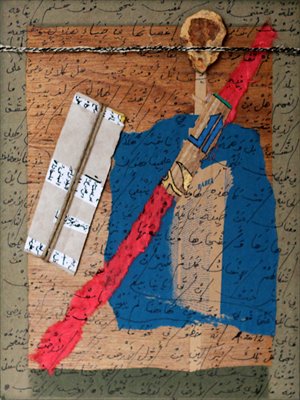
One of Adonis' collages using Arabic calligraphy on parchments and rags Photo: Courtesy of Minsheng Art Museum
It was just like one of his poems: "Your childhood is a village. You will never cross its boundaries no matter how far you go." For Adonis, this most well-known living poet and thinker of the Arab world, the memories he has of his homeland, Syria, are represented by the old house in which he was born.With his original name, Ali Ahmad Said Esber, Adonis was born in a small village of Qassabin in western Syria in 1930. After leaving Syria in 1956 because of political reasons, Adonis rarely returned. "I lived in the house for 10 years after my birth. I still remember it was made of mud, grass and stone."
Recently, the 83-year-old Adonis was recalling his mother country to the Global Times in Shanghai during his fifth visit to China since first coming here in 1980.
"It (Syria) collapsed soon after I left there, which became the most impressive image that Syria left in my mind," Adonis said. "A collapsed old house" seems like the current situation of Syria.
"But I believe everything in Syria will recover one day," he added, "since it is still a country that has an ancient civilization of thousands of years."
Bold and provocative
After spending most of his time in Lebanon in the 1960s and 1970s, Adonis, now, has settled down in Paris since 1985, even becoming a French citizen.
With more than 20 published collections of poetry and several critical works on cultural theory, Adonis enjoys an esteemed international reputation. He was the first Arab writer to win the Goethe prize in Germany and has been regularly nominated for the Nobel Prize in Literature since 1988. And within the Arab world, he is regarded as a controversial dissident and secularist.
In a comment about his old friend, another great Arabic writer and thinker, Edward Wadie Said (1935-2003), once called Adonis "the boldest and most provocative Arabic poet."
For a long time, Adnois has strongly emphasized his own convictions in his poetry and other works. For example, he believes people should have religious freedom and shouldn't be tied to or controlled by any political regime or ideology; nor should any literary forms, including poetry, be made to serve or fit a religion or ideology.
"Unfortunately, [these freedoms] have not been realized in the Arab world," Adonis said.
Going back to 1950, the reason why he was forced to leave Syria without being allowed to return during the next 20 years was because he was identified as a member of the Syrian National Socialist Party (SNSP).
Founded in Beirut in 1932, the secular nationalist political party has been legalized in Syria now, but in 1955, it was not. Adonis was imprisoned for a whole year from 1955 to 1956. After that, he fled to Lebanon.
As a poet, Adonis began to create while still very young. At the age of 17, he even wrote a poem for the Syrian President at that time, Shuki al-Kuwatli, and got an opportunity to recite a poem in front of him.
No place for poetry
However, Adonis told the Global Times that, actually, in the Islamist scheme, there is not much room for poetry, and the status of poet has been reduced since Islam assumes that the knowledge of the Koran is complete and there is nothing to add.
"No place for them /They do not create a lineage or a home for their myths/No place…" These are some fragments from Adonis' poem for poetry, named "The Poets."
"And today," Adonis said, "most of contemporary Arabic poetry is used by the ruling regime or heavily commercialized.
"In the Arab world, especially in ancient times, the great poets, including Abu al-Alaa al-Maari (973-1058) and Abu Nuwas (756-814), were never religious believers; they were all against religion like that," he added. Adonis, himself, is also a nonbeliever.
However, there is one thing that Adonis always insists on since he first began to create: He writes all his poetry in his mother tongue, Arabic, although he is also very good at French. "Because I know it is my only 'mother,'" Adonis said.
In Adonis' opinion, poetry cannot change society, but it has a more important function. That is, for people to think about the world and to question the world. "And I believe to question the world is the essential thing for people to live in the world," he said.
Adonis took his past whole life to question, rebel and subvert, and he said he knew it is contrary to traditional Arabic culture and even the whole Orientalism.
Seeking love in China
As well as writing, about 10 years ago, Adonis began making small collages using Arabic calligraphy on parchments and rags, adding fragments of his own poems or classical Arabic poetry on them. Some of Adonis' collages are being exhibited at Minsheng Art Museum in Shanghai until August 14.
"Through my collage creations, I found that images can also create poetry, like painting is another kind of poetry," Adonis said.
For the China visit this time, after attending a poetry event about himself in Shanghai, Adonis will go to Xining, Qinghai Province for the fourth Qinghai Lake International Poetry Festival held there from August 7 to 12.
And on August 13, in Beijing Normal University, he will have a literary dialogue with some other famous writers from China and abroad. Mo Yan is scheduled to appear as one of the other guests.
When being asked why he is so willing to visit China again and again, Adonis half-jokingly replied that, "Our Prophet, Mohammed said…'Seek love even as far as China.'"
Since 2009, one of Adonis' poetry collections and an essay collection have been translated and released in China.
Posted in: ARTS, Books