Rubbing out Chinese characters
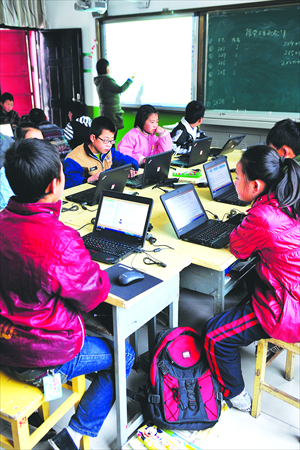
Grade 7 students in Guanzhuang Middle School of Tongchuan, Shaanxi Province are obsessed with computers. They are reluctant to leave the classroom even after the class ends on November 7, 2012. Photo: CFP
The difficulty of writing Chinese characters is not exclusive to foreigners. A majority of Chinese speakers today find it hard to write their mother tongue, despite having pride in being the modern custodians of one of the world's oldest written languages, dating back to before 1100 BC.
As the digital age takes over people's daily lives, the need to use pen and paper is getting smaller. It has become commonplace now for Chinese natives to find that words they can pronounce and read easily get lost when they try to write them.
In this summer, several new TV shows that are competing to show modern mastery of the Chinese language have attracted large audiences. These shows have even beaten out the singing and dancing contests which have traditionally dominated ratings.
Such programs have renewed people's interest in Chinese scripts but also sounded an alarm bell on the downward spiral in the nation's handwriting skill.
Many are calling for a national effort to correct this tendency but others say that handwriting is already on its way out and that it should be naturally phased out while allowing calligraphy to be cultivated as an aesthetic art form.
High-tech blamed
During the recently televised Chinese Character Dictation Contest by CCTV-10, when the host asked the 14-year-old contestant Yu Shuang from Guizhou Province to write the word for toad, the audience frowned. Yu failed as she wrote the character with one dot missing. However, among 10 adult participants offstage, only three had written the word correctly.
Meanwhile, those sitting at home also felt embarrassed during the broadcast, since on several occasions they were stumped as to how to write words that are commonly used in daily conversation.
According to a survey by Beijing-based Horizon Research Consultancy in May, up to 94.1 percent of respondents said they had encountered memory lapses concerning how to write certain characters while writing and 26.8 percent said such lapses were frequent.
"I'm afraid I would be placed in the latter group. Last week, my father asked me to write a shopping list and I forgot the correct strokes for several characters. I was only reminded after using an app on my phone which allows me to write in pinyin and then displays the characters," said Li Hui, a saleswoman from Changsha, Hunan Province.
Unlike older generations, young people today prefer typing.
"The frequency of students writing words incorrectly has become worse in recent years. The prevalence of digital devices is a major contributing factor," lamented Su Yunsheng, who has taught Chinese for more than 20 years at Hangzhou Foreign Languages School in Zhejiang Province.
"In addition, in order to reduce the burden placed on students, written homework has been largely cut," Su told the Global Times. "In an era of image-reading and voice recognition, handwriting skills have become far less vital," she added.
Cell phone and computers are common devices to most urban children.
A report on the lifestyle of Chinese children published by Beijing Women's Federation in July showed that mobile phones, instant messenger QQ, Weibo and tablets have become a major part of urban children's daily lives.
According to the report, 52.6 percent of kids aged 4 to 6 had used the Internet. The percentage for kids aged between 7 and 9 reached 58.6 percent, and 77 percent for 10 to 12-year-olds.
Yang Lincheng, deputy copy editor at Excessive Wording, a monthly magazine dedicated to promoting the standard use of Chinese language, noted that speed reading has also weakened people's knowledge of the Chinese script.
"Before, people got their information mainly from print media. But now, given the prosperity of new media, people spend less time reading traditionally written full-blown articles," Yang told the Global Times.
Many are calling for the popularity of handwriting to be revived as they are convinced it is significant to pass on Chinese history and culture.
"Chinese characters are ideograms and carry the essence of Chinese culture. Handwriting is an important way to touch this essence. As a result, we must write them and feel them," said Zhang Yiwu, professor of Chinese literature at Peking University. He deemed that opening calligraphy lessons in schools would be a meaningful method to rebuild children's interest in handwriting.
Luo Dongqing, a professor of Chinese language and literature at Nanjing Normal University, also stressed the legacy of Chinese characters.
"They are the most important part of Chinese culture. By studying the formation and evolution of a Chinese character, one is offered a window into the evolution of Chinese culture and history," he told the Global Times earlier.
There are currently over 80,000 Chinese characters and 3,500 of them are frequently used in daily life.
Yang added to this by saying that Chinese characters contain a cultural code. "By studying these pictograms, we can get closer to our ancestors' mode of thinking and their lifestyle," he said.
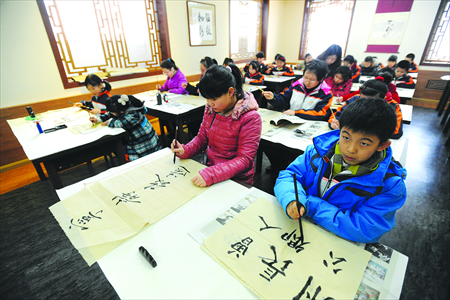
Students at a primary school in Shenyang, Liaoning Province study calligraphy on March 11, 2013. Photo: CFP
Cramping up
While many call for new handwriting classes to be created alongside related TV shows and other methods, others disagree.
"I feel a bit ashamed that I am unable to write some words. But I don't think it will have any effect on my life and work. Using pinyin input, I can type any word as long as I can read them out. It turns out to be much quicker and more convenient than handwriting," said Xiao Jian, an IT engineer in Beijing.
"I don't think it would hinder the cultural heritage unless we completely abandoned this form of writing. But when we have a much more convenient option to write things down, why not accept it?" he noted.
Chen Jianwei, a professor of Chinese education at South China Normal University in Guangzhou, believes that handwriting will be abandoned anyway as new learning tools come into play.
"The new curriculum suggests kids learn to type in Grades 3 and 4. It also renewed requirements for handwriting. Before it was 'see handwriting as a basic tool'; now it's 'cultivate aesthetic taste in handwriting," Chen was quoted as saying by Guangzhou-based Information Times.
Schools across the country are promoting new teaching methods and are trying to reverse classroom models. Blackboard and chalks are gradually replaced by digital devices. In several cities, including Shenzhen, Xi'an, Chongqing and Changsha, education bureaus have begun to experiment with using iPads as textbooks in primary schools.
In front of this technical dominance in schools, teacher Su and her students have been torn over the fading of handwriting.
"It's a pity that letters have been replaced by e-mail, but that's the trend of social development," she said. "My class had a discussion about it. The final conclusion we came to is that letters and manuscripts can be treasured as beautiful memories."
"But I'm convinced that while we are enjoying high-tech achievements, we should nurture our intimacy with characters," she said.
Yang believes that the educators should attach more importance to spelling.
"It's a headache to check my daughter's essays, there are too many wrong words. The teachers are to blame. They spend too little time and passion interpreting characters' strokes and their meanings," he said.
Yang and Su agreed that the current Chinese education falls short of other subjects. "If you look at my daughter's homework, most of it is either English or mathematics. Some colleges even exclude Chinese during their particular recruitment examinations," said Yang, whose daughter is in high school. Su admitted that there are rare extra-curricular classes on Chinese or calligraphy.
Hao Mingjian, a noted linguist, said that negligence is to blame for this downturn.
"It seemed that people have got used to the frequent presence of wrong words. Some celebrities even purposely use wrong words. Under this impetuous, mainstream attitude, many people become careless and hasty when writing," Hao told the Youth Daily.
Reviving a habit
While most rely solely on type, some still keep up the habit of handwriting. Chen Xun, who teaches classic literature to kids in Huaian, Jiangsu Province, spends one or two hours daily transcribing ancient masterpieces by hand.
"I enjoy the time. It helps me find quiet and seek peace. Handwriting is helpful to mould a person's temperament," Chen told the Global Times.
Hai Yan, a successful fiction writer, still cannot use a computer. "Handwriting has become my favorite method of expression. It works best to inspire me and trigger my passion and imagination. It's a wonderful pleasure to write with a pen," he said, according to Jiefang Daily.
He deemed that keeping up handwriting helps nurture love for the Chinese language, cultivate moral character and increase an aesthetic sense.
In Shenzhen, some parents have taken action to avoid their kids relying too much on electronic devices. They jointly petitioned to local educational bureaus and demanded a stop to textbooks being replaced with an iPad.
In an open letter circulated on the Internet, the parents cited a school in the US.
The Waldorf School of the Peninsula in the middle of Silicon Valley is a private institution with many students whose parents are executives in the technological industry, working for firms like Google and Apple. But the school sticks to ways of yore, with blackboards, chalk, pens but no computers.
The education department of Futian district in Shenzhen eased parents' worries in late June, saying that digital devices would only be used for supplementary assistance and the kids could choose to use tablets voluntarily.
"iPads can not necessarily help enhance children's ability to read and calculate. I'd rather my child do more homework by hand rather than watch and type on digital screens," said Zhao Zhenying, father of a 5-year-old daughter. He said he makes his girl practice handwriting every day.