Iron fists vs. steel knees
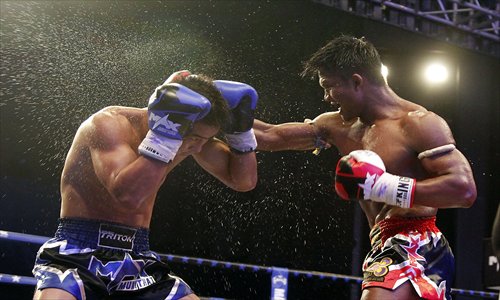
Buakaw Banchamek of Thailand (right) pummels Dong Wenfei of China on the way victory on August 10. Photo: CFP
Chinese kung fu fighting against various martial arts from other countries in a boxing ring is not just a scene in action movies. Thanks to a program on Henan Satellite Television, Wulinfeng (martial arts trends in Chinese), audiences get a chance to see real life arena bouts.
Wulinfeng is dedicated to combining traditional Chinese martial arts with modern TV art and introducing Chinese kung fu to the rest of the world. After tournaments with countries like America, Japan and New Zealand, this time Chinese kung fu goes up against Muay Thai.
Tournaments between China and Thailand on the stage of Wulinfeng began at 4:30 pm on August 10. It was live on Thai Channel 7 and will be on Henan Satellite Television for three consecutive Saturdays beginning on August 17.
This ultimate combat between China and Thailand was co-sponsored by World League of Fighting (WLF) from China and MAX Muay Thai from Thailand. It had been anticipated by fans from both countries for a long time. The online buzz and live audience enthusiasm added feverish excitement to this tournament.
Highlights
The talented athletes participating in the tournament generated the most excitement. Buakaw Banchamek (called Bo Qiu in China), is famous in the Muay Thai sport. He is the champion of many international matches and is the highlight of the Thai team. He fought against Dong Wenfei, a Chinese fighter who has also won his share of championships.
The highlight of the Chinese team was Yi Long, who was known as the "warrior monk" and also a representative figure in the world of Chinese traditional martial arts. He fought against Petchnumchai F.A. Group from Thailand.
Although the two leading characters from both countries didn't encounter each other this time, it was highly expected by the fans for months that they might compete.
At the press conference for Wulinfeng's tournaments between China and Thailand held on August 9, Henan Satellite Television revealed that a bout between Buakaw and Yi Long is in the works. Yi also said that simply meeting each other this time was part of the preparation for their upcoming bout.
Tough rivals
Yi Long participated in many international tournaments that Wulingfeng organized. He studied kung fu in Shaolin Temple, where he mastered many traditional Chinese martial arts. He expressed his own opinion in an interview with the Global Times about the difference between Chinese kung fu and other martial arts like American boxing and Korean taekwondo.
"But Shaolin kung fu and Muay Thai have many things in common. Muay Thai is good at steel knees, iron elbows and iron legs, those who master Muay Thai have strong defenses. It's the same in Shaolin kung fu. In Shaolin we have iron fists, iron legs and iron cloth (means the body is hard enough to defend any attack)," said Yi Long.
Without doubt, Muay Thai is a strong rival. "Thailand is a country of martial arts, a country of actual combat. They were trained to fight in matches since they were children," Yi Long said.
But China has less experience in actual combat. Many countries already had a well-developed system and vast experience with arena fights, whereas China started long behind them. Despite this disadvantage, he still believes that "real traditional Chinese kung fu is tough enough to take on any kind of martial arts."
When talking about fighting the Chinese team, Narit, CEO of the MAX Muay Thai, told the Global Times during the press conference that "I think the result will be 50-50, but that is not the most important thing. The important thing is we would like to introduce Muay Thai to more people through this tournament."
At the match, a fan surnamed Mao, who didn't reveal his full name, said to the Global Times that he started to watch Wulinfeng since it started. He said, "Thailand is very powerful in terms of martial arts. When China faces Thailand, of course I hope China will win. But if Thailand goes up against other countries, I hope Thailand wins."
Glamour of kickboxing
Kickboxing has become a serious industry in many countries, and the athletes are professional, whereas it is still not the case in China.
During the meeting to announcing the foundation of the WLF, Wu Lixin, the associate director of Henan Satellite Television, talked about the development process and the aim of Wulinfeng.
As the iconic program of Henan Satellite Television, Wulinfeng started in January, 2004. It is on air at 9:25 pm every Saturday. In the first few years, they focused on Chinese traditional martial arts and fights between various factions. But soon they found those were just illusions existing only in martial arts novels and movies. In terms of fighting against the international kick boxers, there were significant gaps and limitations.
So they chose to follow an international path - carving out the way for China's kickboxing professionalism, communicating with foreign masters and bringing Chinese kung fu to the world. And in recent years, they have successfully promoted their own tournaments to America, Japan, Malaysia, The United Arab Emirates, Germany and many other countries.
Yi Long also explained how the international stage has changed the situation of Chinese kung fu and his own combat techniques: "My way of fighting has changed. Using traditional Chinese kung fu itself is not enough, fighting in a ring with international martial arts opponents, we must combine techniques of international kickboxing."
In the kickboxing ring, the smooth attacking skill, the collision of the spirit and the flesh, and the male power are the charm of watching the match. A roar is heard from the crowd each time a fighter executes a perfect strike.
Su Yue, the special assistant of Dong Xi Hui Culture and Sports Communication Company (the company that plans and promotes Wulinfeng), gave his own observations to the Global Times. He mentioned the time that Tie Yinghua, a Chinese boxer, was knocked out in a fight with the champion from New Zealand. It left a memorable impression on him.
He said, "Everyone knew that day would come, but no one knew in which match it would occur. When Tie was knocked out, in that moment the audience fell silent. But when he walked out of the ring, the audience still gave him applause. The connection between the audience and the athletes in the ring is special."