Diving in the deep end
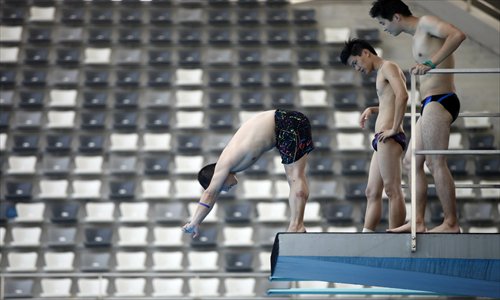
A variety of enthusiasts train at the Shanghai Oriental Sports Center for the Shanghai diving competition which is planned to open the sport up for ordinary people. Photo: Cai Xianmin/GT
In China, diving used to be a sport associated only with top-level athletes and medal-winning professionals. Now a Shanghai diving competition is being staged to open the sport up for ordinary people who want to enjoy the thrill of stylishly plunging into water from a height.
The competition is being held at the Shanghai Oriental Sports Center in Pudong New Area. People have enthusiastically been signing up to dive themselves or take part as spectators for the event, which is organized by businesses and government departments including the Shanghai Sports Federation and the Shanghai General Labor Union.
In the US this year, two reality television shows based on diving screened, interlacing medal winners with celebrities learning how to take the plunge. Stars in Danger: The High Dive featured Olympic bronze medalist Troy Dumais and Celebrity Splash starred gold medalists David Boudia and Greg Louganis.
A Chinese version of Stars in Danger was screened on Jiangsu Satellite TV since April this year. The show featured the former Olympic gold medalist gymnastic star Li Xiaoshuang. However, during the making of a Zhejiang Satellite TV version of Celebrity Splash in April, a celebrity's assistant accidentally drowned leading to public concerns about the safety of these shows.
Historically in China, accounts of diving as a sport and entertainment date back at least to the Song Dynasty (960-1279) when skilled acrobats would somersault off special boat trapezes into the water.
Preliminary round
About 600 people have applied to actually dive in the Shanghai competition and last weekend more than 400 of them took part in a preliminary round. The turnout was a great relief for the organizers who had extended the period for applications, fearing the event would not attract enough people.
Li Boxuan, the vice president of Shanghai Xuanda Culture Media Company, one of the organizing companies, said the competition had proved so popular that they had had to reject any applicants who did not come from Shanghai.
"We limited the applicants to people living or working in Shanghai this year. But we hope the competition can be expanded to cover a larger area next year," Li told the Global Times.
Only people aged 18 to 45 years old are eligible to compete but those who are too young or too old can apply to take part in an alternative "friendly" contest, where the divers are not judged and assessed. Applicants have also had to pass a swimming test, diving from the starting block of the swimming pool, and swimming eight meters underwater before completing another 50 meters.
Anyone who touched the bottom of the pool or a side during the swim was excluded - as were people with heart disease, high blood pressure, nearsightedness or other health problems. Anyone wearing contact lenses was warned that these were inappropriate for the contest.
Li said most of the contestants were office workers or university students. The competition does not have separate sections for age or sex, but more than 60 percent of the contestants were men. As few of these amateurs had any experience in diving before this competition, the organizers arranged training sessions to give people the basic skills.

A girl dives into the pool. About 600 people have applied to enter the Shanghai competition and last weekend more than 400 of them took part in a preliminary round. Photo: Cai Xianmin/GT
Never before
Sheng Wenyuan, 35, is a tour guide and water sports enthusiast but, as he told the Global Times, he had never tried competitive diving before. "I have dived from rocks or the deck of a boat but that was just for fun and that was very different from competitive diving. You have to pay a lot more attention to techniques when you dive from a diving platform."
In the preliminary round, Sheng dived from a 1-meter and then a 3-meter board. He was not concerned about the height but felt he had to work harder to keep his body straight when he entered the water.
Contestants in this event can choose to dive head first or feet first. Head-first dives are rated as having a higher degree of difficulty in the diving judging system.
"For head-first divers, the trainer said we needed to hold our arms close to our ears, then to stand on our toes and let out bodies drop naturally into the water - we shouldn't leap," Sheng said.
Although Sheng did not have the top score in his squad of 15 divers, he said the most important thing he learned was how to conquer his own fears. "Unlike the professionals, many of us amateur divers in this contest are just battling our own fears and not competing with the others. When we actually do manage to complete the first dive from the higher board, we get so much joy and confidence."
The competitors are divided into squads of 10 to 15 divers and the best from each squad go on to the next round. There will be 60 players in the second round this weekend, and up to 30 players will be chosen for the final next weekend.
Zheng is an official with the Civilian Sports Promotion Department under the Shanghai Municipal Sports Bureau and explained: "Divers will use the 3-meter board in the second round and will be allowed to dive from the 5-meter board in the final. If they want to dive from the 7.5-meter or 10-meter boards, they have to get approval from the judges and their trainer."
Zheng said that the organizers have put an emphasis on safety in the competition. "We have rescue teams ready around the pool and every competitor will be insured for free." An ambulance will also be on standby poolside during the competition.
Ji Siyu had the best score in Sheng's squad in the first round. Ji works for the Shanghai Municipal Electric Power Company and played water polo as a boy. "I played water polo for seven years when I was in elementary and junior high school. We trained in a stadium with a diving pool," Ji told the Global Times.
He said that he and the other students used to climb the diving tower and jump off into the water for fun. "The stadium where we trained no longer exists. It was the only official diving pool in the city at that time. My experience with water polo had helped me in the contest." But he was not expecting any medals in the competition - he was taking part mainly because he wanted to experience the excitement of diving again and there were few places in the city with proper diving pools.
Closing the gap
The sports bureau's Zheng said the competition was a good opportunity to close the gap between competitive sportsmen and ordinary people. "Many people thought competitive diving was an impossible sport for ordinary people - they could only watch it on television and there were few diving pools open in the city. But competitive diving is not as difficult as people think. People can grasp the basic techniques of diving quickly."
Zheng said a big reason for staging this competition was to let the public use and enjoy the diving pool that had been built for the 14th FINA World Championships in Shanghai in 2011. "After the championships the pool was only open to professional divers for training. It's a waste if the pool cannot be used for other events."
There are only two Olympic-standard diving pools in the city. The other pool is at the Shanghai Indoor Stadium.
The senior judge for the competition, Zhang Shufang, told the Global Times that a club for amateur diving enthusiasts was being established and, after the competition had been completed, anyone interested in the sport would be able to be trained by experts at the Shanghai Oriental Sports Center.