Ghostly apparitions
Strange Stories from a Chinese Studio (Liaozhai Zhiyi), written by the great Chinese writer Pu Songling in the Qing Dynasty (1644-1911), has long been regarded as a classic of Chinese literature for its enchanting stories about humans and ghosts. A string of hit TV and film adaptations testify to the book's enduring popularity.
But when Shanghai-based painter Zhu Xinchang decided to depict the stories on rice paper over one year ago, he was stunned to discover that there seemed to be little usable information to refer to.
"The ghosts in the TV series and films are very different from the original ones in the book, as they are too modern and dramatic," said the artist, who currently works at the Shanghai Chinese Painting Academy and who recently finished 120 ink and oil paintings, each featuring a story from Liaozhai. The paintings are on display at the Putuo Library (1278 Tongchuan Road, 5265-5000) until the end of this month.
Before painting the supernatural classic, Zhu was known for his illustrations of other literary works such as Journey to the West, The Scholars (Rulin Waishi), and five novels from the Ming Dynasty (1368-1644) known as San Yan Er Pai.
Liaozhai contains some 500 independent stories in total. Zhu selected 120 stories to paint, including both the very popular ones and those he felt could be easily conveyed in paintings.
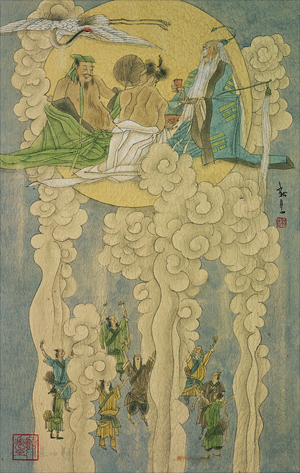
The painting Laoshan Daoshi is one of the artist's favorite works Photos: Courtesy of Zhu Xinchang
Laoshan Daoshi (Taoist on Laoshan Mountain) is one of Zhu's favorite paintings on show. One of the most well-known stories from Liaozhai, it follows a young man who goes to learn magic skills from an immortal. The story has been rendered in paintings before, usually depicting the man trying to show off by passing through a wall only to end up with a bleeding head. However, Zhu chose to depict an episode from the story in which the immortals drink amid clouds in the sky with the apprentices on earth looking up at them.
If visitors examine Zhu's paintings carefully, they may find some traditional folk art elements in his works, for instance, patterns from paper-cutting as well as patterns usually found on porcelain.
The houses featured in the paintings resemble the houses in Shandong Province where Pu Songling lived. Zhu paid a visit to Pu's former residence and his tomb last summer, which had a huge effect on how he approached painting Pu's stories.
"Before the trip I painted his stories out of sheer interest, but after that I was touched by Pu's spirit and felt like I could relate to his stories," Zhu told the Global Times. After the visit, Zhu abandoned 20 paintings he had already completed before the trip. "The previous pieces focused more on composition and color. But after the trip I wanted to focus on how to convey the characters of figures through their postures and the overall atmosphere created in the painting," said the 59-year-old, who said that he also applied Western methods of painting. "Although they are ghosts featured in the stories, you always feel that they are kindhearted human beings with integrity and honesty," added the artist, whose views on the book changed during the course of painting.
The 120 paintings by Zhu are also included in a newly published book with the original stories from Liaozhai. Mo Yan, the Nobel Prize-winning writer, wrote a prelude for the book.