Gentle fighter
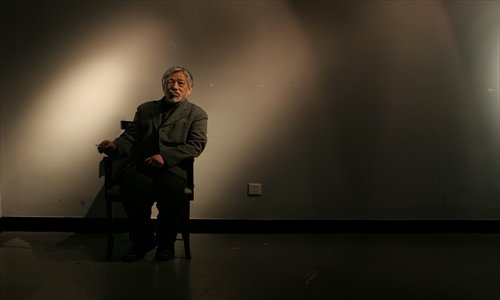
Li Xianting Photo: IC
Almost everyone who has been keeping an eye on the Chinese art scene might have heard about Li Xianting.
He is called the godfather of Chinese contemporary art. He is a curator and art critic who has actively engaged in the discussion of Chinese art, coming up with new interpretations and interesting comparisons of concepts such as cynical realism and political pop in the last century.
He is seen as a leader and mentor dedicated to helping and promoting young artists. His name is often mentioned along with the most successful artists of the first wave like Fang Lijun, Wang Guangyi, and Yue Minjun.
In recent years, the name Li Xianting has regularly made headlines due to a number of events organized by his film fund, established in 2006 during the first Beijing Independent Film Festival (BIFF), which was originally derived from a forum held by Songzhuang Art Center, where Li was a former director.
The film fund later launched Li Xianting Film School in 2009, inviting international academic professors as well as industrial experts to train perspective young filmmakers.
As many of the films selected by the BIFF do not go through the censorship process and the film school operates as a non-profit organization instead of an official school, people working there sometimes face pressures from local authorities when it comes to film screenings or other big events.
Despite the difficulties involved, Li continues to hold a placid attitude toward these things. In his words, it is just the basic fighting mode of an artist in his daily life.
Bonded with the country
Born in 1949, most events Li has been through are related to the social climate of China.
At the age of eight, Li's family encountered the Anti-Rightist Movement (1957-59). Then there was the involvement of family relatives in the Four Cleanups Movement in 1963. During the Cultural Revolution (1966-76), Li was put into prison for 2 years for holding "different" opinions.
After being released, he became one of the thousands of people that were sent to rural areas to work.
Later Li's talent in art, mostly inherited from his father, a folk handicraftsman, helped him eventually get into China Central Academy of Fine Arts to study Chinese painting.
In the 1980s, everything had a new start. Li was closely involved in the development of new art in China.
He has been editor of several art magazines where he got to know artists who later worked on independent film production.
"I am the same age as the People's Republic of China, a few months older… Most people of my generation had similar experiences. I am just more loose-lipped," he said laughing.
As an art critic, Li does show his honesty and courage when talking about his views in history and politics.
Though words are penetrating, unlike those famous Chinese artists that are generally given a tag of being political in some ways and show anger or a profound disappointment toward the society in their works, Li is more polite and rational.
He has a concept: little environment, which means that instead of complaining about the environment, it is more useful to calm down and work on the things that need to be done.
"Every little environment coming together would make a change for the big environment. As we have so many creators, it would be the growing up of a culture," Li told the Global Times in a face-to-face interview.
Independent and real
As many of the independent films and documentaries portray the dark side of society - focusing on conflicts related to demolishing buildings, earthquakes or gay couples - they are seen by many as not having a very helpful effect on the public.
Li finds that there is a misunderstanding of the concept "independent."
Independent filmmaking is now a global concept, which refers to an alternative film culture and production process that abandons the Hollywood-styled industrial chain. Here in China, another ideology was added suggesting that they do not serve mainstream values.
"Even if they touch sensitive issues, it's more about self-expression and it emphasizes realness. We have too many 'documentaries' that are fake," he said.
Zhang Tengfei, a former student of Li Xianting Film School told the Global Times the people teaching and working on independent filmmaking are actually very much connected to the mainstream commercial film industry. "They just dare to play," said Zhang.
Persistent pursuit
Chinese art has experienced a booming market in recent decades. Arts now face as much commercial pressure as political pressure.
Li sees commercialization as a certain result, but it is essential to separate the art market from the process of creating an artwork. Artists need one platform for academic communication and another to make a living but should not be "kidnapped" by business or politics.
When an artist finishes his work, the piece belongs to society. "Just as a commercial product or whatever is not the business of an artist, we artists are not qualified to judge if the commercialization is appropriate," he said.
The development of Chinese contemporary art goes ahead of the other art forms in the world. The diversity is also comparable with more developed art industries in the rest of the world.
The biggest difference, according to Li, lies in the environment and the public's knowledge and interest in art. Real culture needs sophistication.
Yet the whole trend is to become more open, China has been continuing to come back to common sense. "It is sad that a nation has been in enlightenment over and over again through time," said Li.
Thus, it is the everyday mode of an artist to fight for freedom and change. Even if the political environment is totally loose, artists still face challenges from the public because avant-garde art is a rebellion to the traditional aesthetic habit.
For Li, a real artist emphasizes an expression of a unique feeling, standing out from usual aesthetic language. "Without a free heart, there is no way to liberate imagination."