Pingtan: voice of Jiangnan
Dressed in casual clothes rather than the long Chinese gown worn for performing, Gao Bowen, deputy president of Shanghai Pingtan Troupe, does not appear at first glance to be an inheritor of a traditional art form. However, when he sits down and begins to talk in a mixture of Shanghai and Suzhou dialects, the subtle sound and choice of words reveals that this 41-year-old man is definitely a Pingtan performer, devoting his life to the old but lively intangible heritage.
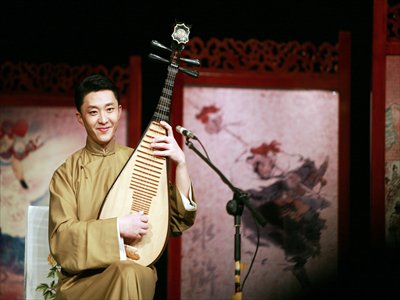
Gao Bowen, deputy president of Shanghai Pingtan Troupe, performs the traditional art form. Photo: Courtesy of Gao Bowen
Pingtan, originating in Suzhou, Jiangsu Province, is a typical art form performed in the local dialect, that was once popular in southern Jiangsu and Shanghai. The history of Pingtan traces back to the Ming Dynasty (1368-1644). Pingtan combines pinghua, or storytelling, with tanci, or singing ballads. Two performers playing the pipa (four-stringed Chinese musical instrument) and the three-stringed lute tell a long story in the Suzhou dialect by singing, talking and joking. Performances are held in shuchang, a place where audiences drink tea and chat with friends when listening to Pingtan.
Golden age
"During the golden age of Pingtan, every small town in southern Jiangsu and Shanghai had a lot of shuchang where Pingtan performers sang and told stories. People often spent a few days here listening to a long story like The Pearl Tower. It was an indispensable part of life along the Yangtze River," Gao told the Global Times.
Born in the 1970s, Gao grew up at a time when Pingtan enjoyed popularity in Jiangsu and Shanghai. Famous Pingtan performers were treated like today's pop stars. It was in the small shuchang that a young Gao became enamored with the delicate art form. When he was in senior high school, he went to Shanghai Traditional Opera School to learn Pingtan from the famous performer Yao Yicheng.
At the end of the 1980s, attracted by Western culture and the idea of overnight success, many traditional art performers including Pingtan learners gave up their careers and jumped into the wave of getting rich quick. "There were 10 students in my class at that time, but only I stuck to Pingtan. The other nine just left," Gao recalled.
The situation got worse in the 1990s. Other traditional arts like Kunqu Opera also disappeared from sight and were brought to the edge of extinction. "It is a sad but irreversible truth that the traditional pastoral lifestyle has gone forever. Pingtan, as a symbol of a slow and tranquil way of life, no longer suits the fast modern world. It is too luxurious for people to sit for days listening to a long story," Gao sighs. "The language has also changed. Many old ways of talking have disappeared. The young generation in Shanghai cannot totally understand the language now."
Every afternoon Pingtan performers from Shanghai Pingtan Troupe give performances in their shuchang on Nanjing Road West. "Loyal old retirees who have a lot of time on their hands come here and enjoy Pingtan every afternoon. Some of them even follow our tour to listen to Pingtan," Gao said. "But my concern is that we cannot just wait here until all the old audience members pass away. The challenge of building a new audience is extremely important not only for Pingtan but also for other traditional art forms."
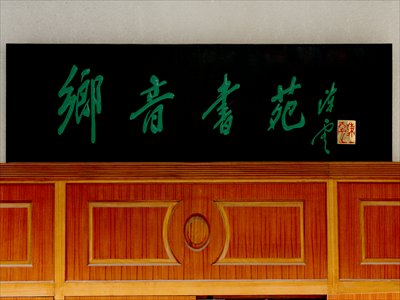
Shuchang
Updating the old art form
One of the most talented Pingtan performers of his generation, Gao is the sixth generation inheritor of The Pearl Tower, a classical story which is so long that it takes several days to finish telling it. Confronted with the responsibility of inheritance, Gao never stops looking for new ways to update the old art form. He recently staged a performance at the Chang'an Grand Theater in Beijing, which assembled many of the most talented Pingtan performers of this age accompanied by the Shanghai Philharmonic Orchestra to create a unique effect. With the music of Pingtan played on Western classical instruments, the performance surprised many long-time appreciators of Pingtan; however, many people thought highly of the experiment.
"It is just one of the possibilities that I would like to try for Pingtan, but it is not the only right way or the future," Gao explained. It is not the first time that he has tried to do something different. In 2008, he mixed Pingtan with rock music and performed at Xintiandi, which drew considerable attention not only among followers of Pingtan, but also from the public at large. "If I want Pingtan to be performed in a particular place like Xintiandi, I have to change it to match the occasion. But it is not the way that can be followed in future," he emphasized. "We have to admit that it is a good way to gain a new audience."
Although these trials of innovation are sometimes faced with questions and criticisms from experienced Pingtan watchers, Gao believes the experiments represent possibilities for Pingtan to evolve. "The audience will not leave Pingtan because of these experiments, successful or not, they will always support Pingtan. What I should do is to attract a new audience by any means possible. If just one person tells me that he or she is interested in Pingtan because of these experiments, I think it is the triumph I have been seeking for a long time," Gao said firmly.