Firmer stance on driver delinquency
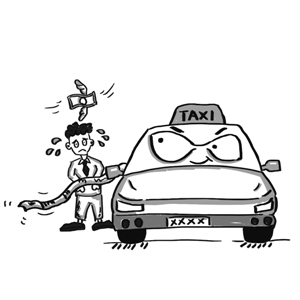
Illustration: Chen Xia/GT
It was recently reported that a local taxi driver surnamed Zhao forced a Japanese passenger to pay 2,300 yuan ($375.88) for a 4-kilometer ride in Pudong New Area in early August.
The victim got into the taxi near the Longyang Road Station on metro Line 2 and asked to be taken to the Okura Garden Hotel, a luxury hotel in Huangpu district.
While passing the intersection of Yanggao Road South and Pujian Road, Zhao demanded the exorbitant fare. To prevent the passenger from leaving, Zhao, who worked for Shanghai Mingtai Taxi Co, locked the doors and told the passenger not to call the police.
The passenger gave the driver 500 yuan that he had on him, but the driver still did not allow him to leave. The passenger had no choice but to hand over another 1,800 yuan worth of foreign currency.
The incident is another unfortunate case of taxi driver delinquency reported in local media.
A taxi driver was reported to have driven his car into a construction area while drunk, killing two workers and injuring two others, in July of 2011.
Earlier this year in February, another taxi driver reportedly drove his taxi after taking drugs. He shouted at a female passenger after she questioned the route he was taking. The driver also locked the passenger's 5-year-old nephew in the taxi after the passenger got out.
A 40-year-old cabbie surnamed Wu injured two police officers after using methamphetamine on May 15 in Jing'an district. Wu hallucinated that someone wanted to kill him and attacked the two officers when they found him with a knife.
Although taxi companies are currently struggling to recruit drivers, it is of vital importance that they first ensure that all the drivers they hire are qualified and responsible.
When reports of delinquent or dangerous drivers emerge, local media generally only give the surname of the driver and do not reveal the name of the taxi company that the driver works for.
Media should report the full name of delinquent drivers and the taxi companies, and make public the driver's punishment. Taxi companies should be rated in local newspapers or online, where the misbehavior of the company's drivers is exposed.
A rating system will help to hold taxi companies accountable as it may influence passengers' choices, and encourage companies to take further efforts to improve their management of drivers.
In the rip-off case that happened last month, the transportation authority temporarily revoked the driver's operating license and required him to return the money to the passenger.
This is a very light punishment indeed. The driver is merely forbidden from driving a taxi for five years and escaped without a fine.
The transportation authority said in July that it started to implement a new regulation on April 1 this year to keep credibility records of taxi drivers. Taxi drivers' credibility will be ranked by four levels according to their scores.
Points will be deducted if the driver breaches rules and added if the driver behaves well. The driver's operating license will be revoked for five years if he or she is given the lowest level rating for two consecutive times.
The taxi driver credibility record should also be integrated with the municipal individual credibility system. This would mean, for instance, that a taxi driver with a bad credibility rating would not receive financial support even if he or she comes from a low-income family. Taxi drivers will hesitate before breaching the rules if their misbehavior will have a long-lasting impact.