Polluting children
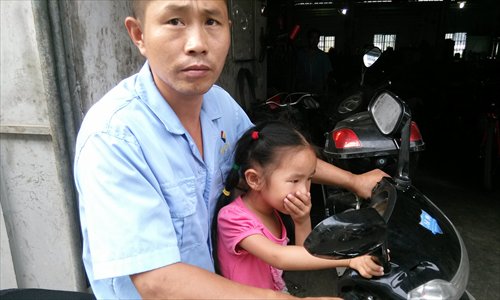
A girl covers her nose while passing a factory near the No.9 Primary School of Beibaixiang township in Yueqing, Zhejiang Province, on September 6. Photo: CFP
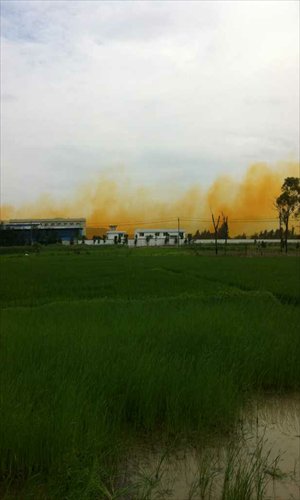
Yellow smoke rises from the factory of the Dongfang Plating Company in Yueqing in March. Photo: CFP
Ni Fengzhi (pseudonym) has refused to let her daughter go to school at Beibaixiang township in Yueqing, East China's Zhejiang Province, for the last two days.
Her daughter was released from hospital on Tuesday, one day after the No.9 Primary School moved back to its old location. Since September 3, the 1,200 students of the school had been studying at a new campus just one kilometer away from the old one, but on September 4 and 5, Ni's daughter was among 100 children who suffered from chest pains and vomiting. Another 19 suffered from nosebleeds and nausea.
The school suspended classes and authorities were quick to offer free checkups, but Ni is still suspicious.
"Although the school asked parents to allow our children to go to school, I can't agree before my daughter finishes a comprehensive checkup," Ni told the Global Times on Tuesday. "My daughter's health is more important than anything."
The case is under investigation, but many parents and local residents, who have been campaigning against the plethora of chemical companies nearby, believe these factories - often operating illegally without licenses - are the cause of the sickness.
Sick kids, scared parents
Ni is one of many anxious mothers in the town. Zhao Xia (pseudonym), another mother, did not know what she could do after she was told by the local hospital on Friday that scans of her 10-year-old boy showed a "shadow" on his lungs and that he had an unsteady heartbeat.
"The doctor said these were caused by pollution," Zhao told the Global Times. "My son has started coughing and uses his hands to beat his chest. I'm so worried about him."
The old campus was becoming crowded and worn down, and the facilities were lacking. But Zhu Qiming, the school principal, had no way of anticipating that the new campus would prove so much worse.
According to Zhu, the new campus address was selected in 2008, when there were few chemical factories near the school. It is close to a high school and there hadn't been any reports of health problems among the high school students.
But now, within a kilometer of the new campus, there are dozens chemical factories and workshops. Among them, the emissions of at least 39 enterprises hadn't gained any approvals from the local environmental protection bureau, and six were being run without a license, the Xinhua News Agency reported.
By Tuesday, 13 of 21 entirely illegal buildings had been demolished, and local authorities had cut electricity to 39 enterprises to facilitate their demolition, a local official told the Global Times on Tuesday, who wished to remain anonymous, saying that now the local government doesn't allow staff to comment without approval. The official said the bureau has sent specialists to monitor air quality in the school and enterprises and the relevant samples have been sent to the bureau.
"Before the final results come out, we can't confirm that the students' symptoms were caused by pollutants from these enterprises," the source said. Another official from the town government told the Global Times that there could be many reasons for the nosebleeds and nausea, especially in August and September, when summer ends and autumn begins.
However, Zhao Zhangyuan, a research fellow with the Chinese Research Academy of Environmental Sciences, told the Global Times the incident was almost certainly caused by pollution given the large number of people affected in a short time.
"The incident is not like food poisoning. It should be judged from the density of pollutants in the air and water around the school," Ren Zhijuan, a doctor with the Zhongshan People's Hospital in Guangdong Province, told the Global Times on Tuesday. "The final investigation results carry more weight than any simple assumptions."
The Yueqing government said that on Monday, 19 of the students who had experienced nosebleeds had returned to school, however a report in the Hong Kong-based Wenweipo paper said that on the same day, three other students suffered from nosebleeds and one fainted.
The Global Times also contacted Wang Xueliang, the head of Yueqing education bureau, in regard to the nearby high school, which locals say mostly teaches children of migrant workers. Wang said students there had experienced bad smells but none had reported health problems, then he hurriedly ended the call saying he was at a conference.
Finding the poison
According to preliminary investigation results published by the Yueqing government on Friday, local authorities have found chemicals including benzene and toluene in painted steel bars in the school as well as in a storeroom.
They also found chromic acid mist exceeding legal standards at the local factory of the Dongfang Plating Company, which processes various metals for metal coatings.
Environmental experts point out that plating companies are often associated with pollution. "Plating factories can easily exceed the standards for heavy metal emissions, which can affect the nervous system or cause blood diseases," Zhao Zhangyuan said. But both the school and the company said these were irrelevant to the issue, the Guangzhou-based Nandu Daily reported Monday.
With 40 workshops, the Dongfang Plating Company was founded in 2007 and is the biggest of its kind in the town. Its operations were suspended on Friday. A staff member from the company told the Nandu Daily that the company had "treated the waste gas properly."
In regard to the school, principal Zhu pointed out that no students had been close to the bars or the storeroom.
There are also several other plating companies in the area, according to Ge Ping (pseudonym), a father of a 10-year-old child.
Ge was skeptical of the investigations, saying that the authorities heavily monitored the new campus but the inspections of nearby factories were limited. "The authorities are reluctant to investigate enterprises with serious pollution, which would cause them trouble," Ge said.
Other parents said that the authorities just tore down illegal buildings that were responsible for minor pollution, and avoided heavy polluters, but the source with the local government disagreed. "Evenly distributing monitoring stations is a specialized task. We chose the spots according to the pollution and are monitoring enterprises every day."
As the town is close to the Oujiang River, many chemical industries chose the location so they could discharge waste into the river directly.
Protests against pollution have already occurred in the town. Residents have lodged appeals with the local government over environmental issues, and had some success in August, when the Rosi Chemical Company, a Zhejiang-based company, announced it would relocate its local premises within three months.