Amazon fever in Roraima
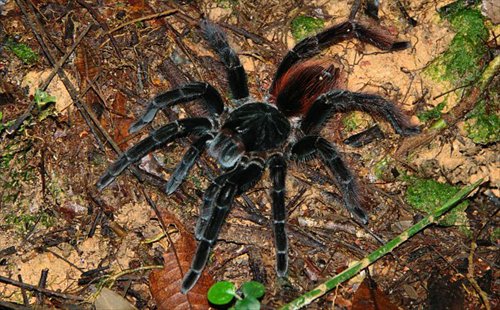
A juicy tarantula Photo: Chris Dalby/GT
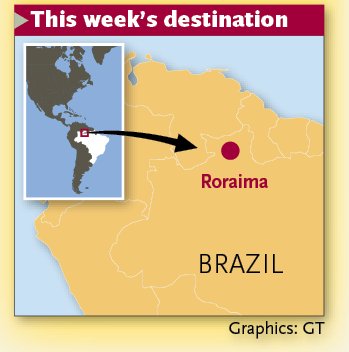
This week's destination
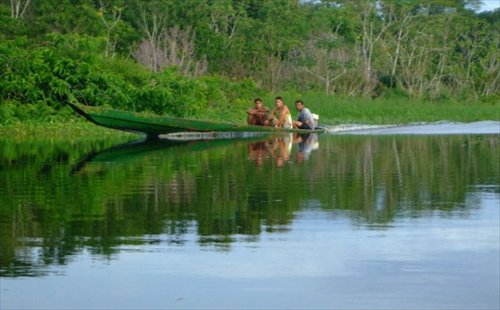
Fishermen relaxing along a river in Roraima. Photo: Chris Dalby/GT

Former Brazilian president Luiz Inácio Lula da Silva (center) participates in celebrations for American Indigenous People Day at Raposa Serra do Sol reserve in Uiramuta, Roraima in 2010.Photo: AFP
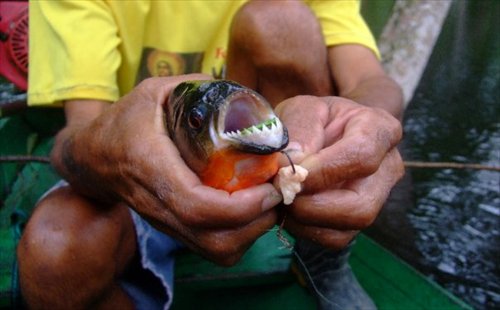
A piranha catch Photo:Chris Dalby/GT
Tucked away in the very northwestern tip of Brazil, the state of Roraima is so remote that even the former president of Brazil had not visited it before 2009 (Luiz Inácio Lula da Silva made his first trip here two years before completing an eight-year term in office).
It exists almost as a bridge between Guyana and Venezuela, nestled against the tepuis, the flat-topped mountains made famous in Pixar's movie Up. It contains a major reservation that houses a number of tribes, including the Yanomami and Macuxi. Many of their members have migrated to modern villages but some still pursue a very traditional and isolated way of life. Rumors of as yet undiscovered tribes and continued practices of cannibalism have flourished in recent years but, if true, take place in very small numbers.
Flying into the capital Boa Vista, a peaceful and only moderately interesting town of 300,000 people, is really the only way of getting there. The town has decent road links to Guyana and Venezuela but is only connected to Manaus, the nearest large city, by 780 kilometers of rugged tracks and a few tarred sections (11 hours). No matter how big a road trip aficionado you think you are, this may be a bit beyond you. The Amazon rainforest here is one of the most well-preserved in the province, making it a real treat for those adventurous enough to commit to the trip.
Having gone to Boa Vista for an interview, I found myself with two days to kill. Deciding not to miss the chance of exploring such a remote area, I phoned up the only travel agency I found in Boa Vista. It is clear that most of their foreign clients booked trips to Venezuela to climb the tepuis. Few wanted to book trips to the immediate vicinity. Finally, they hooked me up with Bernardo, an affable and experienced tour guide, who had done some local tours of the rainforest.
A curious ride
After picking me up in his battered 4x4 very early on the first morning, we trundled off down a nice tarmac road leading to the forest. I inquired why this road was so modern when land links to the rest of Brazil were not. He explained that Roraima had once been the site of a massive gold rush in the late 1980s. Prospectors had flooded in, building small villages to cater to their needs while also erecting ramshackle shacks next to rivers, seeking to strike it rich. An airstrip was even built to fly goods and materials in. Unfortunately, all too few succeeded in finding any real quantity of gold and the region fell into abandonment.
We passed a few of these run-down shacks as we drove deeper into the small parched strip of land that separates the town from the rainforest. As we passed one river, I stopped to take a picture of one of the shacks just as a rail-thin, old man stepped out. He was one of those prospectors who had risked everything on the gold rush, and despite having struck out, continued to eke out a living in this inhospitable environment, praying for an ever out-of-reach pay day.
Just past this shack, a moving black shape on the side of the road caught my eye. Bernardo told me that it must be vultures feasting on something. We drove by them slowly and indeed, four huge black-winged vultures were devouring the carcass of a horse that had fallen there. It must have been somewhat fresh; the body looked fine but the skull had been picked clean by scavengers - its teeth frozen in a rictus of death. Not the most charming sight for a tourist, but a strong reminder that humans are not the masters here.
Eventually, the road ended near a huge rock formation, but I was unable to see any forest. Bernardo bade me be patient and we marched off, equipped with backpacks, mosquito repellent, ample water supplies and two machetes. We walked about three kilometers, through the mass with rocky pieces jutting out this way and that, and just as I was growing impatient over where the rainforest was I heard an eerie background noise.
We rounded a corner and my senses were assailed by a cacophony of sight and sound. The edge of the Amazon rainforest, one of the greatest spectacles in nature, was sprawled out in front of us. The noise I was hearing came from a pandemonium of macaw parrots, just starting their day. They were perched too high up to distinguish clearly, but occasionally, we saw a quick red or blue flash above us.
The Roraima way
Tales of the Amazon wildlife can seem dangerous or fantastical, but this introduction to the forest took my breath away.
Entering deeper into the forest, it was clear that were only a few tracks for humans, which were not frequently used. For the first few kilometers, Bernardo's expert machete cuts were enough to push back the encroaching flora but pretty soon, even walking behind him, I was forced to hack a passage through as well. Much of the day passed by in a blur. As overwhelming as the sheer majesty of the Amazon was, I was eventually unable to shake off a sense of creepiness. Never before had I been in an environment so alien, and while it didn't feel hostile exactly, the certainty of never finding my way out if I lost Bernardo was anything but reassuring.
Noticing that I was beginning to tire, Bernardo rallied and began showing me some of the hidden aspects of the forest. Rejecting my offer for mosquito repellent, he ripped a chunk of bark from a nearby tree. Underneath, a flurry of big red ants crawled everywhere on the trunk. Grabbing a handful at a time, he crushed them and spread them on his naked torso and neck, leaving a pale red paste over much of his body. Noticing my slight shock, he quipped "Roraima way of doing things. You'll never get stung."
A massive arachnophobe, I took a minute to inquire about the likelihood of coming face-to-face with one of the hairier and larger members of Shelob's brood. Bernardo said that it would be hard to see one out in the open, but asked if I wanted to try. I absolutely did not. Yet something (I still have no idea what) possessed me to enthusiastically answer, "Sure!"
Walking a few yards off the relatively beaten track, Bernardo rooted around for a bit with a large stick before calling me over. At the foot of a large tree, several round holes were dug into the ground. Telling me to watch carefully, he jabbed the stick inside and poked around for a bit. After twenty or so seconds, he slowly raised it out. At the end, several legs wrapped around the stick proved to be those of a large tarantula.
Though we were clearly intruding on its territory, a tentative curiosity swept over my fears - but I stopped short of taking the stick from an encouraging Bernardo. I snapped a few photos before Bernardo gently placed it back in its hole, leaving the stick as a farewell present.
Natural wonders
Seeing wildlife in this thick jungle during the day was highly unlikely, but the views soon made up for it. On the second day, we hiked along a dried out stream bed for about an hour, until we heard the sound of rushing water. We came across a small river, its flow quiet and sedate, which headed over a vast waterfall a few meters past us. Beyond the waterfall, the forest dropped and opened up, leaving a magnificent vista of trees as far as the eye could see.
Slightly fatigued, we cooled off with a dip in the river before sprawling out on a rock atop a waterfall, taking in the astounding majesty of the Amazon. Cawing its heart out, a red macaw burst from the canopy near me and flapped off into the distance, a perfect addition to the day.
Fishing a length of rope out of his bag, Bernardo spoke of four Swedes he had brought here a few months earlier. They had been enthusiastic about rappelling down the waterfall to a small rocky outcrop halfway down, and he imagined I would also be game. Unbecoming as it is for a Welshman to be outdone by a few Scandinavians, I passed on the offer that was a step too far outside of my comfort zone.
We stayed overnight in one of the few villages that survived the abortive gold rush, where I had entertained two fisherman by gawking at their catch of piranha. The car had stayed in place, and it was now sadly time to head back.
Driving toward Boa Vista, I thanked Bernardo profusely for his help and guidance. He simply replied that Roraima was being choked economically, with few tourists going there. He begged me to tell others about my time there and to tempt them to go themselves. Well, here you go, Bernardo.
Rules of Thumb
What to expect: Some trips around the Amazon are very easy-going and tourist-friendly. Roraima is not one of those, but it is a mesmerizing assault on the senses and a chance to see one of the last untouched parts of the rainforest.
When to go: The rainy season runs from January and or February to May, but a visit at the start of summer or early autumn will see absolutely charming weather.
How to go: As mentioned, the only easy way to get there from within Brazil is to fly from Rio de Janeiro, Sao Paulo, Brasilia or Manaus.