Imperial intrigue for the Internet age
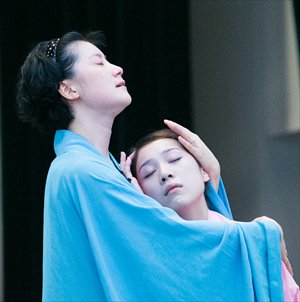
A rehearsal photo from the opera
Since the end of 2011, Liu Lianzi, the pseudonym of young Chinese writer Wu Xuelan, has become a household name in China thanks to the huge popularity of a TV adaptation of her Internet novel Legend of Zhen Huan. It is a story depicting the overt and covert struggles between an emperor's numerous consorts.
The main storyline follows the eponymous Zhen Huan as her circumstances, and eventually her character, change when she is selected to be one of the emperor's concubines.
In Liu's original fiction, the whole story is independent from any particular time or place, but leaves the reader space for imagination.
However, in the TV adaptation, which is reportedly in talks to air in the US, the story is set during the reign of the Yongzheng Emperor (1722-1735), the fifth ruler of the Qing Dynasty (1644-1911). The plot unfolds around the emperor and the concubines in his imperial palace.
"Although I understand that a TV drama is different from a literary work, because it needs to be more specific," Liu said, "it is still a pity for me that the story was limited to a certain era in the TV version."
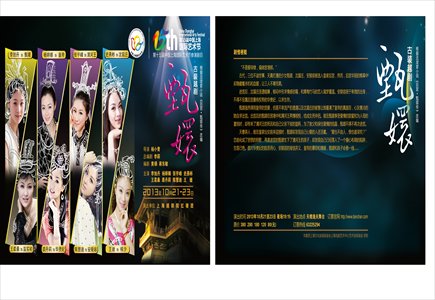
A poster for the opera Photos: Courtesy of Shanghai Yueju Opera Troupe
However, when Liu read the script for a Yueju Opera version of her novel, she found herself unexpectedly riveted by the adaptation.
"I felt very excited when I discovered my original idea was restored in the script of the Yueju Opera version," she said at a recent press conference for the Shanghai Yueju Opera Troupe's (SYOT) production of Legend of Zhen Huan.
Huang Yan, SYOT's lead writer and the driving force behind the Yueju script, explained to the Global Times that there were two reasons they didn't set the plot in a particular time period. Firstly, like Liu, they wanted to leave the setting up to the audience's imagination.
"And secondly, I don't want the Yueju Opera performers to wear flowerpot shoes on a traditional Chinese opera stage," Huang said, referring to the high-platform wooden shoes shaped like a horse's hoof that were worn by the Manchu women of the Qing Dynasty. "Otherwise Yueju Opera's elegant body movements and actions can't be freely shown."
Early this year, after reading Liu's original novel, Huang and her team agreed that it was a work suitable for being adapted into a Yueju Opera play.
"Although it describes the power struggles between the concubines of an emperor, it is in fact full of rich and touching human emotions and the fates of the characters, which are the basic qualities of Yueju Opera," Huang said. "And of course, a romance between a man and a woman is also included in the original work, which is also another important element of Yueju Opera."
Huang said that on the Yueju Opera stage, the basic plot depicting the intrigue and rivalries between the concubines will be minimized, and instead, more attention will be paid to shaping the characters' inner thoughts and emotions.
Several years ago, when Liu's literary work was still being serialized online, the 24-year-old Yueju Opera performer Li Xudan and her young colleagues at SYOT were among the large number of readers following the story as it unfolded on the Internet.
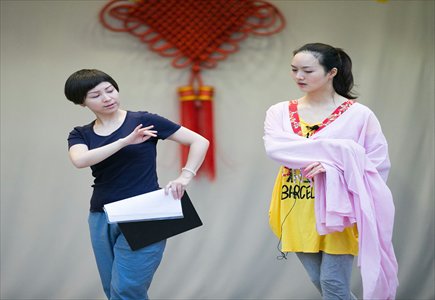
Wu Jiasi (left), deputy director of the Yueju Opera Legend of Zhen Huan, demon-strates a pose during a rehearsal.
Naturally, Li was delighted to get the opportunity to play the main character in her own profession - Yueju Opera. She plays a green, young Zhen Huan, who is ready to be selected into the imperial palace as one of the emperor's concubines.
Another performer will play an older, savvier Zhen Huan, who joins the palace intrigue and machinations after spending some time learning the ropes.
"For me, I need to shape a more innocent and naïve Zhen Huan at the very beginning in order to show a contrast to the later Zhen Huan, whose personality has changed a lot," Li said.
Huang told the Global Times that they wrote the librettos to match the style of the original novel, and also at the same time, evoke the classical beauty of ancient Chinese literature.
In spite of this, Huang believes that contemporary Yueju Operas have changed considerably from traditional ones.
"At least, for myself, my creative process has begun to be deeply influenced by today's popular culture, like Hollywood films, and also American, Japanese and Korean TV dramas," Huang said. "And I believe that being connected to popular culture is also a way for traditional Chinese operas to survive and develop today."
The first half part of the Yueju Opera will be premiered at Yifu Theatre on Fuzhou Road from October 21 to 23 as part of the 15th Shanghai International Arts Festival.