‘Alien’ style, human message
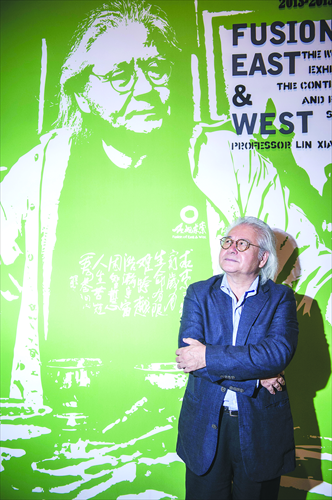
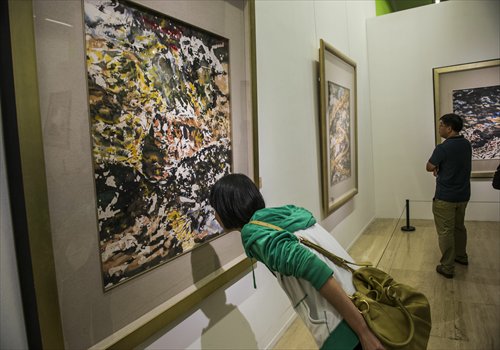
Lin Xiangxiong (top) blends abstraction, traditional painting techniques and modern social commentary in his art (below), which is on display at the National Art Museum of China until Tuesday. Photos: Li Hao/GT
At first glance, there's something both familiar and foreign about the paintings of Lin Xiangxiong, no matter whether you come from an Eastern country or have a Western background. Look closer and you will discover where such feelings come from: They are Western, abstract paintings about modern times and people, yet they are brought to life with traditional Chinese wash painting that uses brushes and ink on rice paper.
Such a hybrid of techniques is the signature of Lin, a contemporary Chinese-Singaporean artist.
Late Singaporean artist Liu Kang said of Lin's work in 1993, "If one intends to trace the origin of [Lin's] painting, one may see hints of Shi Tao, [Wu] Changshuo, [Qi] Baishi, and [Pan] Tianshou, but in reality they are not. His painting also suggests a touch of the Western modern art of Pollock and de Kooning, but this is also not totally true."
But if Lin's artworks were only a combination of East plus West, he would not have received the respect from other artists that he does now.
Lin is not an artist who only highlights the beauty of nature. Many of his more recent pieces tackle topics such as the hardships of the lower classes, modernization and war.
"You are not only a true artist but more importantly a generous person with a golden heart," wrote Eric Messerschmidt, president of the China chapter of the European Union National Institutes for Culture, in an e-mail to the artist shared with the Global Times.
Now, a group of 99 paintings, which Lin completed between 1990 and 2013, has started a world tour that will last until 2015. Titled Fusion of East & West, the exhibition that opened September 9 will travel from continent to continent after first showing in Chinese cities like Beijing, Shanghai and Zhengzhou, Henan Province.
His own style
Lin's artistic career has spanned more than five decades now.
Lin first chose to use brushes and rice paper for his paintings in the 1970s, "but the composition and perspective are still Western," Lin said.
In the very beginning, Lin told the Global Times in an interview, it was hard for people to accept such pieces.
"They are not purely Chinese, nor Western. They are alien beings," Lin said. "Such way of painting has no [precedent]. This is not passed down from a renowned teacher."
Lin began to pay attention to social problems in the 1980s, exploring what he calls "the conscience and responsibility of an artist."
"As an artist, one has such a short life and so limited power to change anything. ... But with through his art, an artist can record some of the real history and raise awareness," Lin said.
So in his Roughing It out in Street for the Rest of Their Lives (2008), Lin shows a number of workers in Southeast Asia having no home but the streets, and in Whence? My Home? (2012) a group of refugees struggles to find a home.
Lin believes his art can be understood by Western audiences as well, not only because the imagery he employs, like factories and skeletons, are understandable to all, but also the messages in his paintings are universal.
A Christian who is at the same time deeply influenced by Taoism and Confucianism, Lin finds there are many commonalities between the beliefs.
Multiple identities
Lin has many titles - artist, researcher, entrepreneur and social activist. Yet, in his own words, "the ultimate goal of all that I have done is for art."
After achieving a name for himself in France, Lin went back to Singapore, where he found himself stuck between a career in teaching or commercial art.
He chose instead to do business that had little to do with his art as his own way of keeping his art pure. He invested in mining, building materials and home decorating.
Later he founded the Global Arts & Culture Society, and worked to set up foundations to help kids in China's rural area receive education.
Taking on different roles has helped Lin's art, giving him a broader view of society and "plenty of material for creation," he said.
Returning to Chinese roots
White haired but still vigorous, the 68-year-old artist was born in Shantou, Guangdong Province. Lin left China at age 11 to look for his father in Singapore after his mother died during the harsh time of the Land Reform Movement in the 1950s. "My life was exchanged with my mom's," Lin wrote in a preface for a collection of his paintings.
However, Lin has no hatred toward his homeland or its people.
"As a Chinese born in this time period, it is both fortunate and unfortunate," Lin emphasized. "No one is able to change the time."
Lin feels a strong tie to China. He described it as a Chinese cultural gene planted deep in his heart. His art is not typically Chinese, and neither is he, yet he is still accomplishing a Chinese dream.
A stronger feeling toward China rose when he was living and painting in France several decades ago.
"When one lives further [away from his homeland], then there are stronger feelings of longing," Lin said.