Back on stage
Source:Global Times Published: 2013-9-23 18:33:01
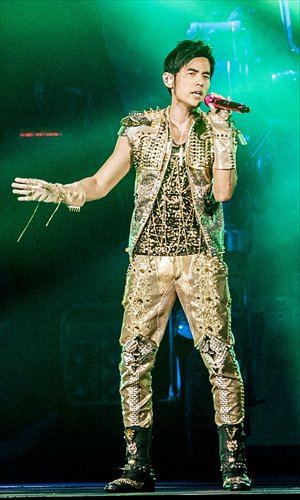
Taiwanese singer Jay Chou performs in Taipei earlier this month with a virtual version of the late Teresa Teng (below). Photos: CFP
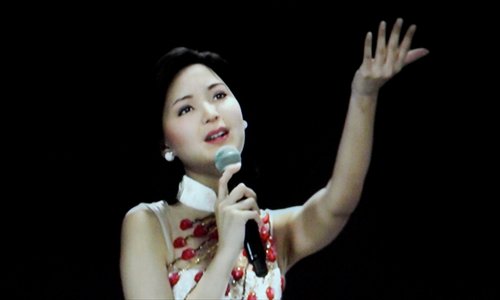
A virtual version of the late Teresa Teng Photo: CFP
Seeing the "return" of a deceased loved one is no longer as whimsical as the idea once seemed.
When late rapper Tupac Shakur came back to the stage - thanks to 3D technology - and joined Snoop Dogg, Dr Dre and a bunch of other singers for a live performance at the Coachella Valley Music and Arts Festival 2012, audiences were shocked.
Though using the voice and footage of a deceased vocalist to make it appear as though he or she is performing on stage had been done before, never had it been done so in such a lively and believable way.
The technology that creates the illusion of making a deceased person appear as though he or she is still alive has recently made waves in Asia, giving Chinese audiences the chance to see their beloved singer Teresa Teng once more.
The Taiwanese singer showed up at a three-day concert in Taipei as part of the Opus Jay Chou 2013 World Tour early this month - some 18 years after her death. For the 11,000 fans in the audience, seeing virtual Teng singing her famous songs with Chou, one of the most iconic Chinese pop singers of today, was a crowd favorite, according to a report on 163.com.
Teng sparkles
The article on 163.com describes a scene with Teng slowly rising from the stage, "wearing a white qipao and singing her old songs, looking as beautiful and elegant as ever."
After singing her song "Ni Zen Me Shuo," she sang two of Chou's songs with him, "Hong Chen Ke Zhan" and "Qian Li Zhi Wai." Fans sang along, and even Teng's brother, Deng Changfu, who was in the audience, was also clapping and singing along.
Chou said after the show that he felt as though Teng had really been there with him. In a media interview during a celebration party after the concert, he said that it was a humbling cooperation as many singers have always dreamed of performing with Teng. He made the dream of singing with Teng come true, and moreover, Teng sang his songs.
"I think the audience was stunned. 'Wow, it's awesome,' seemed to be the reaction," said Chou.
One fan told the media after the concert, "I kept asking the staff, where did you find an imitator who looked so much like her? Then I found out they did it by using computer technology to make virtual images. I couldn't believe how real she looked!" the fan said.
The five-minute clip of the performance spread widely and rapidly online, with millions of viewers watching it within 24 hours after it went viral - and about 45 overseas media outlets covering the story, according to an article on qq.com. Viewers praised the work, saying that it was both sincere and entertaining.
Some viewers said that the ending, when the image of Teng scatters and disappears into a night sky of sparkling stars, was the most touching moment. One Net user said, "Although I knew it wasn't really her - when she disappeared I still couldn't help but burst into tears."
Behind the scene
The wonder-maker was Oscar-winning digital production company, Digital Domain, which first proved it had what it takes to get the job done when they stunned the world at Coachella 2012.
Steve Preeg, who won Best Visual Effects at the academy awards in 2008 for The Curious Case of Benjamin Button, headed up the project - the company's first try at producing a Chinese idol - as the visual effects supervisor and animation director.
Producing a virtual figure requires an artful eye in addition to the knowledge and application of a series of complicated techniques. To reproduce a real-looking version of Teng's body, spirit and voice, the team made hundreds of revisions before a slew of tweaks and adjustments came down during the two-month process.
Preeg also admitted that unfamiliarity with Chinese made it even more difficult to synchronize the mouth's movements to match Teng's voice, according to 163.com. The other big challenge was making the singer's hair appear natural - a detail that involved at least 7,000 images - and imitating the movement of each and every strand of her hair.
In qq.com's article, animator Tom Stamand regards capturing the "soul" of Teng as the most significant responsibility. He said that producing a "real-life person" has monstrous challenges that differ from creating big, scary creatures. The hardest aspect for him was creating an exact replica of Teng that included her vitality in a manner that convinced audiences.
Preeg said that the team tried to pay tribute to Teng with their creation, adding that they hoped her virtual avatar would trigger warm memories of Teng for fans.
Though the attempt was largely praised, Digital Domain has said that there is still much room for improvement. The company said it aims to come infinitely closer to the real prototype by the end of next year when it shows a virtual version of a mystery celebrity - with "hopefully" perfect actions and facial details.
Dreams come true
Preeg went on to say that the 3D virtual image reconstruction technology, which has brought back classic superstars like Teng, is challenging traditional modes of entertainment and bringing unprecedented entertainment experiences to audiences while leading new industry trends.
In fact, the "revival" of a deceased star as famous as Teng has already led some fans to expect even bigger and better appearances. Some Net users even have their fingers crossed on the virtual Teng holding some of her own concerts.
Others said that the technology applied to karaoke could make the wildest dreams of fans come true.
"Imagine singing along with Andy Lau as he stands right next to you - you'd never have to dream again about what it would be like to meet your favorite singer," said a Net user.
Posted in: Music