Galloping to glory
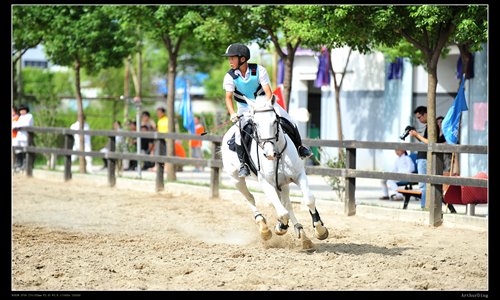
A young rider at the Shanghai Youth Equestrian Competition Photo: Courtesy of Shanghai Roborant Equestrian Club
The Shanghai Roborant Equestrian Club has returned to normal after the Mid-Autumn Festival and the 56 horses, who are the centerpiece of the club, are back home in their stables, resting quietly after a major outing. Two days ago, many of them were involved in the club's third Shanghai Youth Equestrian Competition.
The competition saw more than 130 contestants under 18 from 10 clubs taking part. The riders and horses had demonstrated their skills first in dressage, a series of elegant exercises and then show jumping, where riders and horses had to jump a series of walls, hedges and ditches ultimately within a time limit.
Equestrianism is growing in popularity in Shanghai as more people show interest in taking up the rather rarified Western sport. It will make its debut in the 15th Shanghai Games next year. The Shanghai Games, held every four years, is the largest city-level sporting event in Shanghai. To date, seven districts - Pudong, Qingpu, Songjiang, Minhang, Yangpu, Fengxian and Jinshan - have signed up for the equestrian events at the games.
Since it opened in 2009, the Roborant club, which can be found in the remote Pudong New Area, has seen interest in equestrianism flourishing.
Chen Jun is the club manager and explained that the club's horses fall into three types: imported, domestic and mixed. "The imported ones are mostly warmblood (middleweight) horses from Britain, Belgium and the Netherlands. They're also the most expensive and cost an average 1 million yuan ($163,388).
"Our domestic horses are all from Yili in Xinjiang Uyghur Autonomous Region. They are much shorter and smaller, not so suitable for equestrian competitions, but they have more stamina and endurance than imported horses and are more suitable for children and beginners."
The mixed breed horses have been bred from Chinese and imported horses at the club.
Worth a million
The costliest horse at the club is a brown Belgian stallion named Gucci. Born in April 2006, it stands 1.72 meters tall and cost its owner well over 1 million yuan to bring it here.
Buying a horse is just the start of the expenses. The hay feed for the 56 horses at the club costs more than 1 million yuan every year. As Shanghai does not produce hay, this has to be brought in from Inner Mongolia, Xinjiang and the US.
Another 1 million yuan is spent on grains, supplements and treats every year. A small tin of food concentrate, imported from the US, can cost as much as 2,000 yuan. "Because of the cost, we only give this to the best horses," Chen said.
It's no wonder that Chen admits that the club is struggling to balance its books. The club charges a 5,000 yuan annual membership fee and 300 to 500 yuan for a private 45-minute riding lesson.
"To be honest, the prices at Shanghai's equestrian clubs are considerably lower than the prices in Beijing or even neighboring cities like Hangzhou, some of which charge as much as 100,000 yuan for membership. The market is growing but it is still relatively small in Shanghai and we don't want to frighten potential customers away."
The club has about 100 members at present, but only 30 come regularly for riding and lessons. "Many signed up for membership but came once or twice and then stopped turning up. I guess they were just curious, but horse riding requires dedicated training and patience," Chen said.
He pointed out that most club members only came to the stables at the weekend. "But we need to feed the horses and train them every day to keep them in peak conditions. We can't turn them off like machines when they're not used."
In Chinese culture, horse riding is more associated with scenes of nomads riding wildly across grasslands and not aristocrats wearing jodhpurs, jackets, helmets and leather boots. "A lot of people have come here saying that they rode horses in Inner Mongolia and couldn't understand why horse riding required instruction. But after trying a basic riding lesson, they knew they were wrong," Chen said, adding that newcomers, children and the elderly can all enjoy riding as long as they take precautions. "The youngest member of our club is only 7, while the oldest is 60. Horse riding really doesn't have an age limit."
Twelve-year-old Chen Chen has been taking riding lessons for six months. He comes to the club every week or so. "I enjoy horse riding. It tests your balance, your reaction to emergencies and your connection with your horse. The longer you ride a horse, the more you learn. And I love horses. They're kind and docile," he said.
It is said that riding can also bring health benefits, boosting the cardiovascular system and easing stress.
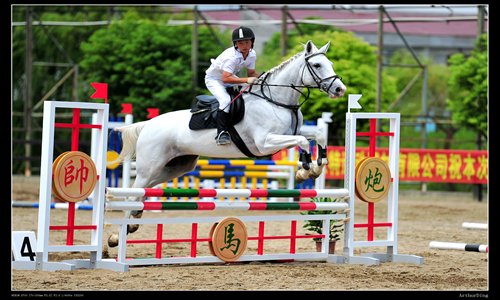
In the competition, the riders and their horses have to jump a series of walls, hedges and ditches within a time limit. Photo: Courtesy of Shanghai Roborant Equestrian Club
Well treated
Yang Xiao, aged 23, is one of the club's instructors. He comes from Jining, Shandong Province, and he began working with horses when he was 14.
A typical day for Yang sees him giving the horses food and water, cleaning out the stables, washing and brushing them and then training. It is his responsibility to see the horses are all treated humanely and carefully.
He is also a sort of horse psychologist. "Generally, horses are sweet-natured and docile. But changes in the weather, the environment and people can frighten or excite them, and that's when instructors need to step in and pacify them."
The best thing about his job, Yang said was hanging out with the horses. "Unlike human beings, horses are much easier to communicate with and they ease your worries. They trust you and rely on you, and that feels good. We have a saying that the sport is 30 percent the person and 70 percent the horse. The connection between the man and his horse is the key."
Xu Genfa, the secretary-general of the Shanghai Equestrian Association, said that there has been professional equestrianism for more than 15 years in Shanghai. The first professional riders in Shanghai were mostly athletes from other disciplines who were chosen to form an equestrian team.
Zhang Bin, the only Shanghainese rider who participated in an Olympics (he represented China in the 2008 Beijing Olympic Games), was a swimmer until he turned 15. Later he became a modern pentathlon competitor, an Olympic event that comprises five sports including show jumping. That was when he first started riding horses.
At present, the city lacks experience and an equestrian culture. Xu acknowledged that Shanghai was one of the first Chinese cities to establish a horse racing club soon after it opened its port in 1843 - but that is of little help to professional equestrianism in Shanghai more than a century and a half later.
However, with equestrianism now a part of the Shanghai Games, this could be changing and the trainers and breeders involved with Shanghai's first National Games equestrian team later became a critical force in Shanghai's equestrian scene.
At the 11th National Games in Shandong in 2009, the four riders in the Shanghai team won gold medals but had begun their involvement as horse breeders. "They were migrant workers from Anhui, Henan and Xinjiang, but their knowledge of horses made them the most suitable to be professional riders, and so we trained them," Xu said.
Talent program
Now the city is trying to set up an equestrian talent selection program. There are eight equestrian clubs scattered around the suburbs of Shanghai, and every year the clubs participate in three tournaments to find new talent - the Songseng Cup, the Roborant Open and the Shanghai Equestrian Sports Management Center competition.
Xu anticipates that with equestrian events being included in the Shanghai Games, it will introduce the sport to many more locals.
Although enthusiasm for horse riding is growing, the costs involved keep it a sport for a select few. Riding in equestrian events in Shanghai can cost an individual between 40,000 and 60,000 yuan a year.
Most equestrian clubs are built in Shanghai's suburbs, over an hour's drive from the city center and unreachable by public transport. This means only car owners can bring family members to ride and the membership fees are another formidable hurdle for most people wanting to try the sport.
Unlike other hobbies people cannot learn to ride horses in a class - it has to be taught through personal instruction. "Because of the space it takes and the safety requirements, clubs can only teach a few people at a time," Xu said. "So it's a small scale sport."
Riding instructor Yang added: "In China, we have a saying that people are 'slapping a horse's butt,' which means flattering someone. In reality, one should never slap a horse's butt - it might frighten the animal and it could suddenly kick you."