French connection
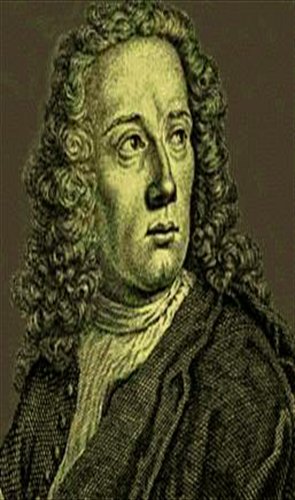
The author of Lettres Chinoises.
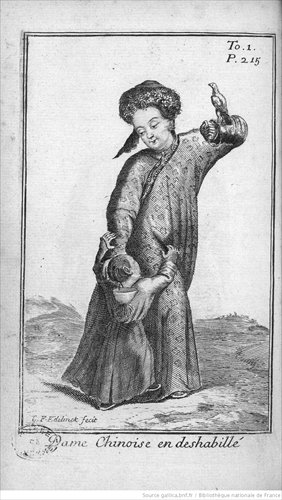
Lettres Chinoises illustrates 18th-century European views of China like this illustration of a Chinese woman's dress. Photos:Courtesy of Central Compilation & Translation Press
People have so many ways of obtaining knowledge about distant parts of the world in this information era, with just a few taps of the keyboard. But 200 years ago, communication between different cultures was much more difficult.
Lettres Chinoises ("Chinese Letters"), an epistolary novel written by French writer Jean-Baptiste de Boyer, Marquis d'Argens (1704-1771), was popular among European readers in the late 18th century. It told of five Chinese expats living in different countries and sharing their thoughts in letters.
The book had never before been introduced to China until earlier this month, when a Chinese translation by Lu Wanfen and Jean-Yves Calvez was first published by Central Compilation & Translation Press.
"The book is valuable for modern people in that it describes an image of China in European people's eyes at that time, and includes customs from different cultures," said Lu, 46, an ethnic Chinese from France, in an interview with the Global Times. "What makes it especially unique is that his language style is so different from other Enlightenment writers at that time."
China's image in history
The book was originally published when a wave of interest in China swept through Europe in the early 18th century. European scholars studied Eastern countries based on descriptions written by missionaries, who often stayed in Eastern countries for long durations.
D'Argens creates five Chinese characters: Sioeu-Tcheou living in Paris, Choang in Persia, Tiao in Moscow, Kieou-Che in Japan and Yn-Che-Chan in Beijing. They learn foreign languages from their missionary friends and travel around the world. They experience different cultures in different areas, and express their views on different societies.
D'Argens praises the imperial examination system and appreciates the way Confucianism impacted Chinese society, while he indicates that science and technology lagged far behind European countries, and remarked on dishonest Chinese merchants and foot-binding traditions of Chinese women.
"There were various views on China in Europe at that time," said Zhang Jinling, an researcher fellow at the Chinese Academy of Social Sciences. He explained that Voltaire (1694-1778) preferred to show the positive side of China while Montesquieu (1689-1755) exaggerated the negative parts to support his own theories.
"Unlike Montesquieu or Voltaire, d'Argens was trying to explain a foreign country in a rational and comprehensive way," concluded Zhang. He believed the publication of the new French collection of Lettres Chinoises would be very meaningful for Western countries in helping them understand China from different perspectives.
Director of Peking University's French department Dong Qiang said first impressions from foreign writers, even if flawed, have value.
"It is not necessary to judge whether the image of ancient China is accurate," Dong said. "It is also helpful for us in building a national image today to check the differences between the China in their minds at the time and what we wanted to show them."
The rise and fall
Lettres Chinoises is the third book of a trilogy, La Correspondance Philosophique. The first book of the series, Lettres Juives ("Jewish Letters"), was written from 1735 to 1737 and brought d'Argens both popularity and controversy. He was severely criticized by defenders of religion, but gained favor with Prussian Emperor Frederick the Great, who invited him to the Sans-Souci Palace to write Lettres Chinoises.
Lu, the translator, praised d'Argens' language and rhetoric. The author annotated clearly every time he cited the Greek classics. And even when he was trying to mock, he wrote in a very graceful style, which is rarely seen in modern French literature.
However, this style was not popular after the French Revolution (1789-1794), when inflammatory literature was in vogue. People trumpeted up Rousseau (1712-1778) and Voltaire, and largely ignored d'Argens.
But he wasn't overlooked in all circles.
"As he was a key role for studying the relation between Germany and France, scholars of international relations and spies have never forgotten him," said Lu.
The book was published in five editions in the 18th century, and the author made revisions to every one. Lu chose to translate the final version from 1756, and annotated it with her own research.
Lu's translation and annotations were almost complete in 2008, but Lu's partner Calvez passed away four months before they planned to come to Beijing in 2010. The new French version with Lu's annotations was published in 2011. Lu selected 38 more letters related to China from the 160 by d'Argens and put them in a book to commemorate her partner.
At a conference discussing the book on August 30, scholars pointed out that the publishing date is only a few months from the 50th anniversary of the establishment of diplomatic relations between France and China on January 27, 1964.
Cosmopolitan vision
Instead of developing the characters of the Chinese letter writers individually, d'Argens made these Chinese observers of their time period.
The author regarded them as philosophers, not only deeply impacted by Confucianism, but also representatives of European Enlightenment thinking.
"At that time, the term 'philosopher' implicated that they were against theists," Lu said. "He was trying to express his critical thinking on religion through these Chinese characters."
Though d'Argens was writing in French, Lu sees his work as representative of greater Europe at the time. "The book is multicultural commentary rather than just a focus on China and France," she said.
The French author shows China through the prisms of Chinese people in other countries like the US and Japan. He himself had never travelled to those places, but his descriptions are still clear and beautiful.
"He was working like a journalist. ... He was trying to record objectively what he learned through interviewing the missionaries," Dong said. "The author was studying culture in a way very close to the modern anthropology, which was popular in Europe in the late 19th century. He focused on religion and customs and tried to find out how people were living in other lands."
Dong appreciated the speculation shown in the book.
"Some European countries like France have the tradition of studying and discussing other countries with speculative philosophy, and they passed on the tradition very well and received very good feedback. This is where we should learn from them," Dong said.