Contingent love
After each performance of Beauvoir and Sartre, an original Chinese drama production currently showing at the Shanghai Dramatic Arts Centre (SDAC), a board is hung on the outside wall asking the audience whether they would be willing to sign a contract with their lover similar to the famous "open marriage" between the great French thinkers Jean-Paul Sartre and Simone de Beauvoir, which is the inspiration of the play.
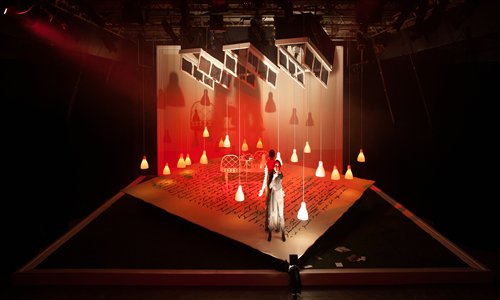
Stage photos of Beauvoir and Sartre. Photos: Courtesy of Shanghai Dramatic Arts Centre
Although they never married or had children, Sartre and Beauvoir were lifelong partners. In 1929, not long after they met, Sartre proposed a pact to Beauvoir: "What we have is an essential love; but it is a good idea for us also to experience contingent love affairs." The pair also agreed to be transparent and honest about their other liaisons.
The play is being staged at the SDAC until November 10. After five shows, a majority of audience members who responded to the post-performance query said they would be reluctant to enter an arrangement like the one depicted on stage.
When the play premiered on October 17, 84 people - with a male to female ratio of 1:6 - took part in the survey: 79 percent of women and 67 percent of men stated that they wouldn't consent to such a contract.

Stage photos of Beauvoir and Sartre. Photos: Courtesy of Shanghai Dramatic Arts Centre
Based on the couple's relationship and Beauvoir's groundbreaking feminist treatise The Second Sex, the play revolves around one important "contingent love" of Beauvoir's, her relationship with the American journalist and author Nelson Algren. Beauvoir even wrote him into her Prix Goncourt-winning novel The Mandarins.
However, rather than depict the complicated love triangle, the play focuses on the inner world of Beauvoir herself, her own entanglement and conflict between two identities as a progressive with independent thoughts and values, and also as an ordinary woman who is eager for love, especially an exclusive love of her own.
On stage, Beauvoir questions Sartre about his relationship with her young student Olga Kosakiewicz: "It is perfectly ok, I know she loves you, but do you love her, Sartre?"
The play's producer and director are both women. They even designed a dream sequence for Beauvoir to show her complicated emotional world. Another actress wearing a mask enters Beauvoir's dream and begins to direct a battery of questions towards her.
"This character is still Beauvoir herself, who represents the other side of her," Zhao Lian, the playwright, told the Global Times.
She added, "For Beauvoir, Sartre is more of a soul mate, who can supply her with seemingly unending novel and deep feelings and also as much freedom as she wants. And her relationship with Algren is more like an ordinary romantic relationship, which has both lust and happiness."
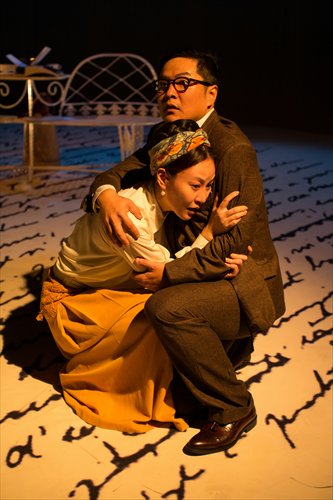
Stage photos of Beauvoir and Sartre. Photos: Courtesy of Shanghai Dramatic Arts Centre
"I never imagined that a woman's independence and freedom would mean sacrificing her love and life," Beauvoir says to the masked woman in her dream.
An audience member wrote on her microblog that she didn't respond to the inquiry after seeing the play since she felt ambivalent.
"We all know that Sartre and Beauvoir accompanied each other for their whole lives in reality, but in spite of their agreement, they still couldn't avoid getting hurt emotionally by each other, which is a common weakness of human nature," she wrote.
Date: Until November 10, 7:30 pm
Venue: Shanghai Dramatic Arts Centre
上海话剧艺术中心
Address: 288 Anfu Road
安福路288号
Admission: 150 to 300 yuan
Call 6473-4567 for details