Fu Manchu strikes back
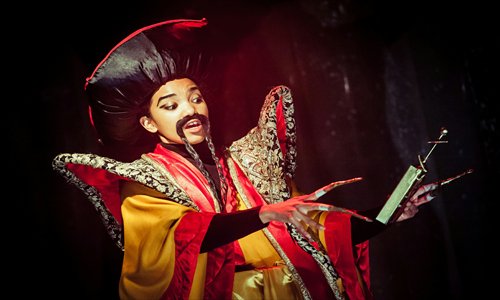
Chipo Chung as Fu Manchu in The Fu Manchu Complex at London's Ovalhouse Photo: Courtesy of The Corner Shop
Urbane, sinister and inhumanly intelligent, the criminal mastermind Dr Fu Manchu first appeared in Sax Rohmer's The Mystery of Dr Fu Manchu. Written at a time when London was quickly filling with inhabitants from diverse backgrounds, the series of books were part of a wider "Yellow Peril" meme at the turn of the 20th century.
Now a century since its 1913 publication, Daniel York brings the evil archetype back to London in the play The Fu Manchu Complex that challenges the racism of this character.
The real Fu Manchu
Set in the late 19th century, the play follows Dr Petrie and Inspector Nayland Smith as they battle through clouds of opium to foil the dastardly plans of the title character, who intends to turn the Western world Chinese by way of genetically engineered fungal poisoning.
As Petrie and Smith's blundering leads them to ever more absurd conclusions, the play re-examines who the real Fu Manchu is.
Born of Chinese and English parentage, playwright York counters racist Western stereotypes of Chinese people in this hilarious comedy. He emulates the enormous charisma of the character seen in Rohmer's books, but makes the villain a self-aware and comic figure who comments freely on the racial profiling his image has engendered.
"This is a Fu Manchu who knows he's on stage and is fully aware of his cultural baggage," the playwright told the Global Times.
Of all of the villains of the 20th century, "none lingers in quite the same way as Rohmer's Dr Fu Manchu - tall, lean and feline, high-shouldered, with a brow like Shakespeare and a face like Satan, a close-shaven skull, and long, magnetic eyes of the true cat-green," Leslie S. Klinger wrote in an appendix in the first of Titan's reissues of the original books.
York said Rohmer's imagery and characterizations have influenced the way modern British media views the Chinese.
"This exoticized and luridly sinister image of Chinese and East Asian people still seems to pervade our media, and with China's increasing prominence on the world stage, possibly more so," said York, adding that recent TV series Sherlock and Spooks feature plots and characters straight out of Rohmer's books.
The Fu Manchu character was also a huge success in the US.
William F. Wu, author of The Yellow Peril: Chinese-Americans in American Fiction, 1850-1940 (1982), said that Fu Manchu "was the first Asian role of prominence in modern literature to have a large American readership."
While his play is a critique of the character, York said, "There's no denying author Sax Rohmer's gift as a storyteller and his ability to create a truly iconic and larger-than-life character that continues to capture the imagination and influence perceptions 100 years later."
"Interestingly, though, Rohmer created this fictitious, sinister Chinaman whilst freely admitting he knew nothing about Chinese people or culture," York acknowledged. "In fact, it's highly probable he had never even met a Chinese person!"
Subverting stereotypes
Rohmer based Fu Manchu and other Yellow Peril capers on real Chinese crime figures he knew during his time as a newspaper reporter covering activities in East London's Limehouse district. Fu Manchu inspired numerous other characters, providing a model for most villains in later Yellow Peril thrillers.
"What I like about the show is that it fuses the 19th century Sherlock Holmes-type farce with contemporary fears about the rising China," Lee Jones, lecturer in International Relations at Queen Mary University of London, told the Global Times.
The play, staged at South London's Ovalhouse, has Fu Manchu plotting to turn Caucasians Chinese. The show has fun with this paranoid notion and points out its inherent silliness.
Although if introduced today, such an overtly xenophobic character as Fu Manchu wouldn't go over well with audiences. But that doesn't mean racial stereotypes are extinct.
The play uses ethnically Chinese actors to get away with the racist humor, Jones said. Otherwise, "it will be less comfortable," Jones noted.
The way the British media has portrayed China's involvement in Africa is also "a stereotyping that is unconvincing and unconstructive," argued Emma Mawdsley from Cambridge University in her paper "Fu Manchu versus Dr Livingstone in the Dark Continent." UK newspapers tend towards "a rather simplistic binary between the sometimes mistaken or frustrated but essentially well-intentioned West (Dr Livingstone), and the amoral, greedy and coldly indifferent Chinese (Fu Manchu) battling over a corrupt and/or helpless Africa (the Dark Continent)," wrote Mawdsley.
York stressed that stereotypes mainly exist in the media.
"The majority of ordinary people don't think like that, which is why the lurid image must be resisted," York said.
York's play makes fun of British stereotypes and Chinese stereotypes in a farcical way. The comedy pokes fun at the proclivities of numerous races with broad caricatures.
Jennifer Lim as Fu Manchu's daughter, Fah lo Suee, also plays against archetype.
This Fah lo Suee "is a deliciously subversive character in our version," Lim told the Global Times. "She speaks aloud her true thoughts to the audience."
The East Asian actors are endeavouring to shed their stereotypes on stage. The lack of visible presence on British stages and screens leads to East Asian actors and actresses being typecast, devalued and ignored.
"In an ordinary British production, an Asian actor is often cast specifically because the part stipulates that and more often than not it's a peripheral role," Lim said, adding that the best scenario for an actor is that you get to play a part not defined by your ethnicity but your qualities.
To break through these limitations, it's high time for Asian actors to be more assertive, York said.
"We have talent and powerful stories. Let's be seen!" said York.