Jinshajiang Road Station
Just one stop north of Zhongshan Park, Jinshajiang Road Station connects Line 3, Line 4 and Line 13. With the newly opened shopping mall Global Harbor right above ground, the station is now seeing an even larger flow of passengers as a transport hub in the middle of an emerging cultural and commercial circle.
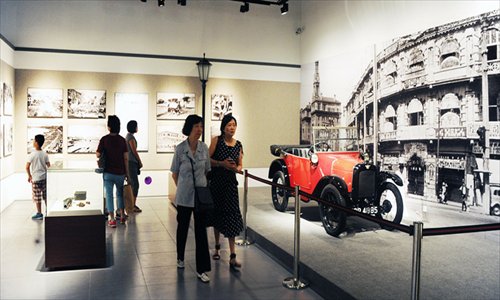
The Memories of the City exhibition at Global Harbor. Photos: CFP
Memories of the city
A behemoth of a building, Global Harbor resembles a giant cruise ship from the outside and inside is carefully decorated in the style of a grandiose palace reminiscent of Renaissance paintings. Its 480,000 square meters is filled with shops, restaurants, a 4D cinema and a five-star hotel; in short everything you would expect of a shopping mall. But its ambition surpasses mere commercial success.
There is a skating rink on the B2 level and a 20,000-square-meter open garden atop the fifth floor, which also functions as a drive-in cinema. It is one of the very few shopping malls to dedicate the better part of a whole floor to culture - the fourth floor hosts numerous small exhibitions, among which are showcases of Chinese comics, qipao and Thang-ga, a Tibetan form of Buddhist-themed paintings on embroidered silk, listed as an Intangible Cultural Heritage by UNESCO.
One exhibition especially worth noting is called Memories of the City in the Global Harbor Museum, the biggest exhibiting hall on the fourth floor.
Recounting the history of Shanghai starting from 1843, it was jointly organized by the Shanghai History Museum and six other museums. Among the treasure trove of historical photos and objects are silver dollars bearing the infamous, portly visage of general in the late Qing Dynasty (1644-1911) Yuan Shikai, steel boundary markers that once demarcated foreign concessions, American-made railway surveying equipment from the 1930s, a name plate of a KD7 steam train from 1947, a real Austin 7 car which was very popular during the World War II, Republican-era furniture and posters of then famous actresses.
It's striking to survey the history of the development of transport in the city, to see how the roads of Shanghai went from mud to asphalt and public vehicles morphed from rickshaws to tramcars to the metro, which celebrates its 20th anniversary this year. But viewing a photo taken in the late Qing Dynasty of a wooden wheelbarrow carrying a dozen young girls - more like goods than human beings - actually calls to mind the crowded subway carriages of present-day Shanghai.
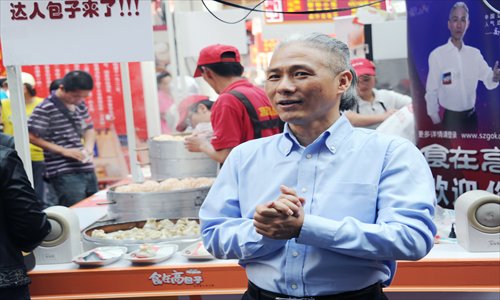
Gao Yifeng
Start all over again
Besides the rather singular Global Harbor, the rest of the area around Jinshajiang Road remains normal residential neighborhoods. And just like other residential areas around town, a culinary microcosm of cuisines from all over the country await discovery: spicy hotpot from Sichuan, rice noodles from Yunnan, lamian from Lanzhou, soup from Fujian, and so on.
Among three baozi stands along Ningxia Road, Shi Zai Gao (544 Ningxia Road) has an interesting backstory. Its founder Gao Yifeng, who, with his melancholy eyes, bears a striking resemblance to Hong Kong actor Tony Leung, was once a business owner with a fortune worth tens of millions before his company went bankrupt. He restarted with the small steamed bun shop, which became famous after Gao moved many to tears with a no-doubt heartfelt rendition of the song "Start all over again" on the first season of China's Got Talent in 2011.
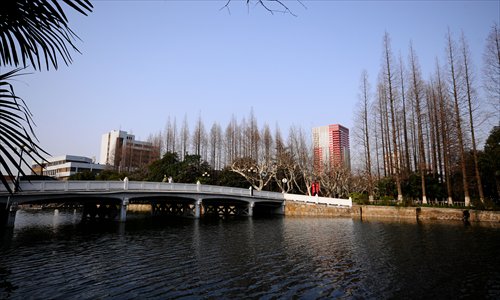
Rio Rita, the river that runs through East China Normal University
The river of a young beauty
A short walk to the west of the station on Zhongshan Road North, you are met with the lovely campus of East China Normal University, one of the most admired universities in Shanghai. Founded in 1951 as the first university in the country to specialize in training educational workers, it aims to be a world-class university by the middle of this century.
The campus enjoys a long history dating back to the 1930s, when the school on the same land was a missionary school. What remains unchanged is the grace of the river that runs through the campus, Rio Rita (or Liwa He, meaning the river of a young beauty), which is named after an even older tragic love story.
As the legend goes, in the early 1920s, a Russian noble family exiled after the October Revolution lived on the land, then a private residence built by a Spaniard named Jose Mario Fernandes. The daughter, Liwa, fell in love with a poor Chinese student but the love was forbidden by her father and Liwa drowned herself in the river on a rainy spring night. The family soon moved out, blaming the river for being too beautiful.
The campus carries the romance on today. It is widely said among college students in Shanghai that to fall in love, you should go to East China Normal University.