Twitter’s strength lies in definition-defying function
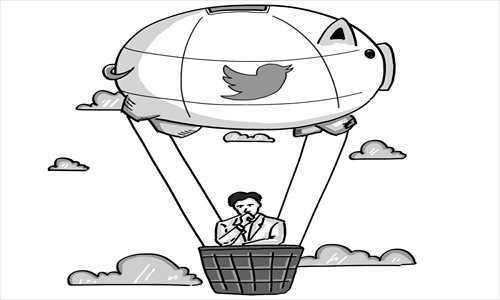
Illustration: Chen Xia/GT
Twitter released details of its long-awaited IPO last week. In a document significantly longer than the 140 characters it allows for tweets, it set out its case to potential investors before its listing, slated for early November.
One criticism made by commentators is that Twitter still has trouble defining exactly what it is. However, this is actually one of its biggest strengths, as this makes it easier to take advantage of new revenue sources, while also keeping its users engaged.
The Internet is awash with commentary on the deal. Most could not resist comparing the IPO with last year's Facebook listing, which was marred by both technical difficulties and an overvalued stock.
To avoid the latter, Twitter has set an initial price of $17 to $20 per share. Many analysts say this is conservative, although it still values the loss-making company at between $10 billion and $12 billion. That said, Twitter execs could still increase the price between now and the listing date if they think demand is high enough. However, they will not want to push the price too high, or else they run the risk of seeing the kind of calamitous decline in value that Facebook had in its first days of trading.
The Facebook debacle casts its shadow over Twitter's S-1 filing. Perhaps to avoid the hype that surrounded Facebook's IPO, Twitter has taken pains to list the many challenges facing its business - including slowing growth in user numbers, high overheads in keeping its technology running, and stiff competition for online advertising spending.
Unfortunately, when selling its plus points, it leans on the kind of jargon that gives ammunition to its detractors. Talk of its "differentiated ability to target users through their Interest Graphs" and "unique value propositions" cause such profuse eye-rolling that reading through the 164-page document can be difficult.
Some say this marketing speak masks Twitter's lack of a clear function. But the lack of a clear function is actually Twitter's greatest strength, and sets it up well for long-term growth in terms of both users and revenue, while maintaining engagement.
Trying to sum up what Twitter is in a simple, compelling phrase is tricky. Facebook lets you stay connected to your friends. Flickr lets you share photos. YouTube lets you watch videos. They all have clear, easily understood points to them.
Twitter lets you send 140-character messages into the electronic void, for everyone to read or ignore as they please. Trying to convince the uninitiated why they would want to do this is difficult.
But this lack of a specific point means Twitter has become many different things. Sure, as with the Internet in general there is a huge amount of banality. But Twitter is also an aggregator of news, a platform for debate, a mass transit system for memes, an educational tool, a marketing platform, an ego massager, or just somewhere to have a good rant.
The platform has maintained a simplicity that makes it easy to use and easy for developers to scale. Compare this with Facebook, which is constantly fiddling with its appearance and functions, often to the chagrin of its users.
Another great attribute of Twitter is that it's an open system. Once you have an account, you can read, search, forward and reply to the tweets of every other user. Also, you can follow someone without them having to make a reciprocal agreement to follow you. This means messages and conversations can spread very quickly, and anyone can become involved - something that is appealing to both users and advertisers.
This also means Twitter can access real-time analytics of what users are interested in - see the aforementioned "Interest Graph" - which the company can then use to sell targeted advertising.
This flexibility has led to many innovative, interactive marketing activities that can spread to a wide audience, give advertisers instant feedback, and can be more valuable than merely selling ad space. Twitter's flexibility and openness mean these activities can be easily integrated into wider campaigns; for example on the advertiser's website or through the use of hashtags, which demark conversation topics on the platform.
Most importantly, openness and flexibility mean Twitter is well-placed to take advantage of future trends and technologies more rapidly than its competitors. Much of the time this will be led by users themselves. While Twitter may not take a direct cut of all the revenue generated from these advances, in aggregate they will help boost the overall appeal of the platform, and therefore its opportunity to generate sustainable returns.
The author is a freelance writer. Adam.skuse@yahoo.com