Hairy today, gone tomorrow
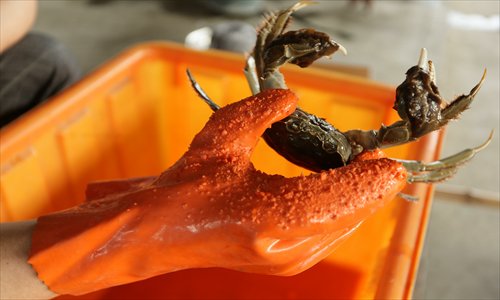
"When the autumn wind rises," says the old Chinese saying, "the hairy crabs are ready to be served." And it's that time again in Shanghai when the highly prized seasonal delicacy appears on dining tables all over town. Even if the long hot summer didn't leave much fat on hairy crabs this year, the city's foodies in town are still eager to sample all six legs, claws and the rest of the Eriocheir sinensis which is also known as the Chinese mitten crab, or the big sluice crab.
A native of eastern Asia, the hairy crab has also been found in Europe and North America. But there it is often regarded as a pest that could threaten local ecologies.
Chinese people started to eat hairy crabs in the period of Three Kingdoms (220-280). A book of the time reported that hairy crabs were called shagou, fengjiang, luhu and pengqi. Some of older Chongming county residents still talk about pengqi today.
Though reports of hairy crabs can be traced back 2,000 years, it was not until the Qing Dynasty (1644-1911) that they became a popular dish in Shanghai. Traditional Chinese Medicine practitioners believe hairy crabs are a cool food, and are good served with hot foods like ginger and yellow wine.
Thanks to the recent cooler temperatures, the female hairy crabs have gained some weight in October. Over the next two weeks, with cooling temperatures, the male crabs will be at their very best.
Experts suggest that while quality of the hairy crabs this season might not be as good as in previous years, lower prices will encourage sales. After the central government launched a series of policies to curb expenditure on official hospitality late last year, the sales of high-end baijiu (the traditional Chinese spirit), tea and moon cakes dropped drastically. This dramatic plunge in demand will also affect hairy crabs.
"Nearly 20 percent of our hairy crabs were purchased by State-owned companies and government offices in the past," Yang Weilong, the president of the Suzhou Yangcheng Lake Crab Association, told the Global Times. He said that this aspect of the market had been cut to almost zero this year.
Valued gifts
Most hairy crabs come from Yangcheng Lake in Suzhou, Jiangsu Province, and are regarded as the finest crabs to be found in the Yangtze River Delta. Traditionally they are served at high-end restaurants or wrapped and delivered as valued gifts. As well as Yangcheng Lake, there are several other breeding areas for hairy crabs in suburban Shanghai as well, like those in Songjiang district and Chongming county.
Located to the northeast of Suzhou, 120-square-kilometer Yangcheng Lake is one of the most important freshwater lakes in Jiangsu Province. The lake teems with seafood and the hairy crabs are the most famous. But on September 17, the first of this season's catch of Yangcheng Lake hairy crabs proved underweight and "slim." According to the Suzhou Yangcheng Lake Crab Association's statement to the Suzhou Daily, those crabs were "not mature."
"But still a lot of people wanted to have hairy crabs for the Mid-Autumn Festival," Yang said, "The first batch were sold for up to 165 yuan ($27) per 500 grams."
Yangcheng Lake hairy crabs are sold to customers across the country and this year the crab association expects to pull 210 tons of the delicacy from the lake. Each genuine Yangcheng Lake hairy crab comes with a ring with an 18-digit serial number which you can track on the association's official website.
Though government and official purchasing has shrunk, the association is still optimistic about the sales for this year. "No matter what, Yangcheng Lake hairy crabs are still the finest in the market," Yang said. "The association is closely working with e-commerce companies to expand distribution channels this year."
Yang said the association has launched an online platform (360xie.com) for its crab farmers. "The website helps local crab farmers sell their products and all the after-sales services are provided by the association," Yang said. The association is also working with major e-commerce companies like jd.com and taobao.com.
A number of hotels in Suzhou are offering hairy crab packages for Shanghai foodies. The Fairmont Yangcheng Lake is offering an autumn getaway package that starts from 2,320 yuan a night on weekdays and 2,780 yuan a night on weekends.
The package includes accommodation, free welcoming tea, a complimentary breakfast for two, a 100-yuan dinner buffet and a pair of Yangcheng Lake hairy crabs. You can have the hairy crabs cooked at the hotel's restaurants, or take them home.
Chongming's crabs
Qingshui hairy crabs (literally "clear water crabs") are the crabs produced in Chongming. As China's third largest island it has some excellent freshwater produce.
The secretary-general of the Chongming Hairy Crab Association, Huang Saibin, told the Global Times, "Because Chongming is an eco-friendly island with great resources, this year we have branded all the island crabs as Qingshui hairy crabs."
Chongming Island used to be a breeding base for juvenile hairy crabs, however after upgrading facilities on the island, farmers there are now focusing on producing mature, ready-to-eat crabs.
Though there are fewer Qingshui crabs than Yangcheng Lake crabs, the quality is high. Dotted with small rivers and lakes, Chongming Island boasts plentiful water plants, river snails and freshwater mussels. "They're the best food for hairy crabs and make the island crabs fat and delicious," Huang said.
Most of the hairy crab farms on the island provide catching and cooking facilities. The Shanghai Baodao Crab is recommended by the association. There visitors can don rubber boots and coats and go down to the water to catch their own crabs. If home-style cooking isn't good enough, visitors can take their catch to one of the local restaurants and enjoy their own crab-themed feast.
Surrounded by lakes, Shui Xiu Fang provides a complete selection of hairy crab dishes, including steamed and boiled crabs and crab meat with bean curd. Diners can relax on the terrace and enjoy the view while eating their fresh crabs which cost from 120 yuan per 500 grams.
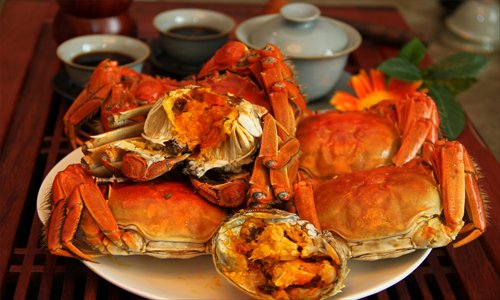
Sanmao crabs
Unlike the hairy crabs in Yangcheng Lake and Chongming Island, the Sanmao hairy crabs in the upper reach of the Huangpu River in Songjiang district were not affected by the heat. Local media reports that, on the contrary, they have gained about 10 percent in weight over the previous year.
Professor Wang Wu from the Shanghai Ocean University said that this year, farmers had harvested crabs twice. In the first harvest, the crab farmers culled unhealthy and imperfect specimens and returned the good crabs to the water.
"With this new breeding method, we guarantee that all the mature hairy crabs will be fat and ready to be served," Wang told the Oriental Morning Post. These hairy crabs are also being given more space to mature in. Wang said that although one square meter usually accommodates 1.5 hairy crabs, on the Sanmao hairy crab farms a square meter only accommodates 0.75 crabs. The low-density breeding program allows the crabs to secure more food and thus grow more than before. Sanmao hairy crabs can be found at wet markets and some supermarkets.
Cooking hairy crabs at home
Steamed hairy crabs
Ingredients: a 200-gram hairy crab, ginger, yellow wine, vinegar and rock sugar
Chop the ginger into small slices and mix it with vinegar and rock sugar;
Tie the live crab with string and put a spoonful of yellow wine on its shell;
Steam it over boiling water for 12 minutes;
Open the crab's shell and dip the meat in the vinegar sauce.
Crab meat and bean curd
Ingredients: hairy crabs, bean curd, minced ginger, Chinese onions, yellow wine, chicken soup, peanut oil, salt and starchy flour
Steam the hairy crabs for 12 minutes and remove the meat and roe;
Slice the bean curd into pieces;
Fry the minced ginger with peanut oil;
Put crab meat and roe, bean curd, yellow wine, chicken soup and salt in the pan, and cook for three to five minutes;
Add the starchy flour and Chinese onions.