Sweet and sour
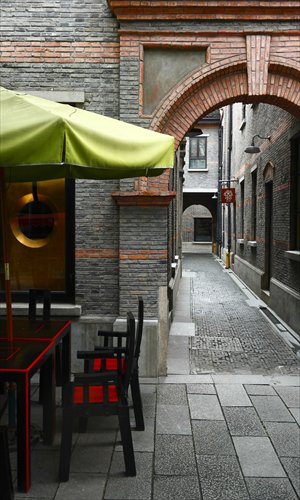
In 1884 the Qing Dynasty (1644-1911) agreed to open the port cities of Guangzhou, Xiamen, Fuzhou, Ningbo and Shanghai to Western nations. From then on, Westerners enjoyed free access to these cities to trade or conduct missionary work. Along with missionary Bibles, Western medicine and jazz, coffee was introduced to the country which had, for most of its long history, been associated inextricably with tea.
The new drink percolated first through Shanghai where it established itself as a viable (though much less popular) alternative to tea. Shanghai, the "Paris of the East," the most Westernized and most important trade center for the country, was the natural home for the new beverage and the business and culture that went with it.
After Shanghai developed and became a haunt for Western traders and adventurers, coffee houses sprang up throughout the city. They stayed there as popular venues until the establishment of the People's Republic of China in 1949 when coffee consumption dropped and, then during the Cultural Revolution (1966-76), when coffee was suddenly officially regarded as a symbol of a capitalistic lifestyle and outlawed. It was not until 30 years or so later when Deng Xiaoping introduced his reforms that coffee returned to the lives of ordinary people in the city and cafés began to open again. Today, China is one of the major markets for international coffee chains like Starbucks, Costa Coffee and The Coffee Bean & Tea Leaf.
Gradual attraction
Shanghai's first coffee drinkers would find their cups in some of the major Western department stores that were flourishing in town, like the Hall & Holtz and Lane Crawford. Shortly after this Western restaurants began offering coffee to their patrons.
The Western coffee houses in the city became popular and even though they were originally intended to make foreigners feel at home, they gradually attracted a Chinese clientele, mostly wealthy folk or celebrities who saw coffee drinking as a symbol of their status in society.
In the early 20th century the demand for coffee houses leapt as thousands of Chinese who had studied or worked abroad returned home with this new habit. Most of the coffee houses in old Shanghai were to be found on Avenue Joffre (today's Huaihai Road), Bubbling Well Road (Nanjing Road West) and Sichuan Road North. By 1946, there were 186 coffee houses registered. There were another 300 outlets offering coffee in restaurants, hotels and nightclubs. Some of the more popular cafés were the Hot Chocolate, DDS, the Rosemary, the Mars, Jimmy, the Philadelphia, Kaisiling, and Laodachang.
Most of the coffee houses in those days fell into one of two categories - the more formal venues where business could be discussed and the relaxed atmospheric cafés where couples could meet on a date or friends could get together. The business style cafés like the Mars and Deda on Nanjing Road East were located close to banks, while the cafés on Nanjing Road West reflected the brash atmosphere of the nearby cinemas, restaurants and nightclubs. Russians ran most of the coffee houses on Huaihai Road.
Although the coffee houses in old Shanghai were run by foreigners, they developed their own features and characteristics. Unlike Western coffee houses which usually only offered coffee, tea and cakes, Shanghai's coffee houses supplied Western foods, cookies, cakes, ice creams and confectionery. Each coffee house developed a specialty. In Westernized families a coffee pot was a necessity for a daughter's wedding dowry.
Shanghai people quickly got used to drinking coffee. But where Shanghai people used to spend their time in cafés, later residents tended to drink coffee at home. A hostess who could produce a good cup of coffee for her guests was highly regarded.
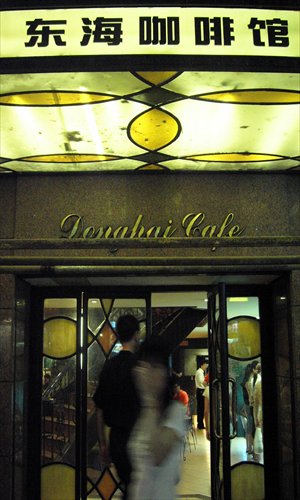
Writers stirred
In Europe and England the original coffee houses were centers where writers, philosophers and activists could gather, meet and talk together, discussing the latest events and current affairs and Shanghai's coffee houses also proved popular with local writers and creative spirits.
Eileen Chang wrote Love in a Fallen City, Pink Tears, and Red Rose, White Rose, three of her most popular novels, between 1942 and 1948 sitting in the coffee house under her home in Changde Road.
The Gongfei Café, on Sichuan Road North, was the place where the influential author and critic Lu Xun and other early members of the League of Left-Wing Writers gathered. The coffee house was on the second floor of a three-story brick house and was usually frequented by Westerners so the Kuomintang authorities visited there. Lu Xun talked to Communist Party members and left-wing activists there and in 1930 the founding meeting of the League of Left-Wing Writers was held there. Lu Xun mentions the café several times in his diary even though he personally didn't like coffee.
Many of Shanghai's writers used coffee houses and the characters from the cafés in their works - writer Ma Guoliang, for example, expressed surprise after he had listened to two women in a coffee house talking about literature, art and politics. Not the normal thing in those days.
After the foundation of the People's Republic of China, the foreign-owned coffee houses began to sell up. In July 1953, Shanghai police introduced strict regulations for coffee houses. In 1956, all of the city's then 67 Western restaurants and coffee houses became joint ventures with the government and began selling Chinese food. When the Cultural Revolution erupted, there were only 13 Western restaurants and coffee houses remaining in the city.
Even in the days when coffee was taboo, coffee addicts did their best to find some beans and water and make their own brews, sometimes putting themselves at risk. The Shanghai magazine The Oriental Outlook reported that one man was reported to the Red Guards by his neighbors for making coffee at home. After the guards confiscated his coffee beans, the man began using cocoa beans to make his daily beverage.
The Shanghai writer Cheng Naishan described how the former head of a rubber factory treasured his coffee above rice. She wrote about how the man, who lived in her garage for a time, rushed to buy coffee and not food every month when he received his cash allowance.
A classic café
Although drinking coffee was regarded as a capitalistic pastime after 1949, Shanghai's State-owned cafés continued to serve coffee. Typical of these State-owned cafés was the Shanghai Café, at the intersection of today's Nanjing Road West and Tongren Road.
The Shanghai Café was originally the C.P.C. Café, a coffee house run by the C.P.C. coffee factory which had been established in 1935 and made coffee with imported beans. In 1958, the C.P.C. coffee factory became the Shanghai Coffee Factory.
Outside of the Cultural Revolution era the Shanghai Café had been a constant favorite for coffee lovers. After Shanghai was occupied by the Japanese army in 1937, the supply of coffee beans from abroad was cut but the Shanghai Café bought coffee beans from Jewish traders at inflated prices or resorted to roasting barley as a substitute. Regulars continued to come to the café and drink there even when they knew it was not real coffee - for many the ritual was all important.
During the period when coffee was effectively banned, tinned coffee produced by the Shanghai Coffee Factory could be bought at Western style hotels. However ordinary people couldn't buy it - only customers with foreign exchange certificates could purchase coffee.
When the Cultural Revolution ended, the old customers and a new clientele rushed back to the Shanghai Café. Beautiful girls and rich men hung around there. It became the number one place to take a girl on a first date. But it began to attract the wrong sort of clientele and it became a haunt for scalpers dealing in foreign exchange certificates, foreign cigarettes and money changing. It lost its reputation for glamor and eventually was shut down.
After a century, Shanghai's coffee industry has returned to its former glory. Coffee chains flourish in Shanghai, baristas are hard at work and some small coffee houses link themselves to the past with either their décor or their names (Kaisiling and Deda).
In this whirl of new business the Shanghai Coffee Factory has been looking for new approaches to the market. During 1960s and 1980s, the Shanghai Coffee Factory was the main source of beans for most coffee houses and its coffee beans sold for 7 yuan ($1.15) a kilogram. In the 1970s and 1980s, it was a mark of distinction to have a tin of Shanghai Coffee Factory coffee on your shelves. But from the 1990s imported brands and instant coffee began edging away at the market and it stopped producing tinned coffee as such. However this year the company plans to reopen the C.P.C. Café and build a new factory in Yunnan Province.