The flavor of fall
What fleeting pleasures can we enjoy during Shanghai's all-too-brief autumn? A wisp of cool breeze kissing faces that a month ago were covered with sweat, or a reflection of lush willows in a lake glowing with sunlight before cold air comes and makes leaves fall and waters freeze. While strolling the streets or passing through parks in the past few weeks, you may have come across another transient but beautiful sign of the season: the soothing fragrance of sweet osmanthus flowers.
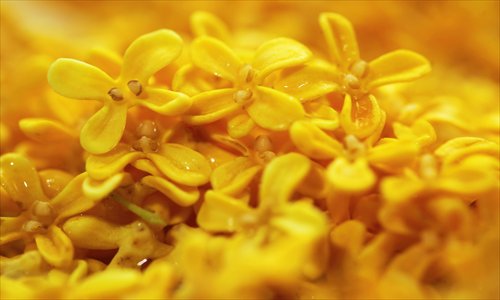
Sweet osmanthus
The blossom of sweet osmanthus, or guihua, which typically occurs in waves, was late this year due to the record breaking hot weather, Shanghai's longest summer in 140 years. This year, the third and final wave of blossoming osmanthus began around October 23.
Over the past few weeks, Guilin Park, Shanghai Botanical Garden and Shanghai Binjiang Forest Park, among others, became a paradise for city dwellers to appreciate sweet osmanthus blossoms. The tiny flowers, which can be white, pale yellow, yellow and orange, are particularly treasured by Chinese people, who have developed a special affection for the plant.

The teahouse in Guilin Park
Sweet osmanthus flowers are not only used to make perfume, but are also featured in Chinese dishes and drinks. Some people believe that the petals can help to alleviate coughs and treat colds. Xiong Anling, a 73-year-old traditional Chinese medicine (TCM) doctor who works with Tong Han Chun Tang, told the Global Times that sweet osmanthus flowers do not have a particular utility in TCM, but it's harmless to enjoy them in dishes and drinks.
Although some people are tempted to pick the flowers they see around town to use in culinary creations, this is not recommended as they may have been sprayed with pesticide.
Dried flowers can be preserved for months, thus in some local restaurants or tea houses, customers can enjoy the flavor of osmanthus all year round.
Common dishes featuring the fragrant flowers include steamed lotus root filled with glutinous rice and flavored with sweet osmanthus, glutinous rice dumplings boiled with osmanthus flowers, as well as steamed glutinous rice cakes with sweet osmanthus and sesame.
The sweet lotus roots and the rice dumplings can be enjoyed in many restaurants serving Zhejiang and Shanghai cuisine, such as Xiao Nan Guo (4/F, 999 Changning Road, 400-820-9777) and Jesse Restaurant (41 Tianping Road, 6282-9260). The sweet rice cakes can be easily found in Yuyuan Garden as well as Shanghai First Food Mall (720 Nanjing Road East, 6322-2777.)

Osmanthus wine is popular among Chinese people.Photos: CFP and Sun Shuangjie/GT
As for the drinks, osmanthus tea and osmanthus wine are always among the most popular choices. Inside Guilin Park (188 Caobao Road, 6483-0915) is a tea house in an ancient-style pavilion in the East Garden area. Here tea lovers can enjoy Longjing tea (10 yuan, $1.64/pot) and Maofeng tea (15 yuan/pot) with osmanthus, or have a cup of brewed osmanthus flowers with lotus root powder (10 yuan/cup). The tea house offers free refills. Home to more than 1,000 osmanthus trees of 23 varieties, the park is a pleasant option for citizens to stroll in the autumn months. Entrance to the park costs two yuan.
The northwestern-style restaurant Tang Yun Qin Feng (4/F, 580 Tianyaoqiao Road, 6161-9788), which has four branches in the city, has become a familiar name to osmanthus wine lovers. Made from rice and osmanthus flowers, the thick, homemade white mijiu (5 yuan/cup), which boasts a smooth and sticky texture and a sweet taste, is one of the restaurant's signature delicacies along with a variety of noodles.
Bottled osmanthus wines are also available in local supermarkets such as Lianhua; try the golden-colored variety (15 yuan) made by the well-known Shaoxing winemaker Guyuelongshan.
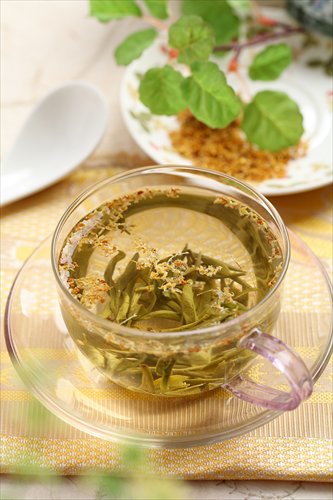
Sweet osmanthus tea
Recipe for steamed lotus root flavored with sweet osmanthus flowers
Ingredients: 600 grams lotus root, 250 grams uncooked glutinous rice, 50 grams dried osmanthus flowers and 250 grams sugar
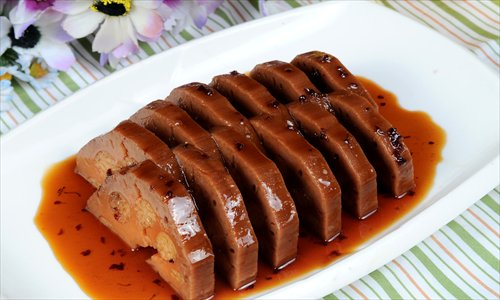
Steamed lotus root flavored with sweet osmanthus
Method:
Wash the lotus root thoroughly and cut off one end to expose the hollow chambers inside.
Fill the hollow chambers with rice and re-attach the chopped off end of the lotus root with toothpicks.
Steam the stuffed lotus root for roughly two hours until it's cooked.
Cut the steamed lotus root into half-centimeter thick slices, put them in a bowl and add sugar and flowers; then cover the bowl with plastic wrap.
Steam the ingredients on low heat for one hour, then arrange them on a plate and serve.