Students need tailored homework
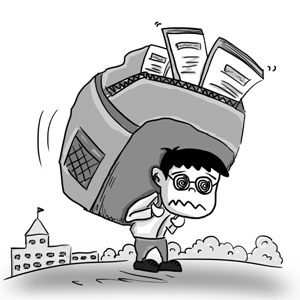
Illustration: Chen Xia/GT
A primary school in Hongkou district was singled out for criticism by the Ministry of Education in its latest survey report released last month because students were assigned so much copying homework every day that they could not finish it until late at night. The school was so focused on academics that even students' PE classes and activity sessions were used to teach core subjects such as Chinese, math and English.
When Shanghai Television Station interviewed teachers and students from Hongkou District No.2 Central Primary School last week, they were told that the school had addressed the criticisms and significantly reduced the amount of homework for every grade. At present, students from grade one to three have almost no homework and students from grade four and five have homework that can be finished in one hour.
However, one student interviewed said that although she can finish the homework assigned by her teachers in 15 minutes, her mother assigns her homework that she has to spend two hours on.
If the school reduces homework while parents increase homework, it still does no good to the students. The point is not the equal amount of homework that should be assigned to all students but the amount and type of homework that should be assigned to each individual student according to his or her ability and learning needs.
For some students, a certain amount of repetitive mechanical exercises, such as copying new vocabulary and phrases, is necessary for them to remember new material.
As a Chinese saying goes: the deeper meaning will become evident once you read the book a hundred times over.
However, not all students benefit from rote learning. Everybody absorbs new information differently.
Rather than simply reducing the amount of homework, changing the content and forms of homework is more important and beneficial to students' development.
In 2011, Shanghai students scored the highest in the Program for International Student Assessment (PISA) conducted by the Organisation for Economic Co-operation and Development, which tests 15-year-olds around the world in the fields of mathematics, science and reading.
However, compared with their Western peers, Chinese students still lack creativity and the ability to think independently.
When British-Australian entrepreneur Nick D'Aloisio was 12, he applied for an Apple developer license using his father's name because he was too young. When he was 15, he received seed funding from Hong Kong tycoon Li Ka-shing, and when he was 17, he became a multimillionaire after he sold his software Summly to Yahoo this March.
Meanwhile, D'Aloisio's Chinese peers are working painstakingly on improving their test scores to compete with each other and push their way into a key high school or a key university.
Chinese students do not have too much homework to finish, but they lack meaningful homework that encourages creativity and independent thinking.
Homework is important because it helps teachers assess each student's understanding of a subject and reinforces what students learn in the classroom.
Practice is necessary when learning any new skill or knowledge. Anders Ericsson, a professor of psychology at Florida State University, believes that it takes 10,000 hours (20 hours for 50 weeks a year for 10 years) of deliberate practice to become an expert in almost anything. Although rigorous practice will not necessarily make a talent out of a mediocrity, it is true that any skill can be improved by practicing.
Teachers should assign different types and amounts of homework to different students according to their individual situations. A fixed amount of time spent on homework after school is not suitable for every student, since some students are faster than others. Slow students need more practicing to build their skills and confidence, while fast-learners should be given more challenging homework.