Flower power
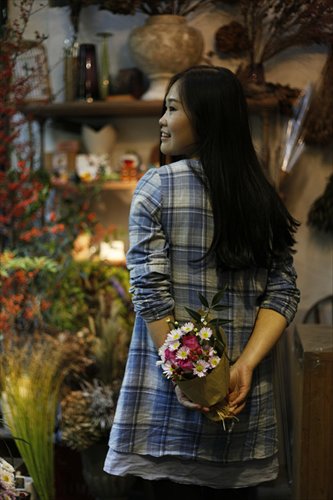
Floral designer Zhang Wanyu Photos: Cai Xianmin/GT and courtesy of Shanghai Xieming Floral Design Training Center
As winter approaches, amateur gardeners are sowing the last batch of seeds and enjoying the last round of blossoms this year. But there are a group of lucky people who inspire envy because their job is to be with flowers all year round.
Flower arrangement artists, or floral designers, are people who make flower compositions in containers such as vases, baskets and bowls, or who make bouquets from flowers, foliages or other plant materials.
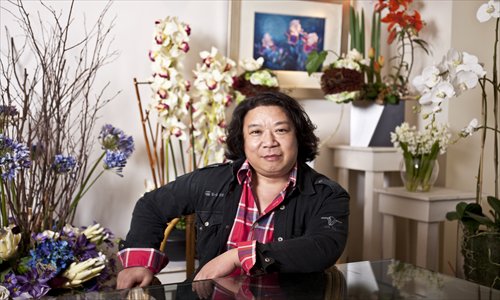
Floral designer Xie Ming Photos: Cai Xianmin/GT and courtesy of Shanghai Xieming Floral Design Training Center
The earliest record of flower decoration dates back to ancient Egypt and floral design has a long history in the West. However, the concept was not widely familiar to the general public in China until the floral industry bloomed again in the 1980s.
Xie Ming was among the first batch of floral artists to emerge after reform and opening-up. He won the gold medal in the flower arrangement competition at the first China Flower Exposition in 1987.
Xie still remembered the scene at the first flower expo. "There was a small corner assigned for the display of flower arrangements. It was the most popular corner as people swarmed there to look at the freshest way of representing plants," he said.
Xie started to teach himself floral design by reading books after he was employed at one of the earliest flower shops to open in Shanghai in 1984. He had not been trained nor received any special education related to the floral industry before he took the job.
"The supply of cut flowers was not enough at that time. The plants were mostly grown for government receptions of foreign guests or were sent to Beijing. Only a small amount was sold to the market," he said, adding that he sometimes had to give gifts to build up connections to access the plant materials.
Nonetheless, there were only about 20 kinds of cut flowers and plants commonly seen on the market, among them roses, sword lilies, chrysanthemums, irises, plum blossoms and magnolias.
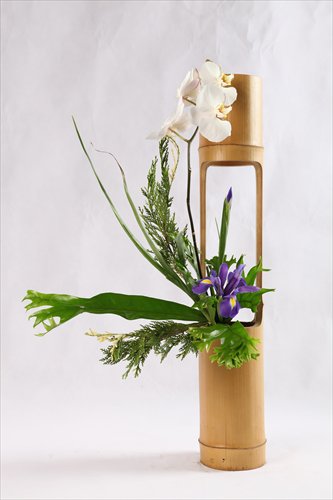
Xie, who has witnessed tremendous change in the floral design industry over the past decades, is now training a new generation of floral designers in his own studio, the Shanghai Xieming Floral Design Training Center.
He said that many young local florists are influenced by Western and Japanese styles of flower arranging, but he believes there is an urgent need to introduce the Chinese style of flower arrangement to young florists.
According to a book about floral design by Xie, Chinese floral arrangement dates back to the Six Dynasties period (220-589). Unlike the Western style, the Chinese style tries to mimic nature and represent seasonal changes by using different colors and varieties of plants. Xie's book features a collection of his art pieces following a style which he calls "new Oriental flower arrangement," including a piece called "A Distant Cry from Spring." The piece was named after a 1980 Japanese film that impressed Xie.
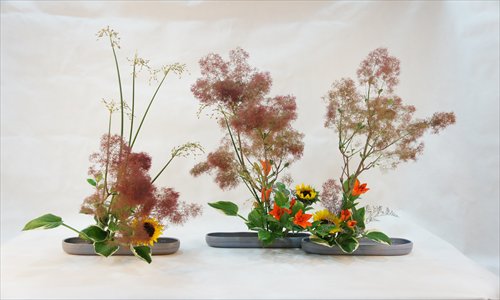
"I still remember a scene from the movie: there is a gentle slope, and sunflowers growing on the slope. It is a misty scene that gives a dreamy atmosphere to life in the countryside," he said.
Xie used smoke trees to create a foggy effect, and used sunflowers and oriental lilies to represent autumn. However, Xie said there is little appreciation or demand for this Chinese arrangement style as most people do not view flower arrangement as art in China.
Zhang Wanyu, a floral designer from Floristeam, a flower store chain, agreed that many people still buy flowers for a special occasion, for example, when visiting a patient, for a wedding ceremony or for Valentine's Day.
"Some people still believe that flowers need to be a certain color or of a certain number to carry a special meaning, whereas how the flowers are arranged come second," Zhang said. She said this is part of the reason why many local flower shops mainly provide cut flowers like lilies, red roses, and chrysanthemums. Only a few other varieties can be found.
Xie said that though there are formal qualifications issued by national professional organizations, few flower stores require that employees be certified flower designers.
But Zhang said that there has been a change in recent years.
"More and more young people are beginning to have higher requirements about flower arrangements. Some even show an interest in creating arrangements themselves," she said. On the request of customers, Zhang is now giving free flower arrangement classes at Floristeam stores. Those interested need to book a time with the shop, and pay for the cost of the plants used in the class.
According to Xie and Zhang, the income of floral designers ranges considerably depending on their skills, experience and reputation. Some reputable designers can earn over 20,000 yuan ($3,280) for designing an arrangement for an event, while those who work for flower shops live on small monthly salaries.