Back to the land
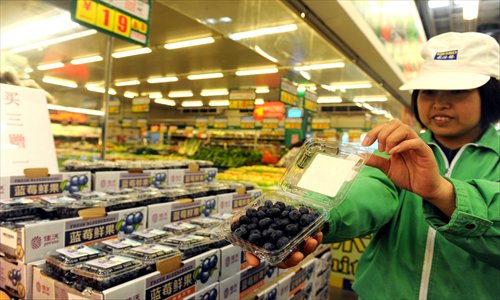
A salesperson shows blueberries produced by Joyvio Group in a supermarket in Zhengzhou, capital of Central China's Henan Province, on July 23. Photo: CFP
After spending three decades building Lenovo Group into the world's largest PC maker, 69-year-old IT tycoon Liu Chuanzhi, chairman of Lenovo's parent company Legend Holdings, is turning to a more earthy business: agriculture.
The company has already launched a high-end fruit cultivation business, and is now set to start importing French wine.
Better value
Joyvio Group, a subsidiary of Legend Holdings, announced on Monday that it will move into the wine business, in partnership with French wine firm Jean-Pierre Moueix and Chilean vineyard Emiliana.
The venture will benefit from "Joyvio's national marketing network," Chen Shaopeng, managing director of Joyvio, said during a wine-tasting event held in Beijing Monday.
Joyvio will import wine chosen by Chen and priced between 180 yuan ($29.5) and 600 yuan per bottle.
"Currently a bottle of wine worth only 200 yuan can sell for more than 1,000 yuan in the domestic market, which is a way of deceiving consumers," he said, noting that Joyvio aims to provide consumers with high-quality wines at reasonable prices.
Chinese consumers tend to prefer imported wine, which is why Joyvio has chosen to sell wine from abroad rather than cooperating with domestic wine makers, Fang Jun, a Shenzhen-based independent wine industry analyst, told the Global Times on Tuesday.
"Joyvio has chosen to enter the mid-market, which is reflected in the price range, rather than the high-end market, because it wants both reasonable profit margins and a broader customer group," Fang said. "Furthermore, consumption in the mid-market will be less affected by China's crackdown on official spending and extravagance."
However, now is not such a good time for Joyvio to enter the wine market, according to Fang, as China's economic slowdown has to some extent curbed consumer demand for nonessentials such as wine. Also, competition in the mid-range market for wine is fierce, Fang noted.
China imported 317,700 kiloliters of wine in the first three quarters of 2013, down 3.2 percent from the same period a year ago, according to data from the National Bureau of Statistics.
Meanwhile, home appliance maker Midea and e-commerce retailer Amazon both announced in recent months that they will also enter the wine business.
"Joyvio's advantages mainly lie in Legend Holdings' abundant capital and brand awareness, but these might not help much in the imported wine market," Fang said.
Agricultural strategy
Legend Holdings announced in 2010 that it would expand into the agriculture sector, and the wine business is part of this strategy.
On November 12, Joyvio started to sell golden kiwifruit. The fruit is sourced from Pujiang county in Southwest China's Sichuan Province, where Legend plans to invest 1 billion yuan to build a major production base for kiwifruit.
On the tmall.com e-commerce platform, a pack of eight Joyvio kiwifruit is priced at 128 yuan, higher than the price of some kiwifruit imported from New Zealand.
Kiwifruit is the second fruit product Joyvio has launched since May, when it began to sell blueberries sourced from Sichuan, East China's Shandong Province and from Chile. The company also aims to start selling cherries and grapes, according to Chen.
According to Liu's business blueprint, Legend Holdings plans a public listing between 2014 and 2016, and the firm hopes that by stepping into the modern agriculture business it can increase profitability in the long term.
But Legend does not expect to start making a profit from its agriculture division soon. Chen from Joyvio noted that it usually takes a decade for investment in the agricultural industry to generate profits.
"With China's transition from an investment-driven economy to a consumer-driven economy, demand for high-quality agricultural products will increase, and by then Joyvio will have a solid foothold in the high-end market," Song Jiening, an industry analyst at Shenzhen-based CIC Industry Research Center, told the Global Times on Tuesday.
As a high-tech company, Song said, Legend can apply its rich experience in the IT industry to the agricultural production process, by introducing new technology to farming and establishing a food tracking system to ensure food safety.
High-end market
With food safety becoming a top concern for many health-conscious consumers, the agriculture sector has become a hot destination for investment.
The 86-year-old entrepreneur Chu Shijian, former chairman of tobacco maker Hongta Group, started to grow organic oranges in Southwest China's Yunnan Province in 2002. Last year, his venture sold 200 tons of oranges within a few days in Beijing through online retailer benlai.com.
This year, Joyvio has partnered with Chu's firm to sell Joyvio's kiwifruit and Chu's oranges together at 368 yuan for a package weighing 5 kilograms on several e-commerce websites.
"These veteran entrepreneurs are optimistic about China's modern agriculture, which will sustain economic growth and improve people's lives," Ma Wenfeng, an analyst with Beijing Orient Agribusiness Consultant Co, told the Global Times on Wednesday.
Chinese Premier Li Keqiang stressed the importance of deepening reform in developing modern agriculture during an inspection tour of Northeast China's Heilongjiang Province earlier this month. He said China should explore ways to build large-scale farms and make innovations in the management system of farming.
At the Third Plenary Session of the 18th Communist Party of China Central Committee held between November 9 and 12, a decision was made to push forward with land reform and give farmers more property rights.
The barriers to access to land for private capital are also set to be lowered and modern agriculture will be further developed, Chen from Joyvio was quoted as saying by Shanghai Securities News in a report published on Tuesday.
"The participation of big companies such as Legend could push forward China's modern agriculture process, which requires extensive capital input and advanced technology," Ma said.
"At the same time, the government should also improve the social welfare system for farmers to protect their interests," he noted.