Hold your Horses!
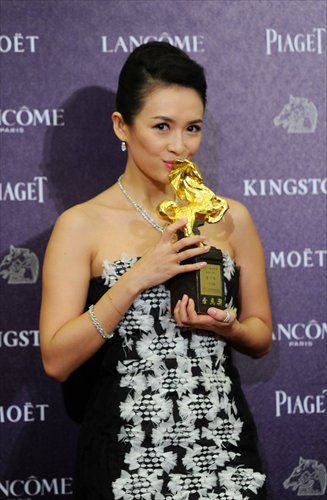
Zhang Ziyi kisses her Best Leading Actress trophy at the 2013 Golden Horse Awards. Photo: CFP
The 50th Golden Horse Awards wrapped up on Saturday night after showing off a star-studded lineup on the red carpet and bringing together some of the most important film stars of the past 50 years on the glittering stage in Taipei.
Winners of the evening included China's most-lauded figures in contemporary film such as Li Xuejian and Zhang Ziyi. But the biggest night in the Asian film industry also highlighted new talent from outside Taiwan, Hong Kong and the Chinese mainland.
The little movie that could
Singaporean movie Ilo Ilo proved this year's dark horse, beating out contending blockbusters by Johnnie To and Wong Kar-wai and taking home the highest prize, the Best Feature Film Award.
As the first feature-length film from director Anthony Chen, Ilo Ilo also bagged Best New Director, Best Supporting Actress and the Best Original Screenplay.
"The film might be the one with the smallest scale and least budget. I never thought that I could win," Chen said at the ceremony after accepting the prize.
Chen is the first Singaporean director to have such a winning night at the Golden Horse Awards in its 50-year history.
"I must thank the juries led by Ang Lee for letting Singaporean movies stand out in this Chinese-speaking world," Chen said. "This will open a new chapter for Singaporean movies and encourage more young directors in Singapore."
Film critic Mu Wei'er in a commentary for ifeng.com wrote that the Golden Horse Awards were "learning from the Cannes [Film Festival] tradition of praising fresh directors."
Indeed, the film received the Camera d'Or award at the 2013 Cannes Film Festival in May for its depiction of the emotional connection between a child and the Filipina maid who takes care of him when his parents are away.
"Ilo Ilo shows the exceptional maturity of the director, who, unlike some young directors, adds some personal experiences to make it much more emotional," wrote Mu. "It presents the conflict at the beginning and emphasizes the pressures of modern society."
Proud winners
Though missing out on Best Feature Film and Best Leading Actor, Wong Kar-wai's martial arts epic The Grandmaster was still undoubtedly the biggest winner, scooping up five awards, including Best Leading Actress, Best Cinematography and Best Visual Effects. It also topped nominations with 11 total nods.
Actress Zhang Ziyi has previously been nominated twice for Best Leading Actress and once for Best Supporting Actress at the Golden Horse Awards. "And I finally got it," she said while accepting the Best Leading Actress award for her role in The Grandmaster.
Zhang thanked the hardworking crew of the film and expressed her respect for director Wong.
"I am so grateful that you let me meet the character Gong Er when I was suffering through my toughest time," she said. "You told me to hold on to courage and believe in myself, and I did."
Though Zhang said her partner Tony Leung Chiu-Wai is always the best leading actor in her heart, the Golden Horse award for leading man went to Lee Kang Sheng for his role in Stray Dogs, which also nabbed the Best Director nod for Tsai Ming Liang.
Tsai once announced he would boycott the Golden Horse Awards in 2006 after his movie I Don't Want to Sleep Alone received criticism by the panel of jurors for the awards. He came back with Visage in 2009 after Hou Hsiao-hsien took the helm as director of the event.
"I was struggling with the Golden Horse Awards. It seemed that they disliked me and I disliked them. It was always 'fast,' and I was always 'slow,'" said Tsai after accepting the prize. Though, he remarked, "it finally slowed down today."
Lee stood out in one of the most competitive categories, beating superstars including Tony Leung Chiu-Wai, Nick Cheung and Tony Leung Ka-fai.
"It is harder to get this prize among these excellent actors than climbing up to the sky," Lee said, after holding the Golden Horse trophy still for a few seconds, joking that he was merely imitating director Tsai's signature slow-paced style.
Celebrating half a century
The ceremony was filled with tributes to Chinese-language movies over the past 50 years. In one of the night's highlights, past winners of Best Actor and Actress awards stood on stage together, giving audiences a sense of the history and success of the domestic film industry over the last half century.
The Golden Horse Awards is the oldest Chinese-speaking film festival. Founded in 1962 in Taiwan, it was dubbed the Chinese-speaking film equivalent to the Oscars by foreign media outlets such as AFP, but critics consider it more in line with film festivals like Cannes because of the way it judges films with a small group of professional juries.
The awards this year were considered by some critics to be loftier, an aspect which may have been influenced by this year's jury leader, Ang Lee.
"Some movies will be reconsidered by the public after they win Golden Horse Awards. Audiences may then find something they ignored at first," said film critic Shi Lai in an ifeng.com interview.
"It promotes some movies that don't immediately draw audiences, and gives them another chance."
Global Times
2013 Golden Horse Awards winners
Best Feature Film:
Ilo Ilo (Singapore)
Best Director:
Tsai Ming Liang, Stray Dogs (Taiwan)
Best Leading Actor:
Lee Kang Sheng, Stray Dogs
Best Leading Actress:
Zhang Ziyi, The Grandmaster (Hong Kong)
Best Supporting Actor:
Li Xuejian, Back to 1942 (Chinese mainland)
Best Supporting Actress:
Yeo Yann Yann, Ilo Ilo
Best New Performer:
Kuo Shu-yau, Step Back to Glory (Taiwan)
Best Original Screenplay:
Anthony Chen, Ilo Ilo
Best Adapted Screenplay:
Li Qiang, So Young (Chinese mainland)
Source: Official website of the Golden Horse Awards