White ribbons
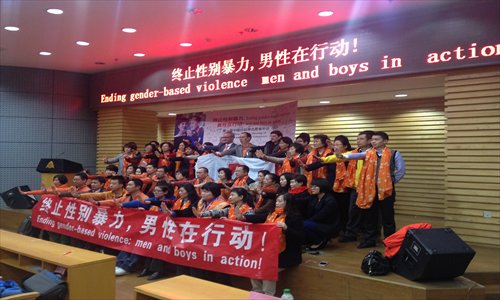
Members of the China White Ribbon Volunteers meet in Beijing on November 25. Photo: Xuyang Jingjing/GT
Between a quarter and half of all women in China have been victims of domestic violence, a plague that's been hard to stop in a traditionally patriarchal culture where people are fearful of getting involved in others' affairs. But now men are being asked to do their part in a new campaign in South China's Yunnan Province.
As part of this year's 16 Days of Activism Against Gender Violence campaign between November 25 and December 10, the Heart to Heart Community Care Center, a non-profit social service organization in Yunnan, is recruiting men as "Family harmony angels." The idea is to get more men involved in the campaign to prevent gender-based violence.
Hu Ye, a social worker at the Heart to Heart Community Care Center, said they have been trying to get more men involved in the campaign against gender-based violence since May.
During their community work with victims of domestic violence, it is difficult to get the offenders, usually men, to participate in projects such as couples' counseling, said Hu, who is in charge of their anti-domestic violence project.
"Some women don't want to split up with their husbands or boyfriends, but they need the violence to stop; and that won't happen unless the men cooperate," she said.
That's when they realized they need to get men involved, to hear what they think about gender equality and domestic violence and better tackle the problem, she added.
"Gender equality cannot be achieved without the cooperation and participation of men," said Arie Hoekman, the UNFPA representative in China, at the meeting of the China White Ribbon Volunteers in Beijing on November 25. "It is critical to engage men and boys in preventing and ending gender-based violence to ensure better health outcomes, including sexual and reproductive health, and harmonious societies," he said.
Violence hotline
Fang Gang, a sexologist and gender studies scholar at Beijing Forestry University, launched the Men's White Ribbon Anti Gender-based Violence Hotline in 2010. Earlier this year the hotline received funding from UNFPA and in April over 40 volunteers from across the country, most of whom were professional counselors and 24 of whom were male, received training in Beijing. Today there are about 100 white ribbon volunteers.
Now, at any one time, there are about 12 volunteers taking calls and providing free counseling to victims and perpetrators.
Between November 2012 and November 2013, the hotline received about 450 calls and the dozen volunteers provided counseling to over 100 callers, according to Fang.
Among the 100 cases, a little more than 10 were men who perpetrated domestic violence, both in heterosexual and homosexual relationships, and men who conducted sexual assaults in public.
Many offenders, reflecting a prevailing cultural belief, still believe that domestic violence is a private affair and others shouldn't get involved. Some men don't want to go to couples' counseling because they feel they have "lost face" or that they did nothing wrong because the victim "deserved" the beating, said Hu.
Some also feel they would become the target of criticism. "They could become defensive, saying 'you are a woman, of course you stick together,'" said Hu.
That's why having male volunteers or counselors is important. One of the three people in Hu's team is male. When they visit couples at their home, sometimes the men in the family would kick them out if the social workers are all women, but they are more willing to talk to the male social workers, she said.
According to the All China Women's Federation earlier this year, 24.7 percent of women in China have suffered different forms of domestic violence. But a survey last year by Netease website and the Maple Women's Psychological Counseling Center in Beijing, which has been providing support for women since 1988, showed that 54.6 percent of respondents had experienced domestic violence, among whom 90 percent were women.
The White Ribbon Campaign was launched by three men in Canada in 1991 and has now expanded to over 60 countries. The campaign asks men to pledge to never conduct violence against women and to never keep silent and thus endorse violence. It is the largest male-led movement against gender violence.
In China, the White Ribbon campaign was first promoted in 2001. But it didn't gain a lot of social recognition or participation.
During the "16 Days" campaign last year, Fang launched an online pledge where over 300 men submitted their online pledges of "No Violence and Break the Silence" under their real names.
'I didn't use my fists'
Ding Shaoxing, a psychiatrist from Henan Province who joined the White Ribbon volunteers late last year, said that they try to make sure the offenders understand they are not being targeted as the "bad guys." "We want to make them understand it's the violent behavior that we are against, and the behavior is a reflection of the patriarchal beliefs and traditional views of masculinity, for instance the belief that the wife should obey the husband," he said.
A quantitative study on masculinities and gender based violence, supported by UNFPA, showed that 73 percent of male respondents believe that men should be tough and 52 percent said they would use violence to defend their honor.
Since May, Hu's center has publicly recruited men from the community, which has a heavy influx of migrant workers, as "harmonious family angels" to make it sound more appealing and honorable to men. About 20 to 30 men, mostly married between ages 35 to 50, regularly attend their meetings, training and discussion sessions, said Hu.
"The most difficult thing is challenging stereotypes in a patriarchal society," said Hu. Many men believe that the society is already quite gender-equal and men sometimes are disadvantaged compared to women.
But even if these men are hardly paragons of gender equality, small changes are happening. One of the "harmonious family angels" said he was able to restrain himself from using his fists when he got into an argument with his wife, said Hu. Some men also brought their wives along to attend the center's activities.
"This is only the beginning. We have a lot more to do to raise the public's awareness and to motivate men to join the campaign," she said.