Building with bamboo
Although the Venice Biennale may be the world's most prestigious showcase of art and architecture, if you're longing to see an international bamboo architecture exhibition you won't have to travel quite so far.
Longquan is a county-level city in Zhejiang Province about a seven-hour drive from Shanghai. Next year, the Xitou village of Baoxi town there will play host to the first-ever International Bamboo Architecture Biennale.
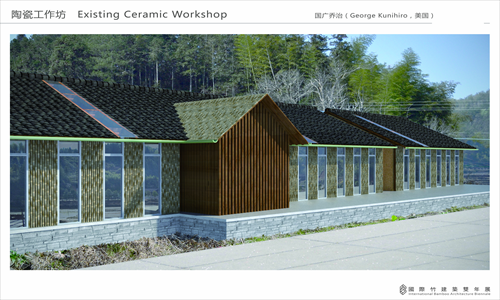
Artist's renditions of bamboo structures designed for the International Bamboo Architecture Biennale Photos: Courtesy of Ge Qiantao
Instead of showcasing building models or artistic installations as is the case in Venice, 11 architects from around the world will design and build 18 real-size architectural structures in the small village.
The participating architects are George Kunihiro (US), Kengo Kuma (Japan), Keisuke Maeda (Japan), Mauricio Cárdenas Laverde (Italy), Simon Velez (Colombia), Sook Hee-chun (South Korea), Madhura Prematilleke (Sri Lanka), Vo Trong Nghia (Vietnam), Anna Heringer (Germany), and Chinese architects Li Xiaodong and Yang Xu. All of them have worked on acclaimed bamboo architecture designs before.
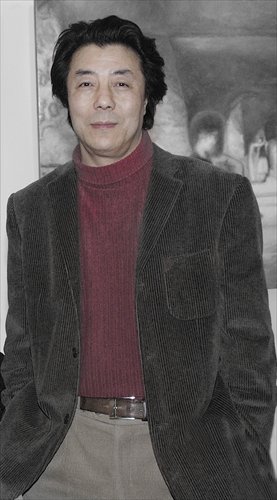
Ge Qiantao
Picturesque village
"The aim of the bamboo architecture biennale is to let the world see a beautiful village in China," said Ge Qiantao (pictured below), the curator of the event, at his studio in Shanghai. The studio (No.5, Lane 209, Nanchang Road, 6473-7578) is the headquarters of the biennale and is currently showcasing the architectural designs to the public.
Ge, who himself is an acclaimed painter and art curator, discovered Longquan when he was working on an international porcelain exhibition four years ago. The city boasts a long cultural history and is famous for its celadon ceramics and sword making industries. Featuring a beautiful mountainous landscape, the area is also home to the second largest bamboo forest in Zhejiang.
"I was touched by the beauty of the landscape in the villages of Longquan, and I came to realize the significance of a saying by President Xi Jinping: green mountains and rivers are as precious as gold treasure," the Shanghai-born curator told the Global Times, noting that he has never seen such picturesque villages within 200 kilometers of Shanghai.
It took Ge three years to present the overall exhibition plan to the local governors of Longquan, who Ge said were very open-minded and willing to finance the whole project.
On 2.3 hectares of land in Xitou village, 18 bamboo structures will be erected next year amid the green mountains, including a tourist center, a restaurant, a bridge, a contemporary celadon ceramic museum, a bamboo product research and design center, three ceramic workshops, and several hotels.
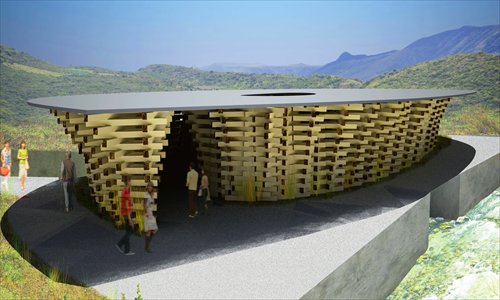
Artist's renditions of bamboo structures designed for the International Bamboo Architecture Biennale Photos: Courtesy of Ge Qiantao
Local inspiration
All of the bamboo used for the structures is locally grown. Early this year, participant architects were also invited to live in the village to gain inspiration from the local life and scenery.
George Kunihiro designed a ceramic workshop, which began as a renovation of a small ceramic factory. The workshop will maintain the factory's thick earth walls, but will have a bamboo ceiling, bamboo wall decoration as well as a number of French windows. The glass ensures there is enough natural light inside, and viewed from the outside, reflects the forest scenery like a mirror.
"I want this building to stand quietly within the biennale grounds during the day, and at night, to be illuminated with varying moods to represent the changing seasons of the local climate. I hope that the building will represent the timeless quality of local village life," said Kunihiro in an interview conducted by Ge's team.
Traditional methods of building walls with earth and cobblestones will also be incorporated in some of the modern designs of the international architects, according to Ge, who hopes the exhibition will be a showcase of Eastern aesthetics with international and modern touches.
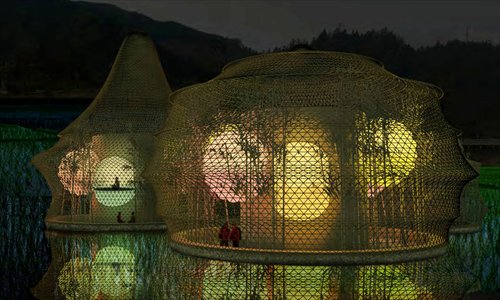
Artist's renditions of bamboo structures designed for the International Bamboo Architecture Biennale Photos: Courtesy of Ge Qiantao
Sustainable development showcase
"It is particularly meaningful that this biennale is held in the countryside, not in city. This biennale will send the message that small towns and villages in China have the possibility for successful growth with their own unique cultures, not with urbanization," said Kengo Kuma in an interview conducted by Ge. Kuma designed a ceramic museum whose walls are constructed by layers upon layers of thick, specially made, rectangular bamboo poles.
"The locally grown bamboo is usually sold to other places, but now through the creative designs, local people can see other possibilities of using bamboo," said the 56-year-old curator.
Kunihiro also hopes that featuring the bamboo that surrounds their community in an international event will instill in the village community pride in their local culture.
Construction of the bamboo structures started earlier this year and is due to be completed by the middle of next year. According to Ge, the international event will not be a one-time show for locals. In the following years, they plan to launch a bamboo architecture competition for young design talents, and a series of seminars and activities addressing how to benefit the local community.
"Maybe we're not the smartest people in the world, but we are the group of people who dare to dream. We hope what we do now may attract more public attention to China's countryside, and thus promote its development in an environmental and sustainable way," added Ge.