Yangshupu Road Station
Editor's note
This year is the 20th anniversary of the opening of the Shanghai metro. The subway has facilitated more than 13 billion journeys during its 20 years, and half of Shanghai citizens cite the metro as their favored mode of transport. To commemorate the anniversary, each week the Global Times will take an in-depth look at one metro station and its surroundings. In the case of downtown stations, we will focus on points of interest within walking distance; while for suburban areas, we will cast our net a little wider.
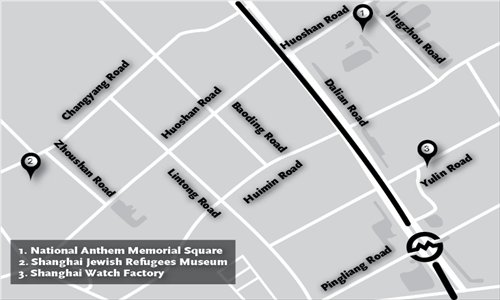
map
On the map of subway lines that looks like a colorful spider web, Yangshupu Road Station lies in the upper right hand corner of Line 4, the only circular route among Shanghai's existing 13 subway lines (including Line 12, to be opened at the end of this year). Yangshupu Road Station, which is located on the border of Yangpu district and Hongkou district, is surrounded by numerous places of historical interest.
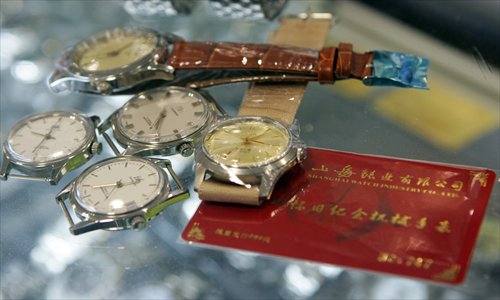
Shanghai brand watches
Shanghai brand watch
Once upon a time in 1970s Shanghai, a groom-to-be was expected to provide "three gifts:" a sewing machine, a bicycle and a watch. There were even demands for specific brands of these three items. While the sewing machine should be a Mifeng (meaning "bee"), the bicycle was preferably a Yongjiu (Forever) or a Bai'ge (Pigeon). The watch, meanwhile, was supposed to be the city's eponymous Shanghai brand.
It was said that if a man did not have a Shanghai watch, no girl would ever marry him. An important object like a watch could not be purchased with money but only with coupons issued by work units. Often, among a group of friends, the hard-to-come-by coupons were pooled together to give to the one who was getting married. It is estimated that one out of four Chinese men wore a Shanghai brand watch. Beyond being merely a prized personal possession, Shanghai brand watches were a pride of national industry.
However, starting in the late 1980s, when more fashionable digital watches from Japan were introduced into China, the previously coveted Shanghai brand fell out of favor with consumers and the company was pushed to the edge of bankruptcy.
Remarkably, in 2005, Shanghai brand watches suddenly returned from oblivion. The brand released a tourbillon watch priced at 100,000 yuan ($16,470), a bold move signaling the manufacturer's confidence that citizens would rekindle their fondness for its products out of respect and nostalgia.
Thus the once old-fashioned Shanghai brand watches obtained cachet as vintage collectibles. East of Yangshupu Road Station, on Yulin Road, where the Shanghai watch factory was established in 1958, a small shop remains selling Shanghai brand watches, now priced at thousands of yuan each, all bearing the two characters "Shang Hai" on the surface. Stepping inside, one can't help but imagine the same old iron watches shining on the wrists of our fathers, uncles or grandfathers, who were then just newly married young men.

A visitor looks at the exhibits at the Shanghai Jewish Refugees Museum Photos: CFP and IC
Jewish Refugees Museum
From 1933 to 1941, at the height of the Nazi regime, Shanghai was one of the very few places in the world that served as a haven for over 30,000 Jewish refugees. Two-thirds of Shanghai's Jews lived in the Designated Area for Stateless Refugees, now the Tilanqiao community of Hongkou district, west of Yangshupu Road Station. Living through the difficult years of the Japanese occupation alongside local residents, most of them survived the World War II. During his visit to Shanghai, former Israeli prime minister Yitzhak Rabin said, "To the people of Shanghai for the unique humanitarian act of saving thousands of Jews during the Second World War, thanks in the name of the government of Israel."
The Shanghai Jewish Refugees Museum (62 Changyang Road, 6512-6669) consists of three parts, the former site of the Ohel Moshe Synagogue (which has been restored to its original style both outside and inside) and two exhibiting halls, hosting more than 140 photos as well as a short film and replicas of refugees' belongings.
Besides the museum, if one is willing to walk a bit further, more sites concerning this part of history can be found in the area, including the former site of the Joint Distribution Committee, Huoshan Park (a small park where Jewish refugees used to congregate during the war), the former site of the Jewish Refugees Shelter (inside lane 138 on Changyang Road, which was the former White Russians' camp of the Shanghai Volunteer Corps), Café Atlantic, Mascot Roof Garden (where Jewish musicians often performed) and the Ocean Hotel.
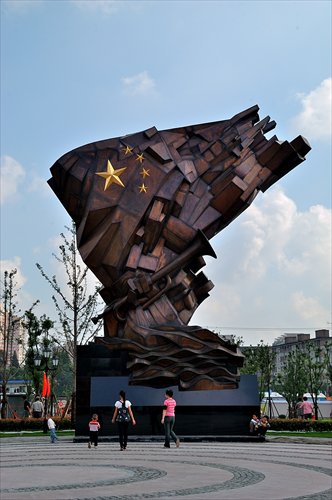
The bronze statue of the Chinese national flag
National Anthem Memorial Square
China's national anthem, March of the Volunteers, was originally composed for the movie Sons and Daughters in a Time of Storm (1935), about a Shanghai intellectual who goes to fight the Japanese, which was shot on Jingzhou Road.
The National Anthem Memorial Square (151 Jingzhou Road) was built nearby in 2006, between Yangshupu Road Station and Dalian Road Station.
Occupying 27,000 square meters, the square includes a 12-meter-high bronze statue of the national flag and a horn. Around the square are exhibition halls divided into six parts, recounting the history and stories of the national anthem with more than 400 photos and documents, including various historical versions of the song and personal items belonging to composer Nie Er and lyricist Tian Han.