The downfall of the DVD

A passer-by glances at the doors of the Movie Star DVD shop on Dagu Road. Photo: Cai Xianmin/GT
Six years ago, Wendy Sun was a freshman at Fudan University. In an ethics class one day, the lecturer screened Les Choristes, a French film about a teacher encouraging a class of misfits by teaching them to sing as a choir. He screened the film via the university's intranet but halfway through the film there was a connection problem and the film stopped.
As the lecturer struggled to fix the problem one of the students left the class, hopped on his bike and returned five minutes later with a DVD of the film, one that he had bought for 5 yuan (82 cents) from a street vendor just off campus. That cheap pirated DVD ensured that the film continued and the class watched all of the critically acclaimed movie.
Sun, a 26-year-old woman who now works in public relations, cited this as an example of how popular DVDs were back then. It was a time when video websites such as Youku and Tudou were havens of piracy and aired much less video (and poor quality video, as well) compared to today.

Movie posters in the Movie Star shop Photo: Cai Xianmin/GT
Higher quality
Even pirated DVDs were higher quality. Sun enjoyed spending afternoons in the DVD shops near the university searching for a good film or American television series among the well-stocked shelves. "I remember buying the first few seasons of Desperate Housewives, and some film classics," Sun said.
At a time when China allowed only 20 foreign films a year to be screened in its cinemas and when few Chinese companies could afford to pay the rights for foreign films, pirated DVDs were really the only choice for young people in China hungry for Western films and television shows. According to a study on the pirated DVD industry by Shanghai Normal University's Chen Yi and Yang Kangxian in 2004, it usually took three to six months for the Chinese authorities to censor and approve a film before an authorized DVD could be released, while pirated DVDs could be bought just a few days after films had opened in Hollywood. Some pirate brands like Weixin and Red Dragon featured additional materials - deleted scenes, director's commentaries and trailers - which they obtained from authorized DVDs picked up elsewhere. Weixin and Red Dragon set themselves apart with their own distinctive trademarks on box sets.
This was the golden age for the pirated DVD industry in Shanghai. On Dagu Road in Jing'an district, several DVD shops coexisted - Oscar's Club, Big Movie, Movie Star and Movie World. Competition was so fierce that when Movie World proved popular among the expat community, Movie Star, its competitor across the street, hung a large banner announcing it was "Even better than Movie World."
The advertising ploy might have worked, but in a way even Movie Star might not have expected. Today, Movie Star is the only remaining DVD shop on Dagu Road.

Boxed sets of recent television series sit on display in a DVD shop on Shuicheng Road South. Photo: Zhang Yu/GT
None survived
Its competitors have all shut down over the past few years. None of them survived the winter for the DVD market which peaked in 2010, although crackdowns and international lawsuits against pirated DVD shops started in 2002.
In 2007, the Motion Picture Association of America organized seven major US films companies, including Columbia Pictures, 20th Century Fox, Disney, Warner Bros. and Paramount to jointly sue pirate DVD companies in Shanghai. On March 22, 2007 the Shanghai No.2 Intermediate People's Court ordered the company Dikai, which ran a DVD shop on Dagu Road, to pay 158,000 yuan to the plaintiffs and fined the shop 50,000 yuan.
Another shop, Leying on Zhenning Road, was sued by the film companies and the city's No.1 Intermediate People's Court eventually ordered it to stop selling pirated DVDs of The Lord of the Rings and other movies, and pay damages to New Line Cinema (7,000 yuan), Disney (12,000 yuan) and Warner Bros. (6,000 yuan). The court fined the company a total of 225,000 yuan.
This was just the beginning of a series of crackdowns. Before the World Expo 2010 in Shanghai, another round of crackdowns, aimed at improving the city's image, saw thousands of DVD shops and vendors shutting down or turning to other goods to sell.
The Dagu Road shops shutdown was noticeable because it occurred after The New York Times reported how the DVD shops were prospering there. Some of the shops reopened at other venues nearby but for a while only regular customers were admitted and the DVDs were stored in secret rooms.
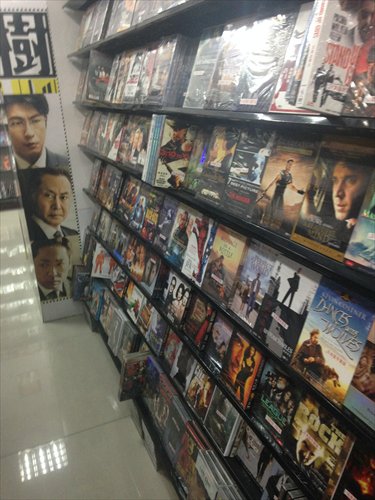
Some of the vast range of DVDs found at a DVD shop on Shuicheng Road South Photo: Zhang Yu/GT
Looking good
Today business for Movie Star looks good. Within half an hour in a weekday lunchtime several customers came in to buy DVDs - most were foreigners. The shop charges 18 yuan for a D9 format DVD and offers a huge range of movies and CDs including the latest releases and classic and European films.
Movie Star has another outlet on Shuicheng Road South in Hongqiao, catering for Japanese expats. Here, girls in the same yellow uniform welcome customers in Japanese and most of the DVDs have Japanese packaging and Japanese subtitles.
"The industry has restructured," commented one regular customer at the shop on Dagu Road. He said that after the 2010 crackdown, the shops that survived were either the traders like Movie Star, which offered quality box sets catering for the foreign community, or vendors with pushcart loads of lesser quality DVDs who can dodge inspections by the city's chengguan (urban management officers). Some sellers have moved online and choose to do their business more discreetly, more cheaply and for less risk. On taobao.com, for example, a search for The Woody Allen Collection produces over a dozen results, all offering the 44-disc collection of the director's works for about 170 yuan.
The cashier at Movie Star said business could not compare with three or four years ago, even though the shop could still break even. "The industry's biggest enemy is the Internet. It has defeated us."
The Internet move
In the past few years, people have moved to the Internet to download foreign movies and television series. After the major video websites like Sohu, Youku and Tudou realized piracy didn't pay, they cracked down illegal sources on their websites, signed contracts with copyright holders so that they now offer more and better quality high-definition films and shows. Viewers can now watch clear, legal versions of popular American television shows like The Big Bang Theory on Sohu for free even if they have to suffer through some commercials.
But there are still some DVD enthusiasts. In "The DVD Hut," one of the largest online discussion groups for DVD fans, people give their reasons why they still buy pirate DVDs when online viewing and downloading is so convenient. A recent poll showed that 62 percent of the members of the group preferred DVDs to downloads.
"Some indie films are so rare that there are either no downloads or the quality of the downloadable version is awful. Buying a DVD is the only choice," a netizen named owenshen wrote.
Another club member, meteorobs, said, "Buying DVDs in a three-dimensional shop is much more fun than shopping or downloading online. You can talk to others about different versions and discuss your experiences. I have got to meet enthusiasts who work in publishing, as DJs or as students at film schools. These experiences are irreplaceable."