Hailun Road Station
Editor's note
This year is the 20th anniversary of the opening of the Shanghai metro. The subway has facilitated more than 13 billion journeys during its 20 years, and half of Shanghai citizens cite the metro as their favored mode of transport. To commemorate the anniversary, each week the Global Times will take an in-depth look at one metro station and its surroundings. In the case of downtown stations, we will focus on points of interest within walking distance; while for suburban areas, we will cast our net a little wider.
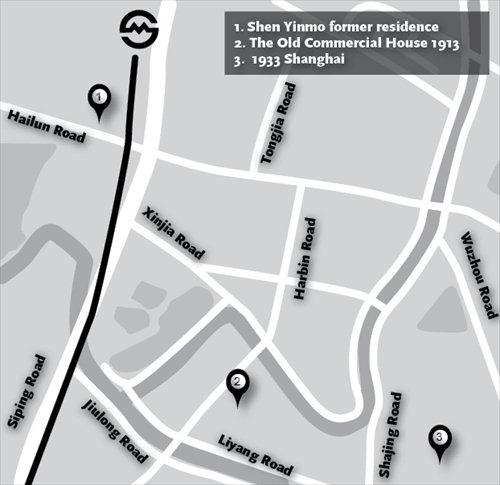
map
Stepping out from exit 2 of Hailun Road Station on metro lines 4 and 10, you will find yourself standing among a cluster of shikumen buildings. The neighborhood, located in the Hongkou district of downtown Shanghai, still exudes the peaceful yet bustling local lifestyle of yesteryear. Meanwhile, the area is also deeply influenced by today's modernization, with some of its surrounding old buildings, built in the last century, transformed into funky creative zones and workspaces. Old and new, historical and contemporary, are beautifully merged here, just a stone's throw from the metro station.
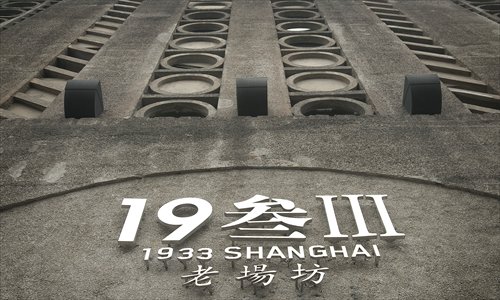
The facade of 1933 Shanghai
1933 Shanghai
One of the typical examples of the combination is 1933 Shanghai (611 Liyang Road), the slaughterhouse turned creative space that has become a landmark in the city. Built in 1933 by British architects, the dark gray façade of the behemoth is awe-inspiring. Within the space, the different floors of the construction are linked by bridges, ramps and spiral staircases, making the whole building a labyrinth. As a slaughterhouse, it was specially designed to keep cool even in the summer. Even though renovated, it still emanates a creepy atmosphere.
The present incarnation of the building houses a slew of restaurants, cafés and boutiques. Bull Market (1/F, No.203, 5596-0576) is a restaurant known for its Shanghainese and Cantonese cuisine. Opened in 2009, the restaurant has earned its word-of-mouth reputation because of its creative spirit, reflected in its traditional Chinese-themed decoration and its carefully designed menu. Retro Revo (1/F, No.111, 6403-1031) is a British-owned home and furnishing store that sells furniture in the "industrial modernist" style. Made from wood, iron, leather and even sacks, the furniture is handmade. The rough, rugged materials are artistically combined with fine craftmanship and clever design, giving a contemporary touch to the vintage-looking products. Kushi (1/F, No.104, 6513-9316), another home and deco store on the first floor, features furniture of a minimalistic design with a modern European style.
Motorsports lovers should head to the first floor of the building. There they'll find the Ferrari Owners' Club of China at No.107, and just beside it, two racing-themed restaurants, Formula Pilota (No.108, 6515-4098) and Ducati Caffe Shanghai (No.109, 6563-1719). Formula Pilota offers fast food and drinks, and is popular for its display of racing memorabilia, including helmets, and a Formula 1 simulator, in which enthusiasts can test their skills.
The building also houses Micro Theatre on the second floor and Sky Theatre on the fourth floor, which regularly host stage plays from home and abroad.
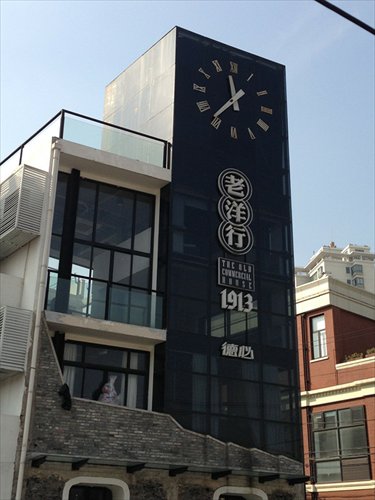
The facade of The Old Commercial House 1913 Photos: CFP and Zhao Dan/GT
The Old Commercial House 1913
The Old Commercial House 1913, which is quite close to 1933 Shanghai, is also a creative workspace that overlooks the nearby Shajing Port. Originally the building of John D Hutchison & Company Ltd - now better known as Hutchison Whampoa - constructed in 1913, the architecture remains in its original British style. Standing opposite is Peninsula Bay, another creative hub for the fashion and culture industries. The building complex had been the factory of Shanghai Schiak Testing Machinery Works. Today, it is the central area of the under-construction Shanghai Music Valley.
Manbo (A113, 160 Harbin Road), a newly opened studio-cum-café is located on the first floor of The Old Commercial House 1913. Meaning "leading a slow life and being indifferent to fame and profit" in Chinese, Manbo promotes a slow but enjoyable lifestyle, displaying original porcelain artworks and homewares from young and promising artists. The studio also holds DIY courses on pottery making, porcelain painting and textiles, with freshly ground coffee on offer.
A wooden door next to Manbo is easily overlooked. But once you open the door, you will see seven luminous letters spelling the word FRIENDS on the wall, and the familiar "Central Perk" logo of the hit sitcom. This exact replica of the Central Perk café (A105, 160 Harbin Road) received massive media exposure when it opened last year. Now, a year later, it is not as overcrowded as it was, but still attracts regular customers, especially avid fans of Friends.
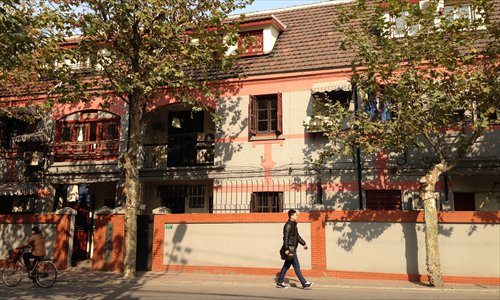
Shen Yinmo lived in the shikumen building for 25 years before his death in 1971.
Shen Yinmo former residence
Exit 4 of Hailun Road Station leads to the Sheraton Shanghai Hongkou Hotel. Right across from the hotel stands a shikumen building, where Shen Yimo once lived in (504 Hailun Road).
Shen was one of the best-known calligraphers of the last century. Born in 1883, he was an active member of the New Culture Movement in early 20th century, and was the president of Peking University. Shen lived in this building for 25 years before his death in 1971.
The first floor of the former residence is open to the public every Tuesday from 9 am to 11:30 am, and 1:30 pm to 4 pm. The exhibition hall displays a statue of Shen, and also photos and archives of his manuscripts, calligraphy works and books.