HOME >> CHINA
Dropouts on the rise
By Liu Sha Source:Global Times Published: 2014-1-6 20:43:01
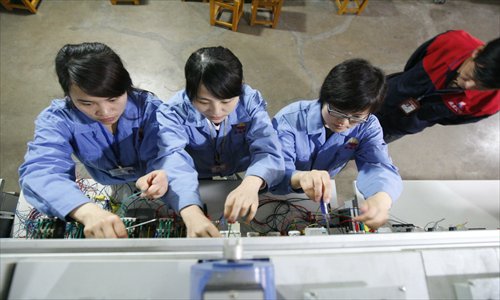
Three girls take classes at a vocational school in Chongqing in April, 2009. They dropped out of university as they thought they could learn more practical skills at a vocational school, which would make finding a job easier. Photo: CFP
When he realized he wasn't learning anything useful, Zhao Mengli, a 20-year-old sophomore, dropped out of a vocational college in Dalian, Liaoning Province.
"I will keep learning and accumulating experience, but not on campus," he told his teacher when he left school to travel to Shanghai, where he had secured a job as a truck driver. "It's time for me to stop wasting time."
Zhao, who majored in English, said he enjoys the delivery job. He told the Global Times that he wants to learn more about the logistics industry and perhaps starts his own business someday.
College dropouts have traditionally been a rarity in China, due to the strong cultural emphasis on education. In recent times however, and with jobs for college graduates getting tougher to come by, the number of students opting out of tertiary education has significantly increased.
Latest figures from the Ministry of Education show that in recent years, about 160,000 students dropped out of university each year, based on figures collected in 2008. The rate of dropouts has been climbing, reaching 2.6 percent in 2008 from 0.1 percent in 2002.
Hong Feng, the founder of "Chinese Dropouts" website for dropout to share their experiences and make contacts, has personally talked to nearly 30,000 dropouts over the last nine years.
He said that 2008 was a turning point. Before then, most students came to Hong feeling unprepared and lost. "They wanted to escape the education system but had no idea of what they really wanted to do next," he told the Global Times.
But now, more students, born after 1990, know what they want to do after dropping out from college, he said.
Changing attitudes
Hong, 32, dropped out in his third year of college. At that time, most parents regarded dropping out to be a terrible decision.
Xu Ming, 35, a Beijing-based engineer, told the Global Times that he had the impulse to leave university and open his own company like Bill Gates, but his parents dissuaded him.
"When they emphasized what they had put in to raising and educating me, and the fact that no one would hire me if I dropped out, I doubted myself and finally chose the 'safer' road," he said.
In contrast, Zhao said his parents supported him after they knew he had found a job in Shanghai. "I told them I don't want to waste time and money on things that do not interest me."
Six years ago, when talking to the students who came to him asking for help, Hong was often asked what they should do next. "Many of them need time to figure out what they want."
"Most of them felt guilty about leaving school, as it was their parents' wish that they graduate from college," Hong said.
The most common reason to drop out is dissatisfaction with the major chosen or poor grades - a problem compounded by the fact that it's often impossible to change majors.
"Before being admitted to college, students only have a very shallow understanding of the majors in college and due to the intense workload in high school, most of them have no idea about their interests and the most suitable major," said Xiong Bingqi, vice president of the 21st Century Education Research Institute.
Hong said that students these days are a little more relaxed, and place less emphasis on graduate certification. "They sometimes share ideas about building a business or tell me their plans including traveling and working, rather than talking about how guilty they feel for failing to live up to their parents' expectations," Hong said.
More options
Some education experts have attributed the rise in dropouts to the increasing number of options available to students.
Cai Xiuneng, 23, dropped out of her college in Hunan Province one year before graduating. She makes a living now by drawing cartoons and running a small shop selling her own handmade works on taobao.com.
She made the decision after a car accident in which her left leg was injured. "I stayed in bed for three months, during which time I was able to figure out what I really wanted to do, she told the Global Times, adding that she loves drawing and had started to run her Taobao shop before entering college.
Hong said one of the important reasons why more post-1990s dropouts have clearer life goals and are more open-minded is that they had earlier access to the Internet.
Many students born after 1990 started to use the Internet in primary school. The number of teenage Net users increased 57 percent to 237 million by the end of 2012, from 107 million in 2007, data from the China Internet Information Center showed.
"They tend to have the courage to make changes and take risks. For them, university education is not compulsory, but a service with a price tag," Hong said.
In a Baidu forum with more than 20,000 participants claiming to be dropouts, there is a group of people who dropped out of school to work and travel in other countries like New Zealand, Singapore and Australia, where they often take on part-time jobs and travel at the same time.
Some education experts think that changes to the education system, such as the removal of age limits for students taking the National College Entrance Examination, or gaokao, are another reason for the increasing dropout rate, as college students can drop out from school and take the gaokao a second time to get a higher grade and choose a better university or major.
Money or knowledge?
However, some experts expressed concern that students are solely focused on making money, rather than learning for the sake of self improvement.
Cai did not agree. "I do not earn much, but just feel happy doing what I like," she said.
Many dropouts, without a university certificate, often start with very simple jobs in areas like sales or cleaning, and do not earn much money, Hong said, but they feel independent, in contrast to the lives that they spent playing computer games and wondering what their futures hold.
"People still value knowledge and the academic spirit, but society has learned to tolerate and respect different choices and the old and rigid standards we previously used to define success have changed," said Wang Hongcai, a professor of education at Xiamen University in Fujian Province.
"Taking me as an example, I have been learning new things while working. I have never stopped reading or being introspective," Hong said.
Posted in: Society