Into the deep
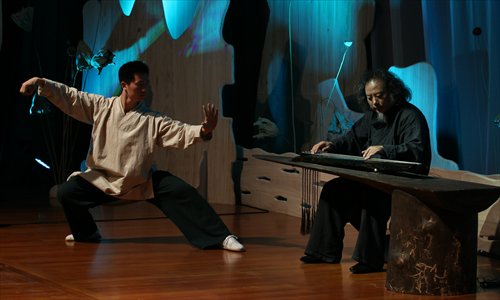
Gao Chong and Wang Peng (right) perform at the National Centre for the Performing Arts on September 19, 2013. Photo: Courtesy of Juntian Fang
Guqin becalms, says Wang Peng.
The music plunges the listener into philosophy.
"Our ancestors felt guqin conveys an aesthetic of contemporary Chinese literacy, purifies the mind and enhances the spiritual progress of society," said Wang, who made the guqin used at the 2008 Beijing Olympic Games opening ceremony, "and that is also what modern people need nowadays."
The traditional Chinese scholar or literati should excel in four skills: the game of Go, calligraphy, ink painting and playing guqin, the ancient seven-stringed musical instrument of the zither family.
Of the four, the greatest is guqin.
China's top guqin maker and a virtuoso player in his own right, Wang brings his ensemble Jun Tian Yun He to the National Centre for the Performing Arts in Beijing on Sunday for "Tread in the Snow - 2014 New Year Concert of Guqin."
Besides classical guqin pieces like "High Mountain and Flowing Water," the concert explores the range of the beloved ancient instrument by combining it with Chinese konghou harp, Kunqu Opera, traditional singers, Buddhist music and a synchronized tai chi performance.
An improvised fusion of occidental and oriental - cello and guqin - will undoubtedly prove one of the evening's highlights. "Guqin and some Western instruments such as the cello are very similar in some ways," Wang told the Global Times. "They are stringed instruments, producing low and warm sounds, without limits."
Carpenter
The guqin speaks to something universal and eternal, Wang said.
"Guqin tends to inspire contemplation of a deeper unity: human and nature, rather than narrow national or ethnic sentiment," Wang said.
"So it is actually not that difficult to cooperate with other instruments from home and abroad. And the theme is something that people will always need to reflect upon, especially in this busy urban life.
"We're not recovering what our ancestors did 100 years ago. We're making something available for all time."
Born in 1966, Wang is an undoubted master guqin maker. At first he preferred carpentry, but finally came back to guqin in 2001, founding the Juntian Fang workshop.
At an auction in November 2013, two of Wang's works sold for 2.1 million yuan ($347,000) and 3 million yuan, a record for a modern instrument.
Wang's guqin, explained Juntian Fang staff member Liu Fang, first and foremost produce a beautiful voice across the scale.
Plus they look great, he said.
"Although some collectors wanted to buy Wang's work at a very considerable price, Wang personally insisted on selling them only to someone who was genuinely interested in guqin culture," Liu said.
1,000 or 100 days
The United Nations Educational, Scientific and Cultural Organization in 2003 recognized guqin and its music as "masterpieces of the oral and intangible heritage of humanity," an acknowledgement of its 3,000-year history.
Guqin classes have opened in colleges and elementary schools around the nation during the last decade. It takes 1,000 days to learn pipa, the traditional saying goes, but it takes 100 to learn guqin.
The guqin isn't too difficult at the beginning, Wang said.
"However, unlike some Western musical instruments that can easily join in a massive symphony, guqin music is about calm and serenity," he said. "The art of guqin cultivates the individual."
How well it all works depends not only on the quality of the player, but also the listener, Wang explained.
The traditional written music for a guqin involves a set of symbols, somewhat similar to a combination of Chinese characters, that outline the style of play, without any reference to pitch or rhythm.
"So the same piece can be played in a totally different way," Wang said. "The coherency and stops of the tunes can be freely presented by various players, but that is how the virtuoso shares their personality and philosophy."
"To understand guqin music, it's better if the audience knows and comprehensively appreciates Chinese culture, in particular the impact of Confucianism, Buddhism and Taoism."
Wang's company offers full-time guqin classes for people with no such knowledge, inviting students to start at the beginning and experience the life of the ancient scholar.
"We are holding concerts, speeches and classes to promote the basic concept of guqin to more people," Wang said. "The best way to inherit this traditional culture is to keep it alive and build a comprehensive background, understand the real meaning behind the music."