Drug clans
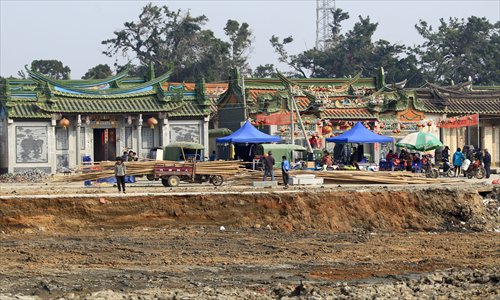
A street market in Boshe village, in Guangdong Province. Photo: IC
In the pitch dark outside the village of Boshe, in Lufeng, Guangdong Province, on December 29, throngs of police officers, accompanied by helicopters and speedboats, waited.
At 4 am, the blitz started. As the power went off, helicopter lights guided the police into the village that had become infamous for its production of drugs.
Boshe had previously been a "no-go" area for police, with villagers bombarding officers who dared to venture into its cramped streets with stones and local officials tipping off manufacturers when a raid was due.
The crackdown, involving more than 3,000 police officers, struck several cities in Guangdong, and saw the arrest of 182 suspects. Police confiscated 2,925 kilograms of meth and 260 kilograms of ketamine, making it the biggest anti-drug operation in the province.
Isolated spot
The morning of the crackdown, Cai Dongjia, the secretary of the Boshe village branch of the Communist Party of China (CPC), was arrested in Huizhou, Guangdong Province.
Cai was the godfather of the village's drug production, police said. He has been involved with drug manufacturing for a few years, but recently had mostly provided cover and protection for other manufacturers, the Guangzhou Daily reported.
The city of Lufeng has been involved in drug-making schemes for several years, the Guangzhou Daily reported. Three years ago, 14 percent of all the meth seized in raids across China was made in Lufeng, today it's over 40 percent.
Lufeng's previous industry was limited to fishing and small-scale farming, generating a monthly household income of a mere 1,000 yuan ($165). Drug manufacture proved a more tempting prospect for many locals, especially in the isolated village of Boshe.
Boshe has a population of 14,000 people, crammed into a small town. The paths inside the village are so narrow that only two roads are wide enough for cars to pass. The dense thicket of alleys made it easy to spot police and difficult for the authorities to penetrate.
More than 20 percent of the village's 1,700 families were directly or partially involved with making drugs, the Guangzhou Daily reported. Some elementary school students even worked part-time when school was off to split open over-the-counter pharmaceuticals for the compounds to be extracted to manufacture meth. Some may even have made as much as 10,000 yuan per month.
The industrialized drug chain in Boshe has ruined the land for other work, polluting it with run-off from meth manufacturing.
"The vegetable gardens are ruined, so are the lychee farms," villagers told the Nanfang Daily. Local water is contaminated. As making meth requires a lot of electricity, the fragile power grid has been struggling to cope, causing frequent power outages, sometimes for as long as two weeks.
Because of Boshes's cramped conditions, there's nowhere to store raw pharmaceutical materials. Some villagers just stick materials in their houses or in alleyways.
The village's trash is littered with drugs. On the uninhabited ground the trash is piled up to nearly two meters high and has unbearable smell, the Nanfang Daily reported.
The police said that the trash is from making meth, since "you can tell from the color of the polluted water running from it."
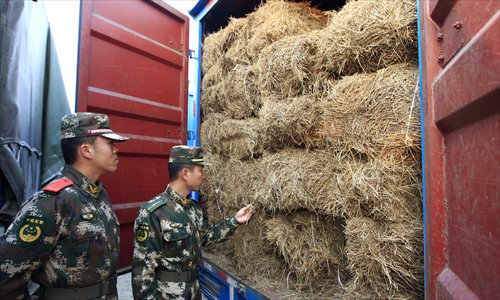
Police check quantities of ephedra seized in the crackdown on Boshe village. Photo: IC
Family affair
Cai has been the Boshe village secretary of the CPC for many years and used his position to intercept police actions and tip off drug makers to run away, reported cnhubei.com. Villagers in Boshe don't usually like to talk about him much, the report said.
"We usually don't know much about his family making drugs, once he shuts the door, who knows what he's doing in there?" a relative of Cai's told media.
An anti-drug campaigner who had contact with Cai remembers that whenever police went inside the village to catch other drug makers, several times villagers stood in the way and even attacked the police. Whenever this happened, Cai would always talk to the villagers and they would disperse.
"It was obvious that he had prestige among the villagers, but nobody knew it was established through offering protection for the villagers," he said.
After Cai was caught, many other officials who offered protection to the villagers have also been found, including three police bureau chiefs, some police officers, and a team leader from the anti-drug force in Lufeng, cnhubei.com reported.
Qiu Wei, commissioner with the Bureau of Narcotics Control in Guangdong Public Security Bureau, told media that in the past two years, two policemen have been punished. They either drove police cars to help transport drugs, or participated in selling drugs.
"In Lufeng, especially the villages of Boshe, Xishan and Haotou, even though the villages are small, they've all adopted family drug manufacturing. Boshe is like a fortress," a policeman who took part in the crackdown, told the Nanfang Daily. In all those villages, police and officials participated in drug manufacturing and tipping off dealers.
The villagers had many friends in the local government, who would inform them of any small police actions, Qiu told the Nanfang Daily. Once the police entered the village, two or three hundred motorcycles would drive up and surround them, nails would be placed on the village paths and stones would be thrown from the buildings. Some of the villagers even possessed illegal firearms as well as homemade grenades.
"The salary isn't high here and the police are faced with hard work as well. They get only about 2,000 yuan a month and they might feel it unfair to see others with cars and houses," the policeman told Nanfang Daily.
Zhang Chunxu, editor of Tencent commentary column InTouch Today, wrote that in many such villages, the case of "family gangs" is prevalent, with the trust of blood ties prevailing.
However, Su Shaoxin, commentary editor of Nandu Daily, wrote on the Shanghai Observer that the reason a whole village is involved in making meth not only lies in the family-based gangs, but more importantly is because the villagers can profit from this industry.
"Whether it's making drugs or breaking up trash, it makes no difference to the villagers. From their eyes, it's not sinful if they are doing this to survive," he wrote. "Also, because the village is closed to society and lacks opportunities for education and employment, the villagers don't have many survival skills."
Prevention better than cure
Drug manufacturing has developed over the years as well, Qiu told the Nanfang Daily.
"Production procedure for making meth is becoming simpler, with shorter period and more production, the price is getting cheaper as well," he said. One kilogram of meth used to cost half a million yuan, but now they can be traded for 7,000 to 10,000 yuan per kilogram.
After the crackdown, village life is growing back to normal, according to Yangcheng Evening News. From December 30, the Lufeng government has sent expert teams to the villages to help residents return to fishing and farming, as well as encouraging villagers to travel outside of the village to find work.
Liu Sa, an expert with the Beijing Education Base of Forbidding Narcotics and Hallucinogens, a government-funded group, told the Global Times that the challenge with anti-drug education right now is the quick evolvement of new drugs and new ways of making drugs.
Anti-drug centers would need to learn new information about different types of drugs quickly enough and spread the knowledge to targeted groups, she said.
"There's usually a lot of reports on crackdown of drug cases, and this is an opportunity for us to follow up with a series of educational activities," she said.
Admittedly, education in rural areas is still lagging behind, she said. Right now, the Beijing education base mainly focuses on anti-drug campaigns in the city, but also has annual trips outside the city into rural areas. However, a full education program requires cooperation from the local authorities and police, Liu said.
"To be honest, they are focusing more on cracking the cases at the moment," she said. "Anti-drug education of rural areas is not high on the agenda right now. This is an area to improve on so that cases like this don't happen again."
Agencies contributed to this story