Korean sculptor inspired by Tang art
Walking on Yuanmingyuan Road near the Bund, passers-by are impressed by a huge black statue of a galloping horse. Its robust body and powerful spirit are embodied in the animal's every clear-cut muscle and the flexible human figure riding on its back. The statue is one of Korean sculptor Kim Seon-gu's many works on display at Levant Art Gallery until March 15.
Kim's solo exhibition is titled Yu, which means "to ride" in Chinese. All the works on display feature horses of varying shape and size, some in high spirits, some appearing depressed. Kim's horse sculptures are influenced by traditional Chinese aesthetics, especially those of the Tang Dynasty (618-907). "For thousands of years, the source of the cultures of China, Japan and Korea were the same. Japanese and Korean cultures originate from China. They are branches of the stream of Chinese culture. Different countries use different ways to express the same oriental culture, which is nurtured and cultivated over many years," Kim told the Global Times.
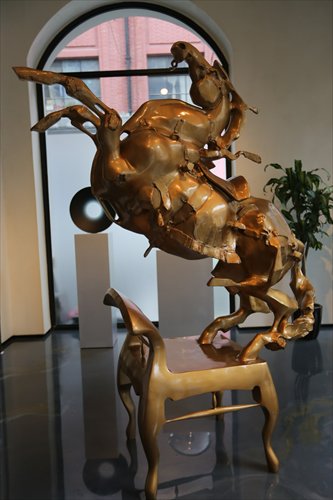
A sculpture of a horse on display Photo: Courtesy of Levant Art
Kim said he borrowed elements like "chubbiness" from Tang era art. To convey different emotions in his horse sculptures, he used different postures, structures and forms. For example, in works like Fly and Happy Walking, the cheerful and elated spirit of the horse is reflected in its high-held head and the rising upper part of its body. By contrast, in works like Porter and Rest, the horse's head is dropped, showing its exhaustion and heavy burden. All the sculptures were handmade by Kim himself. "Medium-sized works took me about two months. But large ones like the one on Yuanmingyuan Road took me around six months," Kim said.
On the exhibition's opening day on January 11, art lover Liu Yuxiang expressed his understanding and appreciation of the artist's works. "I saw Kim's works five years ago. His style is quite the same, but his techniques of expression have improved greatly," Liu told the Global Times. "First, he absorbed the culture of the Tang Dynasty. The body of the horse is strong and robust while the legs are slim. Second, he is influenced by traditional Chinese painting and calligraphy. He is not making a horse that exactly resembles a real horse. Instead, he deconstructs the shape of the horse and turns it into something that expresses his personal feelings."
As the influential Chinese painter Qi Baishi put it, if an artistic work is exactly the same as the real object, it is unsophisticated. If it has no resemblance to the original, it's cheating. "Good artworks are between likeness and unlikeness," Liu said. "Kim injected a stream of artistic spirit into his sculptures, that's what makes his works brilliant."
Date: Until March 15
Venue: Levant Art
阆风艺术
Address: 107 Huqiu Road
虎丘路107号
Admission: Free
Call 5213-5366 for details