Shanghai Baskets
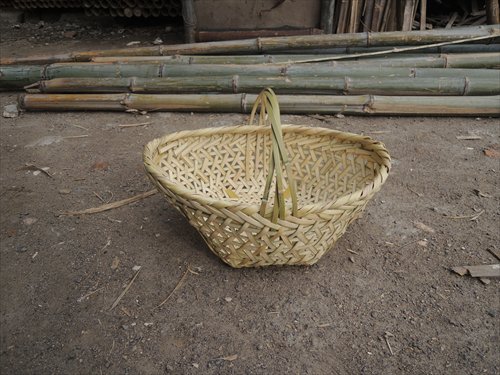
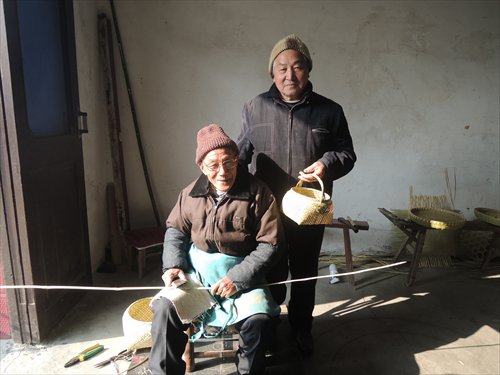
Local craftsmen make handmade baskets. Photos: Courtesy of Zhou Qi
Before there were handbags, there were baskets. But unlike handbags, baskets are always cheap, brandless and have no correlation with fashion. Baskets are fading from daily life, but nor do they qualify as antiques. They seem to belong to those worthless old things that are kept in piles and left to gather dust by grandmas.
Despite the unlikely theme, the new exhibition Shanghai Baskets is worth a visit. Lasting a month from January 23 to February 23 at Xuhui Art Museum, the exhibition is a long awaited echo of a project carried out over 80 years ago by Dr. Berthold Laufer (1874-1934), a curator of Asian anthropology and a pioneering researcher of Asian cultures. The project was called Chinese Baskets, part of Laufer's research on anthropology and design, which resulted in an eponymous book documenting in careful detail 58 baskets from southern regions along the Yangtze River, published in 1925 by the Field Museum in Chicago, where the book is still being exhibited.
"In total we have collected 62 baskets, 50 of which are on display this time," Zhou Qi, a native of Shanghai who managed to obtain all the baskets almost single-handedly and the author of the book Shanghai Housewares, told the Global Times. "We are not professionals in anthropology or design. But in the process of tracking down the baskets, I have realized how closely they are linked to human activities in general. The skills of weaving those baskets came from experience and habits developed over a long period of time," she added.
According to Zhou, Laufer's carefully researched and recorded Chinese Baskets served as a useful reference for her project. But procuring the same baskets mentioned in the book was not an easy task. The baskets were not expensive to buy, costing roughly 20 yuan ($3.30) to 30 yuan on average (though with one exception that cost 450 yuan), but they were sold far from downtown Shanghai, in places that "usually took at least an hour and cost 20 yuan to get there."
"Over and over again, I reached the place only to find that the shop was gone, no one was making baskets any more," Zhou said. When writing Shanghai Housewares, she had met a master Zhu, who specialized in making baskets and introduced her to other weavers. When she had exhausted leads from friends, Zhou had to rely on information from historical books and local newspapers, which often led her to a remote location where no baskets were sold.
Another tough task Zhou imposed on herself was to record - using video, photos and her own drawings - the background information, including the whole process of weaving baskets of different styles as well as the life stories of the craftsmen, who had their own daily schedules, which required Zhou to be on site as early as 8 am, and thus Zhou often had to sleep at local places overnight. The fruit of her hard work is astonishing and much more profound than just a record of local baskets.
Every basket is different, though they may be easily confused with each other at first glance. The names of the baskets are what they are called by local people, which follow different rules. Some are named after their function, like taomi luo (meaning baskets used for washing rice); some are named after where they were made, like Hangzhou lan; and others are named after their appearance, like yuanbao lan (meaning a basket in the shape of a sycee).
"We tried to focus on baskets made entirely of bamboo or cane, not of metal," Zhou said. "The bamboo is mainly from other provinces, such as Anhui, Zhejiang and Jiangsu, since there are no mountains in Shanghai on which bamboo can grow."
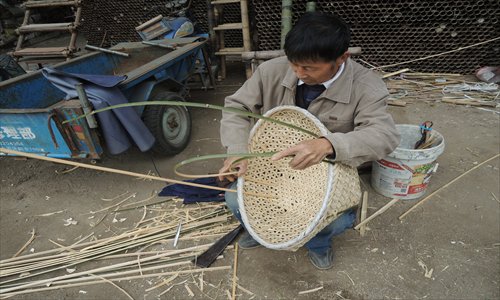
Local craftsmen make handmade baskets. Photos: Courtesy of Zhou Qi
"Bamboo is getting harder to buy recently, which contributed to the retirement of some old masters," Zhou said. Most basket makers have no descendents or apprentices to inherit their craft.
More masters are aware of the increasing trend that their products are better sold in miniature as souvenirs, a method popular in Japan, though the smaller baskets are harder to make. But baskets still have functional value. People on the street would stop Zhou and bombard her with questions about where they could buy one each time she brought a new basket back to the city.
Some local people could even tell where she had been by the design of the basket on her arm, like fractions of cultural DNA. The baskets carry Zhou's ambition of recording what is vanishing and her wish to "shed some light on a simple yet fulfilling way of life," which perhaps is no less luxurious than a famous branded handbag.
Date: Until February 23, Tuesday to Sunday, 9 am to 11 am, 1 pm to 4 pm
Venue: Xuhui Art Museum
徐汇艺术馆
Address: 1413 Huaihai Road Middle 淮海中路1413号
Admission: Free
Call 6431-3738 for details