A venue without visitors
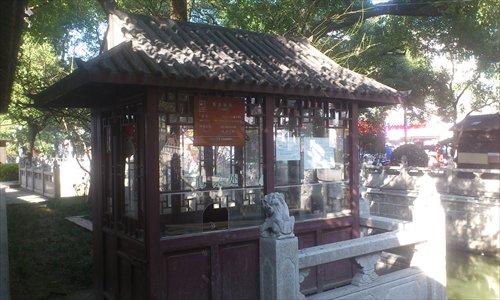
There has been good news and bad news recently for Anting town in Shanghai's northwestern Jiading district. Anting town's Shanghai Auto Expo was named one of Shanghai's AAAA tourist attractions in December. However, at the same, the Shanghai Municipal Tourism Administration stripped Anting Old Street of its rank as an AAA tourist attraction.
In China, there are five ratings for tourist attractions, from A (the lowest level) to AAAAA (the highest). The system was introduced in 1999 with the then top rating being AAAA. In 2004 the AAAAA rating was established. Shanghai's Oriental Pearl Radio & TV Tower, the Shanghai Wild Animal Park and Shanghai Science & Technology Museum have been named AAAAA attractions.
The ratings are set by the China National Tourism Administration, and every year it has local tourism authorities check to ensure that the ratings are valid. The ratings depend on criteria that include the importance of the site, transportation, shopping, management, security and sanitation. The number of visitors is also important - AAA attractions have to see at least 300,000 visitors a year. Anting Old Street lost its rating because many of the tourist businesses there have closed and few people actually visit there.
While it's not the end for Anting Old Street, the setback is also an opportunity for the local government to consider and explore a different developmental model for the town. Gu Xiaoming, a professor with the department of history and the department of tourism at Fudan University, suggests that it needs a complete transformation.
Heavy traffic
On Tuesday, after more than an hour's drive along Cao'an Highway encountering slews of red lights and heavy traffic, the Global Times arrived at Anting town. Although metro Line 11 links Anting town with the center of Shanghai, it can take more than two hours to reach there by public transport.
The most obvious landmark in Anting is Volkswagen's Shanghai headquarters, along with the Shanghai Automotive Industry Financial Center and the National Auto and Parts Export Base, which all underscore the area's industry links. The Old Street is not difficult to find although not signposted well.
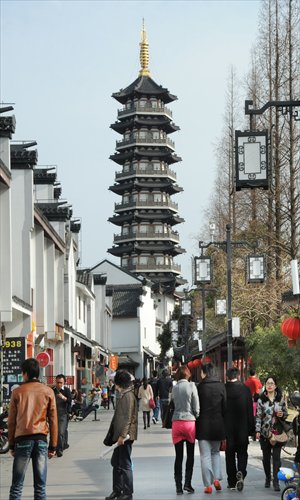
The ornate stone arch gateway to Anting Old Street is grand and dozens of elderly people sit in front of it in the sun. When asked by the Global Times whether they had heard about the street losing its tourist ratings, they all shook their heads. Actually, they said, they hardly even see tourists here. "Just locals," one man added.
Anting Old Street is genuinely old. Human settlement in Anting can be traced back to at least the Three Kingdoms period (220-280) when in 239 AD the Puti Temple was built there and the settlement grew into a town. During the Ming Dynasty (1368-1644), the writer Gui Youguang moved to Anting and taught there, helping put the town on the map.
In 2002, the Anting town government started restoring and renovating the old street and intended to make it a one-kilometer tourist venue where visitors could buy Chinese paintings, precious stones and antiques. On November 16 2007, Anting Old Street was opened for tourists.
The Shanghai newspapers enthusiastically reported that Anting Old Street would be a "cultural tourism street." In February 2010, Anting Old Street was formally rated a national AAA tourist attraction.
But just three years after getting the rating it lost it. Walking down the street it is clear this is a shopping street rather an "old" street - along the roadside fortunetellers and dried fruit sellers sit beside a disordered collection of shops selling dresses, bridal wear, pets and food. The buildings are faux Ming and Qing (1644-1911) dynasty creations.
There are several traditional jade or stone carving shops but many businesses have closed. At the Anting Tourist Information and Service Center on the street, the one assistant there pointed at the eight pictures of tour guides on the wall and said, "None of them work here now. I am 45 and closer to retirement. That's why I was sent here."
Never popular
Even the local tourism authority seems to have given up. No staff seem to work at the Anting Old Street management office and cleaners there said "it's now our office."
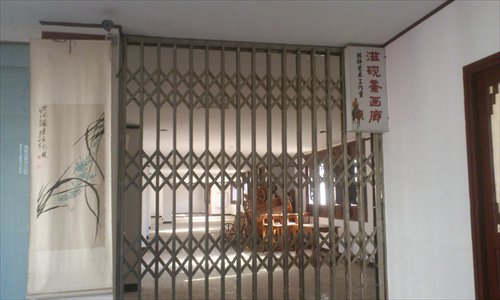
"This street has never been popular," said Wu Sikun, an artist at the Longqi Art Gallery. Originally from Chengdu in Sichuan, in 2007 Wu saw an advertisement in the China Art Weekly announcing that this "cultural street" was about to open and would welcome artists from all around China. In September that year Wu's wife, Yang Daxiu, came to Shanghai with some of Wu's paintings.
"We thought that Shanghai was a modern city and would be better than Chengdu. We didn't think this would be just a small town in the suburbs." Yang wanted to leave but local officials persuaded the couple to stay. Several other artists arrived in Anting at the same time attracted by the lure of the cultural street but have since moved out.
Yang showed the Global Times around the Longqi Art Gallary. The second floor used to be studios for a dozen or so artists but now the rooms are empty and dilapidated.
Pointing at the empty studios Yang walked along, she said, "This artist came from Xi'an (Shaanxi Province), this guy came from Tianjin, and this one came from Henan. A dozen artists came with big hopes, but now all have left."
Yang's husband Wu is the only artist to stay. Wu is a follower of Zhang Daqian (1899-1983), perhaps the most legendary Chinese artist of the 20th century. He said that art was unlike other businesses and did not need daily deals - sometimes one sale would support him for a year. "But every day when we open the gallery, and there are no visitors, let alone buyers, it makes us feel frustrated."
To attract artists and art businesses to come and create an "art center," the local government promised rent-free studios for a year. But, as Yang said, there is no such thing as a free lunch and the free studios were only small spaces on the second floor. The exhibition space on the ground floor costs him 30,000 yuan ($4,955) to rent.
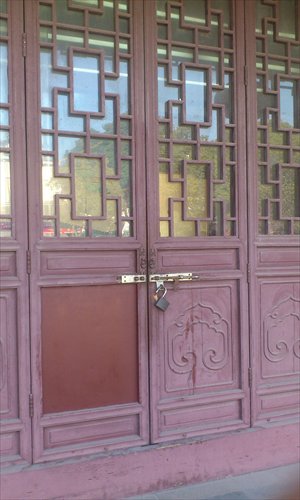
The owner of the Chufu Yu Hang jade shop told the Global Times she had been paying 30,000 yuan a year to rent her premises and the rent had been increased regularly. Many of the original shopkeepers in the street have closed up and moved away, unable to make a profit.
Other successes
There are a number of successful old towns in Shanghai, like Zhujiajiao, Fengjing and Qibao. But they were developed as tourist spots long before Anting. History and tourism expert Gu Xiaoming believes the development of any area has to be linked to the city's, or even the nation's, strategic planning. It was obvious, he said, that Anting Old Street had missed its opportunity to become a popular venue when it was opened.
On the wall of the Anting Tourist Information and Service Center is a map of tourist highlights along the street but many of the listed highlights have never been built. The wharf was only opened for a short time but has now been abandoned. There were no boats to be seen on the murky Anting River.
While other old towns in the city are promoted for their historical and cultural links, Anting is best known as home to Volkswagen's Shanghai headquarters and the Shanghai International Circuit, China's first Formula One racetrack.
Gu suggests Anting has a complete remake. If Anting is famous as a hub of China's automotive industry, Anting Old Street must become part of that neighborhood. Gu quoted a Chinese proverb, "If a healthy man is bitten on the hand by a snake he must cut his arm off immediately to stay alive" - for Anting to develop successfully a sacrifice will be needed.
Ideas needed
Gu said the automobile industry was big enough to involve the artists and businesses that came to Anting. "What is needed are innovative and creative ideas."
Gu thinks local governments should not just sign contracts with businesses and let them proceed on their own as many governments do. "They should carry out evaluation planning beforehand." This planning should be done well before any money is invested. The local government has to set up a complete redevelopment program for the street and evaluate whether this would be feasible or not.
He said the Anting situation was not unique. Sometimes governments want to show they are well-intentioned and launch projects that have not been properly developed.
An official with the Tourism Development section of the Jiading Tourism Bureau said that because Anting's Shanghai Auto Expo had been selected as one of Shanghais AAAA tourist attractions, the local government planned to integrate Anting Old Street into the Expo. The official, who wanted to remain anonymous, said the street itself would never actually be an independent attraction any longer - a move that suggests the authorities have realized the importance of making the old street part of its industrial neighborhood.