Shanghai's CSI stars
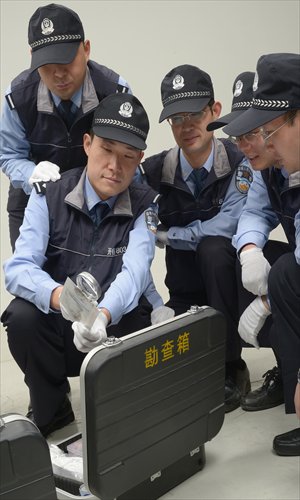
Last year there were 192 murders in Shanghai and the police arrested 190 killers, the highest cleanup rate ever. Crucial to the solving of many of these cases were Shanghai's crime scene investigators, the 18 forensic pathologists of the Shanghai Public Security Bureau's Center for Forensic Sciences - known locally as Police 803 (a reference to the center's old headquarters at 803 Zhongshanbeiyi Road).
Like the television show stars they solve cases that often seem impossible. But they do it without cameras and glamor. In March 2010, two human thigh bones were found under a bridge in Pudong New Area. Over the following days, a skull, breastbone, pelvis, a section of spine, a femur and ribs were pulled from the river, and human organs were found buried in a greenbelt along a major road near the river. The 1999 movie The Bone Collector had come to life.
One of the first steps in solving a crime like this is identifying the body. But the forensics team had little to go on: whoever had committed the murder had removed the ears and nose from the skull and then boiled it in water. But the pathologists noted that the skull had two upper front teeth missing and the lower teeth were irregular. It was speculated that the dead person had had two buck teeth and wore false teeth.
After removing the flesh, the contour of the skull, which had prominent cheekbones, showed the deceased was a man. By measuring his thigh bones the team estimated that he stood about 168 centimeters tall. From the wear of the teeth and after closely examining the other bones the team described the dead man as small and thin and aged about 40.
A real breakthrough
"The keys to the identity of the body were height, age and sex but the buck teeth proved a real breakthrough," said Meng Hang, one of the pathologists.
Detectives took the description of the man and after talking to neighbors identified him and arrested two people.
"Most who dismembers a body is trying to hide its identity in some way. It also showed us in this case that there was a special relationship with the deceased and this dismembering revealed how the killer was venting emotions on the body. Shortly afterwards detectives arrested the dead's mistress and her new lover and charged them with murder," Meng said. "Apart from serial killers who are psychologically disturbed, most dismembered body cases are related to revenge, money or sex."
Forensics work is tough and unpleasant. Rotting corpses produce a unique stench that can linger for days on the people who have to handle them. Once some of the team had to collect body parts from a cesspit.
"The stink on my clothes stayed there for days," pathologist Jiang Tao recalled.
"Although sometimes we encounter difficult conditions we do what we have to do because we are totally involved with our work," Meng explained.
Pathologists from Police 803 attend the scenes of most murders in Shanghai and they are certainly found at all the important or difficult cases.
Straightforward cases are handled by forensics technicians from district and sub-district police stations. "If these station forensics technicians are suspicious about a death or they suspect murder, they report the case to us and we attend the crime scene immediately," Jiang said.
Natural causes
While a dismembered body obviously usually involves a murder, some bodies that they investigate look at first as if the death was from natural causes.
When migrant parents found their 10-year-old son dead in their home when they got back after a day's work in Jiading district last winter, there were no signs of violence. A witness reported that the boy had been knocked over by a car in an accident that day, but had walked home by himself after that, apparently unhurt.
There were no signs of forced entry into the home and the police who first attended the scene believed he might have suffered some fatal internal injuries in the accident.
But the district police station forensics technicians noticed something wrong about the way the body was found, lying sprawled next to a bed. "They thought there was something strange about the way the boy was found on the floor. Normally if he had been hurt in the accident or suffered a physical reaction of some sort he would get into the bed and not lie on the floor. When they looked closely at the body they saw his lips had turned purple. They reported the case to Police 803," Meng said.
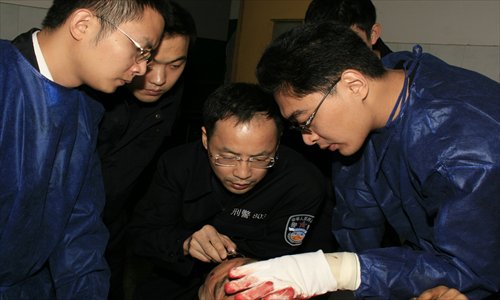
When Meng and another pathologist arrived at the scene, they found there were no immediate signs of violence on the body. But by next morning, at the autopsy, a small yellowish patch had appeared on the skin on the neck. "This made us think there had been violence and when we dissected the neck and throat we found signs of internal bleeding and discovered that the boy's hyoid bone in his throat had been broken. There were signs of bleeding in his lungs and heart which could not have been caused by a car accident. We knew the boy had been strangled by someone wearing gloves or using padding of some sort." Meng said.
With this new information detectives began talking to the neighbors again and the killer was quickly found. He was an unemployed neighbor in his 20s who knew the family and knew that they kept a spare key to their home under one of the windows. He had used the key to check out and steal in the house several times beforehand knowing when the family was out for the day. But on that day the son returned early from school and caught the man in the house searching for valuables. The man tried to explain to the boy that he was just looking for his mother but the boy insisted that he call his mother to confirm the story. The intruder panicked at this and strangled the child.
"Every case we dealt with is unique. After a number of cases we each acquire a range of expertise. There are no set rules to follow for each case. Sometimes we have to change our way of thinking. In this case, the parents hadn't found anything missing at home until we discovered the son was murdered - the other police had been misled from the beginning," Meng said.
Invaluable intuition
Jiang said sometimes the pathologists could get things wrong. "But even in these cases our intuition is valuable - our intuition comes from our experience. Sometimes it is just this intuition that uncovers a murder."
The average age of the team is just 34 and most are under 35. Each works on between 200 and 300 cases every year. "The experience you gain from real cases cannot be got from textbooks," Meng said, "After a crime scene has been cleared and the body cleaned, the pathologists can work wonders using their skills and experience to discover anything unusual."
The pathologists each carry their own kits that include scalpels and simple tools like tweezers, scissors, gloves and tape measures.
"Forensics technology has advanced considerably. In Shanghai we are also responsible for examining the bodies of any foreigners who die in suspicious circumstances and their physiques are a bit different so we have to study a lot of English language textbooks as well," Meng said.
"All of the team members are experts in their fields. The prominent US forensic scientist, Dr Henry Chang-Yu Lee, is an expert pathologist but he has become better known for his crime scene analysis and investigation. Our team members are not known so much for their autopsy skills but because they can analyze crime scenes. In most cases the pathologists succeed because they know what to look for at the crime scenes," said Meng.
In their spare time, Police 803 members enjoy reading crime and detective novels. Meng has been reading detective stories since he was a boy and says he prefers Agatha Christie's books to Sherlock Holmes. He thinks the US CSI series is much more credible than most detective novels.
Highly qualified
All the team members are qualified as doctors - after Meng Hang graduated as a doctor of medicine he studied for a master's degree in forensic pathology at the People's Public Security University of China. While medicine focuses on curing disease, pathology focuses on the study of the human body after death. "Where doctors care about disease, pathologists look for the time of death and the age. Doctors want to know about effective medicines and how to heal injuries while pathologists want to know what caused injuries or diseases."
A big risk for team members these days is contracting HIV or Hepatitis B. Although the person might be dead the viruses and bacteria can still be alive. "If I accidentally cut myself with the scalpel and come into contact with infected blood, I could contract something. It's impossible to screen bodies before we examine them or conduct autopsies," Meng said.
In spite of their grim business, most of the team seem cheerful and energetic. They play sport together regularly to keep fit and relax.
"Fortunately I have support and understanding from my wife who majored in law. She is so fond of me that she has never once complained about my work," Meng said proudly.